
Crafting a lightweight cascade bouquet is less about the flowers and more about mastering the underlying structural mechanics.
- Foam-free armatures and strategic hand-tying provide superior flow and dramatically reduce the final weight.
- Modern aesthetics rely on negative space and dynamic movement, not the dense floral packing of past decades.
Recommendation: Focus on the bouquet’s center of gravity and utilize pre-curved wiring to achieve a design that is both structurally sound and comfortable for the bride to carry.
The cascading shower bouquet is a dramatic, show-stopping piece of floral art. Yet, for many skilled florists, its creation is fraught with technical challenges, the most significant being weight. A poorly constructed cascade can become an unwieldy burden for a bride, its beauty overshadowed by the discomfort of carrying it. The common advice often revolves around using large foam holders or meticulously wiring every single stem, but these approaches frequently lead to heavy, rigid arrangements that lack the graceful movement of a truly modern design.
The secret to a successful, lightweight cascade doesn’t lie in simply choosing lighter flowers; it lies in approaching the design as an act of floral engineering. This perspective shifts the focus from merely assembling blooms to strategically managing weight, ensuring structural integrity, and designing for dynamic movement. It involves a deep understanding of mechanics, from the choice of armature to the physics of balance and the material science of trailing elements. How do you select mechanics that offer support without adding bulk? How do you create a form that flows and dances with the bride’s movements rather than hanging like a dead weight? This is where true mastery is demonstrated.
This guide deconstructs the process from a structural and weight-conscious standpoint. We will move beyond basic wiring techniques to explore the engineering principles that allow for the creation of a stunning, airy, and comfortably light shower bouquet. By mastering these concepts, you can transform this challenging design from a source of stress into a signature offering that showcases your technical expertise.
Summary: A Florist’s Technical Guide to Lightweight Cascade Bouquets
- Teardrop or Waterfall: Which Shape Suits a Ballgown Dress?
- Holder or Hand-Tied: Which Mechanic Creates the Best Flow?
- Ivy vs. Orchids: Which Trailer Withstands Movement Best?
- The Waist or the Hips: Where Should You Hold a Cascade Bouquet?
- How to Make a Cascade Bouquet Look Modern, Not 1980s?
- Petals or Runners: Which Aisle Decor Withstands the Bridal Train?
- The Static Shaping Mistake That Robs Your Arrangement of Life
- How to Design a Wedding Ceremony Floral Concept That Ties the Venue Together?
Teardrop or Waterfall: Which Shape Suits a Ballgown Dress?
The first step in floral engineering is understanding visual balance. The silhouette of the cascade bouquet must complement, not compete with, the bride’s dress. For a voluminous ballgown, this choice is critical. A teardrop bouquet, with its wider top and gentle taper, is more compact and has a higher center of gravity. This can be a wise choice to avoid visual overload against a very full skirt. In contrast, a waterfall bouquet is longer, narrower, and more dramatic, creating an elongated line that can beautifully balance the horizontal volume of a ballgown.
The key is to consider the principle of negative space. An airy waterfall cascade, with delicate trailing elements, can introduce a sense of lightness and verticality that cuts through the density of a heavily beaded or layered ballgown. It’s not just about shape, but also about the internal composition and how it interacts with the fabric and form of the dress.

As the image demonstrates, the relationship between the bouquet’s flow and the dress’s silhouette is paramount. A crucial part of the design process is to test sample shapes against the dress, or a similar silhouette, to assess the proportions in a real-world context. This ensures the final piece achieves a harmonious balance, becoming an extension of the overall bridal look rather than a separate, conflicting element.
Action Plan: Choosing the Right Cascade Shape for the Dress
- Analyze the dress silhouette: Voluminous ballgowns often benefit from elongated waterfall shapes that complement the skirt’s grandeur rather than adding more width.
- Test the visual weight: Hold sample bouquet shapes or mock-ups against the dress to see which creates the most balanced and pleasing proportion.
- Consider the center of gravity: Recognize that teardrop bouquets have a higher, more compact weight distribution, which can reduce wrist fatigue during a long day.
- Evaluate negative space needs: Use airy waterfall bouquets with delicate, trailing elements to add a feeling of lightness to dense or heavily beaded ballgowns.
- Plan for dynamic movement: Consider how each shape will move as the bride walks down the aisle and interacts with guests throughout the ceremony and reception.
Holder or Hand-Tied: Which Mechanic Creates the Best Flow?
The choice of mechanical foundation is the single most important decision affecting both the weight and the final aesthetic of a cascade bouquet. The traditional plastic bouquet holder with floral foam offers a secure water source and a straightforward construction process. However, this convenience comes at a significant cost: weight. According to DIY bridal bouquet guides, using a foam-based holder can result in a 30-40% increase in weight, while offering a 6-8 hour increase in flower lifespan. This added mass, composed of plastic and water-logged foam, makes the bouquet substantially heavier and often results in a stiffer, less natural flow.
The alternative, a hand-tied cascade, offers superior movement and a lighter feel but presents its own challenges in securing the trailing elements. A purely hand-tied method can be less secure for a very long cascade. This is where hybrid techniques and foam-free mechanics become essential for the modern floral engineer. Creating a “natural armature” from flexible, durable materials like jasmine vine or curly willow provides a lightweight but strong framework to build upon.
Case Study: Sustainable Cascade Using a Natural Armature
Floral designer Beth O’Reilly, AIFD, CFD, TMF, demonstrates a superior hybrid approach. Instead of a foam holder, she creates a crescent-shaped armature from natural jasmine vine. This vine structure acts as a lightweight, biodegradable grid. Stems are then arranged diagonally through the armature, allowing a natural spiral formation to develop. This technique achieves the structural security needed for an elongated cascade while maintaining the organic, graceful movement of a hand-tied bouquet, completely avoiding the weight and plastic of a foam holder.
This armature method provides a grid for designing and securing stems without adding significant weight. It allows the bouquet to have a natural, dynamic flow, as the stems are not rigidly fixed in foam. For the professional florist, mastering foam-free mechanics is the key to creating a cascade that is both structurally sound and beautifully alive with movement.
Ivy vs. Orchids: Which Trailer Withstands Movement Best?
The trailing elements of a cascade bouquet are subjected to the most stress. They must be durable enough to withstand hours of movement, potential crushing during hugs, and exposure to the elements without a water source. The material science of your chosen botanicals is paramount. While delicate trailers like certain jasmine varieties are beautiful, they can wilt or break easily. Hardier options like Ivy and Smilax are classic choices for their durability and graceful drape.
However, for a more luxurious and modern feel, Phalaenopsis orchids are an excellent choice. Their waxy petals are surprisingly resilient, and their natural arching stems lend themselves perfectly to a cascading shape. The key is in the wiring; a well-wired orchid stem will maintain its shape and resist snapping. As floral experts advise, the choice of material for the “tail” is governed by one rule. As noted by the Triangle Nursery Academy, you should only use plant materials in the wired ‘tail’ that are happy out of water overnight, while the hand-tied section can be kept in water.
Ultimately, selecting the right trailers is a balance of aesthetics and engineering. The materials must not only look beautiful but also perform reliably under pressure. A pre-wedding stress test is a non-negotiable quality assurance step for any professional florist creating a cascade bouquet.
Checklist: Pre-Wedding Stress Test for Trailing Bouquet Elements
- Swing Test: Hold the completed bouquet and gently swing it from side to side, mimicking the bride’s walk. Trailing elements should move gracefully without detaching or tangling.
- Crush Test: Gently simulate a hug by pressing the bouquet against your body. The flowers and foliage should bounce back without suffering permanent damage or creasing.
- Heat Test: Leave the bouquet in a warm (not hot) environment for 30 minutes to identify which elements are most prone to wilting, allowing you to reinforce or replace them.
- Movement Dynamics: Use stems with a natural curve for the cascading tail and avoid overloading the bottom with heavy flowers to keep it light and mobile.
- Secure Placement: Place large, main flowers toward the end of the construction process to prevent them from shifting downward and weighing down the tail during handling.
The Waist or the Hips: Where Should You Hold a Cascade Bouquet?
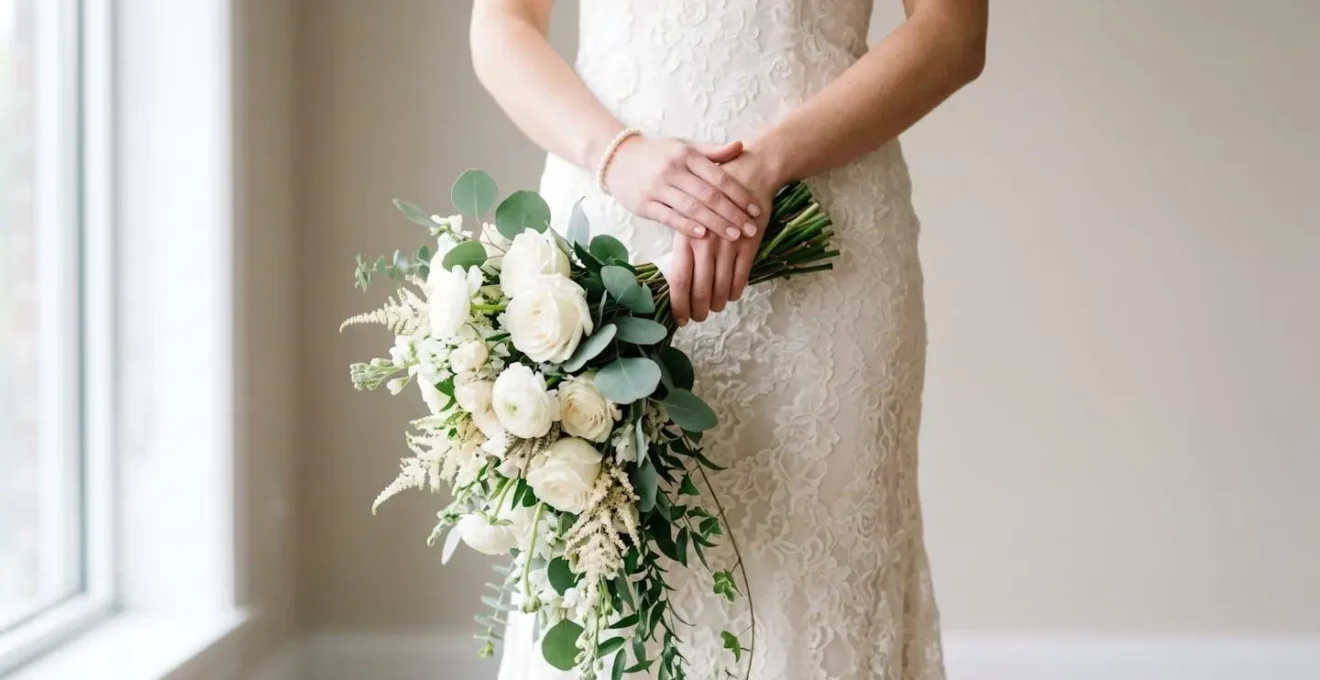
Once you’ve engineered a beautiful, lightweight bouquet, its effect can be ruined if held improperly. The placement of the bouquet is not just an aesthetic choice; it’s a matter of physics and ergonomics. Holding a bouquet too high hides the bride’s waist and the dress details, while holding it too low can look awkward and disrupt the body’s natural lines. The consensus among wedding photographers and florists is clear: the optimal position is at belly button height. This placement creates the most flattering silhouette, allows the cascade to flow naturally, and feels most comfortable for the bride.
For a cascade bouquet, understanding its center of gravity is crucial for comfortable handling. The weight is concentrated in the dense, upper portion of the bouquet where the stems are bound. Gripping the handle far below this point creates a lever effect, increasing torque and strain on the bride’s wrist.
Case Study: The Center of Gravity Technique
Seattle wedding florist Holly Yee emphasizes that a florist’s job includes coaching the bride on how to hold the bouquet. She explains that finding the physical balancing point and positioning the hands there dramatically reduces wrist fatigue. For cascade bouquets specifically, the stems should be held at the wrap, tilted slightly outward, with the stems directed inward toward the navel area. This aligns the bride’s hands with the bouquet’s center of gravity, making it feel lighter and easier to control. It’s why hand-tied cascade stems must be cut short—for the bride’s comfort and to enable this proper, elegant positioning.
Instructing the bride to hold the bouquet at her navel, with relaxed elbows and the cascade tilted slightly forward, ensures the design is showcased as intended. According to wedding professionals, this specific positioning at around the navel area is key for stunning bridal photos. It’s the final step in ensuring your floral engineering results in a perfect presentation.
How to Make a Cascade Bouquet Look Modern, Not 1980s?
The cascade bouquet carries the risk of looking dated, often evoking the dense, heavy “flower walls” of the 1980s. The modern cascade is defined by what it is not: it is not a solid, triangular mass of flowers. Instead, it is characterized by airiness, movement, and negative space. The key is to move away from symmetry and density towards a more organic, deconstructed aesthetic. This is an exercise in aesthetic engineering, using deliberate gaps and varied textures to create visual interest and a sense of lightness.
Contemporary floral designers recommend a formula to break up visual density: a composition of roughly 60% focal flowers, 30% varied foliage, and 10% textural surprises like berries or seed pods. This structured approach ensures variety and prevents the bouquet from becoming a monotonous block of color. The shape itself is also re-envisioned, moving from a rigid triangle to a more fluid ‘S-Curve’ or ‘C-Curve’ that celebrates the unique forms of individual stems.
Case Study: The Deconstructed Cascade
Educator Koko Flora teaches florists to avoid the ’80s look by using the “deconstructed cascade” principle. This involves creating distinct ‘groupings’ of flowers separated by intentional negative space and fine, trailing foliage. This technique creates an airy, floating effect. She advises positioning large blooms slightly above the center to draw the eye upward, making the tail appear longer and lighter. To achieve looseness, the bottom tail must remain light and mobile; overloading it with heavy garden roses is a common mistake that adds weight and bulk. The modern approach builds the bouquet upward and follows an asymmetrical curve, creating a natural, organic line.
The trend is clear. As floral designer Amy Balsters notes in Florists’ Review, “Cascade bouquets were trending last year and are still going strong in 2024, from avant-garde styles like architectural cascading bouquets to lush garden-gathered cascades.” The modern interpretation is here to stay, and mastering its airy, engineered construction is essential.
Petals or Runners: Which Aisle Decor Withstands the Bridal Train?
While the bridal bouquet is a focal point, its design principles can extend to the entire ceremony space, particularly the aisle. The interaction between the aisle decor and the bride’s dress, especially a long train, requires technical consideration to avoid mishaps. The choice between loose petals and a fabric runner involves a risk assessment of factors like wind, moisture, and safety.
Loose petals create a romantic, organic look but are highly susceptible to wind outdoors and can cling to delicate fabrics like tulle. If damp, they also pose a significant risk of staining the dress. A fabric runner provides a smooth, low-friction surface for the train but can become a trip hazard for guests after the ceremony, especially if it bunches up. The material itself can also bleed color if it becomes wet.
A structural approach often provides the best solution. Using potted plants, small arrangements on pedestals, or weighted pomander balls along the aisle eliminates direct contact with the train altogether. This “elevated” decor strategy mitigates the risks of staining, tripping, and wind disruption, ensuring the aisle looks beautiful without compromising the bride’s gown or guest safety. The following comparison, based on insights from floral guides, breaks down the performance of each option.
This comparative data, derived from an analysis by floral experts, helps in making an informed, practical decision.
| Criteria | Rose Petals | Fabric Runners | Alternative Options |
|---|---|---|---|
| Train Interaction | Can cling to tulle/satin fabrics | Smooth surface, low friction | Potted plants: no contact risk |
| Outdoor Wind Resistance | Poor – scatter easily | Good if weighted | Pomander balls: weighted, stable |
| Rain/Moisture Impact | Can stain dress if damp | Can become waterlogged, slippery | Elevated florals: protected |
| Post-Ceremony Safety | Low trip hazard | High trip hazard for guests | Removable markers: easily cleared |
| Staining Risk | High if wet (dye transfer) | Medium (color bleed possible) | Low with non-contact decor |
Key Takeaways
- Prioritize foam-free mechanics like natural armatures to drastically reduce weight and improve the bouquet’s natural flow.
- Design for dynamic movement and negative space. The modern cascade is airy and alive, not a dense, static mass of flowers.
- The bouquet’s center of gravity dictates handling and comfort. Proper hand placement is a crucial element of the final presentation.
The Static Shaping Mistake That Robs Your Arrangement of Life
A common mistake in wiring, even among experienced florists, is creating a perfectly uniform and static shape. When every flower is wired to face directly forward and every stem is perfectly straight, the bouquet loses its vitality. It becomes a rigid, lifeless object rather than a dynamic, organic accessory. This static shaping is the enemy of the modern cascade, which should feel as if it were gathered from a garden and possesses natural movement.
The solution lies in engineering “potential energy” into the bouquet. This is achieved through subtle, deliberate imperfections. Instead of straight wires, use gently pre-curved wires that allow for a natural “bounce” as the bride walks. Instead of having all blooms face forward, manipulate each flower head to introduce slight variations in its direction. This creates a hierarchy of movement, where the core of the bouquet is stable, but the outer edges and trailing elements are free to catch the air.
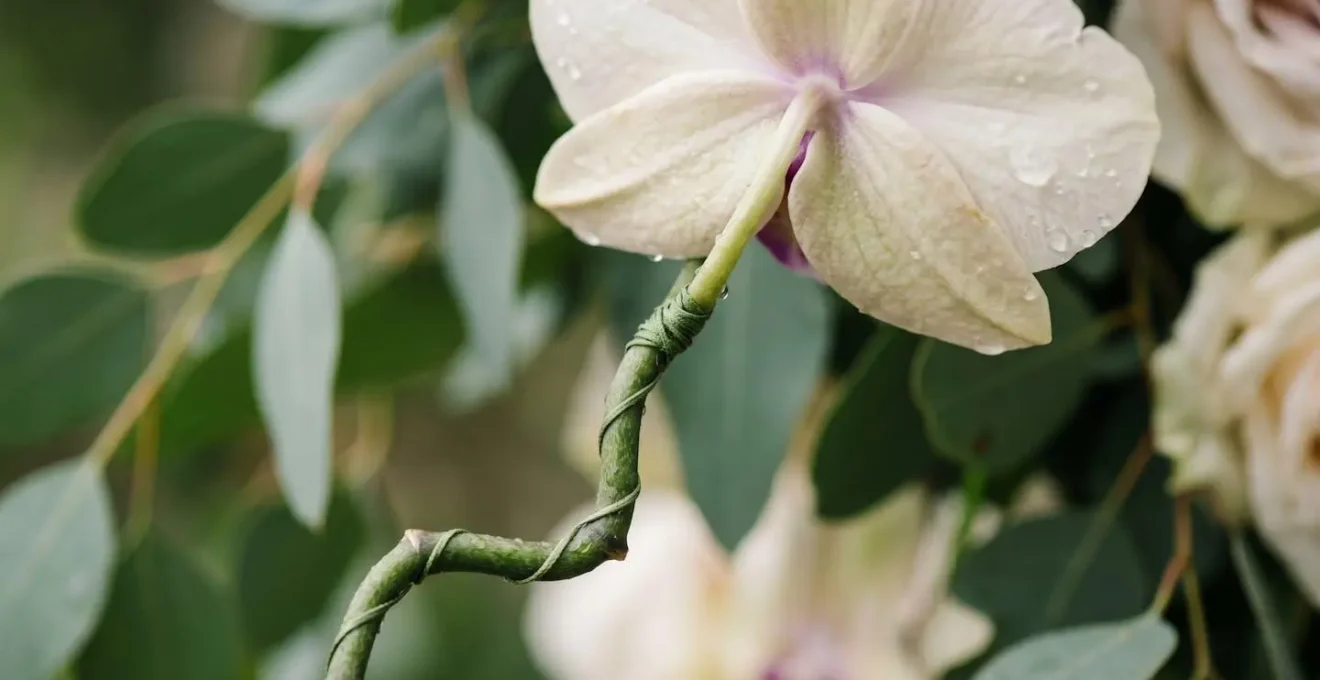
The final “fluffing” or finessing stage is a critical quality control check. After the bouquet is fully assembled, step back and view it from all angles. Identify any areas that look too flat, too uniform, or too rigid. Gently pull some flowers forward and push others back to create depth and a more natural, curved profile. This final manipulation is what breathes life into the arrangement, transforming it from a well-constructed object into a piece of living art.
Action Plan: Post-Construction Technique for Natural Movement
- Step 1: After assembly, step back and observe the bouquet from all angles (front, sides, profile) to identify overly rigid or uniform areas.
- Step 2: Gently manipulate each flower head by softly rotating stems to introduce slight variations in facing direction—not all flowers should face perfectly forward.
- Step 3: Create a ‘hierarchy of movement’ by keeping the core stable while loosening outer edges and trailing elements to create a dynamic, multi-layered effect.
- Step 4: Wire stems with gentle, pre-set curves rather than rigid straight lines to allow for a natural ‘bounce’ and movement when the bouquet is carried.
- Step 5: Check the profile shape from both sides; if it appears flat, pull some flowers out to create a pleasing curved profile rather than a perfect geometric shape.
How to Design a Wedding Ceremony Floral Concept That Ties the Venue Together?
A truly masterful floral design extends beyond the bride’s hands. The cascade bouquet should not be an isolated element but rather the central blueprint for the entire ceremony’s floral concept. This systemic approach, the “Bouquet as Blueprint” method, ensures a cohesive and impactful visual narrative that ties the bride, the wedding party, and the venue together. It elevates the florist’s role from a simple provider of arrangements to the architect of the event’s aesthetic atmosphere.
The process begins by deconstructing the bridal bouquet into its core components. Identify one or two “hero” flowers and the primary foliage type used in the cascade. These elements then become the recurring theme throughout the ceremony decor. The cascade shape itself can be echoed in a large-scale installation, such as on a staircase railing or an archway, creating a powerful sense of visual continuity. This repetition creates a sophisticated, intentional design that feels harmonious and complete.
This strategy also allows for intelligent budget allocation. As floral designer Janelle Gerestein points out, a growing trend sees couples investing heavily in a standout bridal bouquet and major installations. She states, “Interestingly, some couples are opting for only standout bridal bouquets and redirecting their budgets toward larger centerpieces and statement floral installations,” according to an article in a 2024 trends report from Florists’ Review. By using the bouquet as the design key, you can create a high-impact look that feels luxurious and comprehensive, even with a focused budget.
Action Plan: The ‘Bouquet as Blueprint’ Method
- Step 1: Identify one to two ‘hero’ flowers from the bridal cascade bouquet to serve as the signature blooms for all ceremony installations.
- Step 2: Extract the specific foliage type used in the cascade (e.g., trailing ivy, eucalyptus) and scale it up for archway or aisle marker designs.
- Step 3: Echo the ‘cascade’ shape itself in one large-scale installation—such as on a staircase railing or archway—to create visual continuity.
- Step 4: Consider designing a modular bouquet, where a section of the cascade can detach to become a smaller reception bouquet or centerpiece.
- Step 5: Keep all other floral elements minimal to allow the hero elements to create a powerful focal point that ties the venue to the bride.
By applying these principles of floral engineering, you can consistently produce cascade bouquets that are not only breathtakingly beautiful but also lightweight, durable, and a joy for the bride to carry. This technical mastery is what sets a professional florist apart, turning a challenging request into a signature achievement.