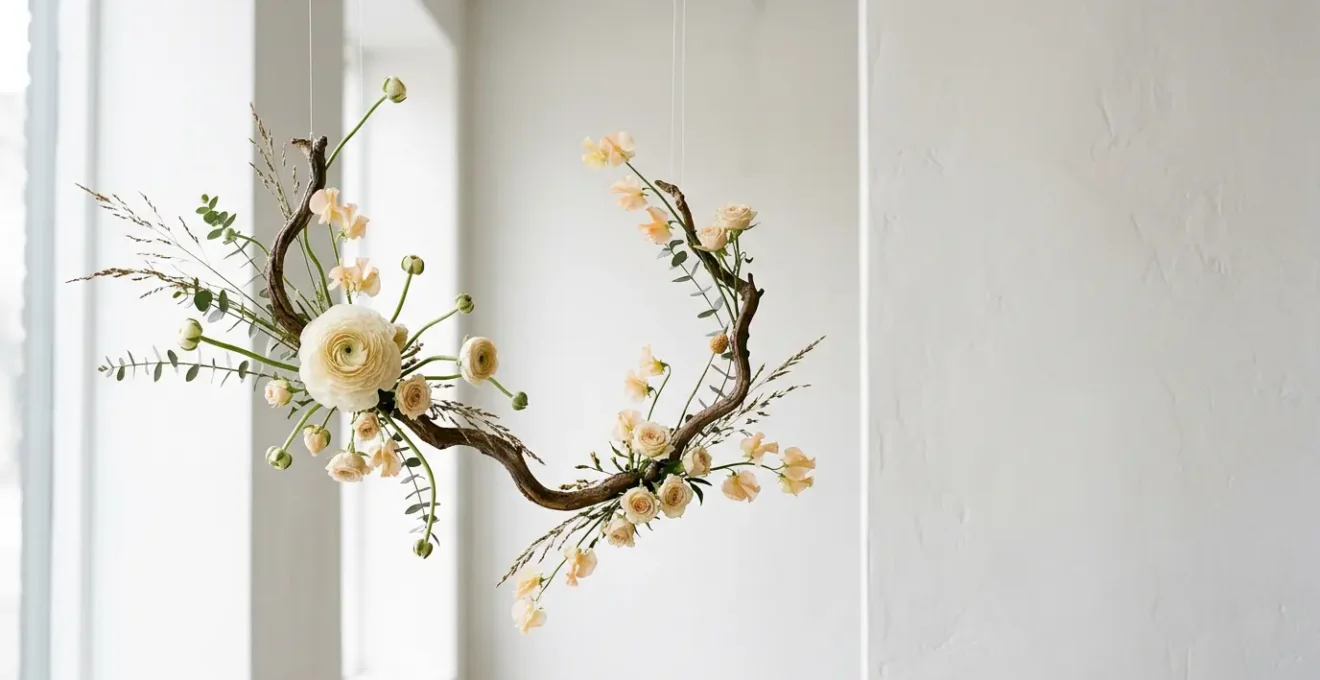
The greatest myth in floristry is that artistry comes from adding more; in truth, it is an act of profound subtraction and intention.
- Successful floral art treats botanicals as sculptural elements with inherent gesture, not just decorative color.
- Mastering negative space, revealing the essential line of a branch, and developing a unique artistic voice are more critical than simply following design principles.
Recommendation: Stop thinking like a decorator who fills a vase and start thinking like a sculptor who curates space, line, and emotion.
Many aspiring florists reach a frustrating plateau. Their arrangements are competent, balanced, and pretty, yet they lack the soul-stirring quality that defines true artistry. They follow the rules of color theory, they achieve technical proficiency, but the work remains stubbornly on the level of craft, not art. The common advice is to practice more, to master more techniques, to use more luxurious flowers. This path often leads to more elaborate decorations, but rarely to work that resonates on a deeper, emotional level. It’s an approach focused entirely on addition.
But what if the key to unlocking floral artistry isn’t found in what you add, but in what you take away? What if the leap from arranger to artist lies not in filling space, but in celebrating it? This is the fundamental shift in mindset from decoration to sculpture. It requires you to see a flower not as a splash of color, but as a form in space; a branch not as a filler, but as a line drawing with its own energy and story. This is the practice of engaging in a dialogue with your materials, listening to their inherent gesture, and using your technique to amplify their voice, not silence it with preconceived ideas.
This guide moves beyond the conventional principles of design to explore the critical, often counter-intuitive, concepts that separate masterful work from the mundane. We will deconstruct the role of empty space, explore the search for an authentic artistic voice, and analyze the techniques used not just to build, but to reveal. This is a journey into the sculptor’s mindset, where every placement is an intentional act and every stem is a statement.
To navigate this deep dive into the philosophy and practice of floral sculpture, this article is structured to build from foundational concepts to advanced applications. The following summary outlines the key stages of our exploration into what truly defines artistry.
Summary: From Arranging to Artistry: A Sculptural Approach
- Why Is Empty Space Crucial for Artistic Floral Composition?
- How to Find Your Unique Floral Voice in a Crowded Market?
- Wire or Glue: Best Techniques for Manipulating Rigid Stems?
- The Static Shaping Mistake That Robs Your Arrangement of Life
- Where to Find Rare Botanicals That Define High-End Artistry?
- How to Use Flowers as Sculpture Rather Than Decoration?
- How to Prune a Branch to Reveal Its Essential Line?
- How to Achieve the Organic Modern Look Without Using Floral Foam?
Why Is Empty Space Crucial for Artistic Floral Composition?
The most common impulse in arranging is to fill the vase, to eliminate voids. Floral artistry begins with the opposite impulse: to create and honor them. This is the concept of negative space—the areas around and between your botanical materials. Far from being empty, this space is an active component of your design. It gives each element definition, allows the eye to rest, and creates a sense of rhythm and elegance. Without sufficient negative space, the most beautiful flower is lost in a crowd, its form and gesture muted by visual noise. It’s the difference between a cacophony and a symphony.
This principle is central to the Japanese aesthetic of Ma (間), which understands space not as a void to be filled but as an essential part of the whole. It is the pause that gives music its meaning. As the experts at Louise & Deb Floral Design articulate, this space is where the composition finds its voice:
Negative space is the area around and between the flowers or materials in your design. It’s the breathing room. The rest spot. The pause between notes in a song.
– Louise & Deb Floral Design, Let It Breathe: The Power of Negative Space in Floral Design
To begin working with negative space, place a single, beautifully formed branch in a vessel. Observe it. Now add one flower. See how the space between them creates a tension, a relationship. Each element is heightened because it has room to exist. This is the foundational act of floral sculpture: curating space itself as a primary material.
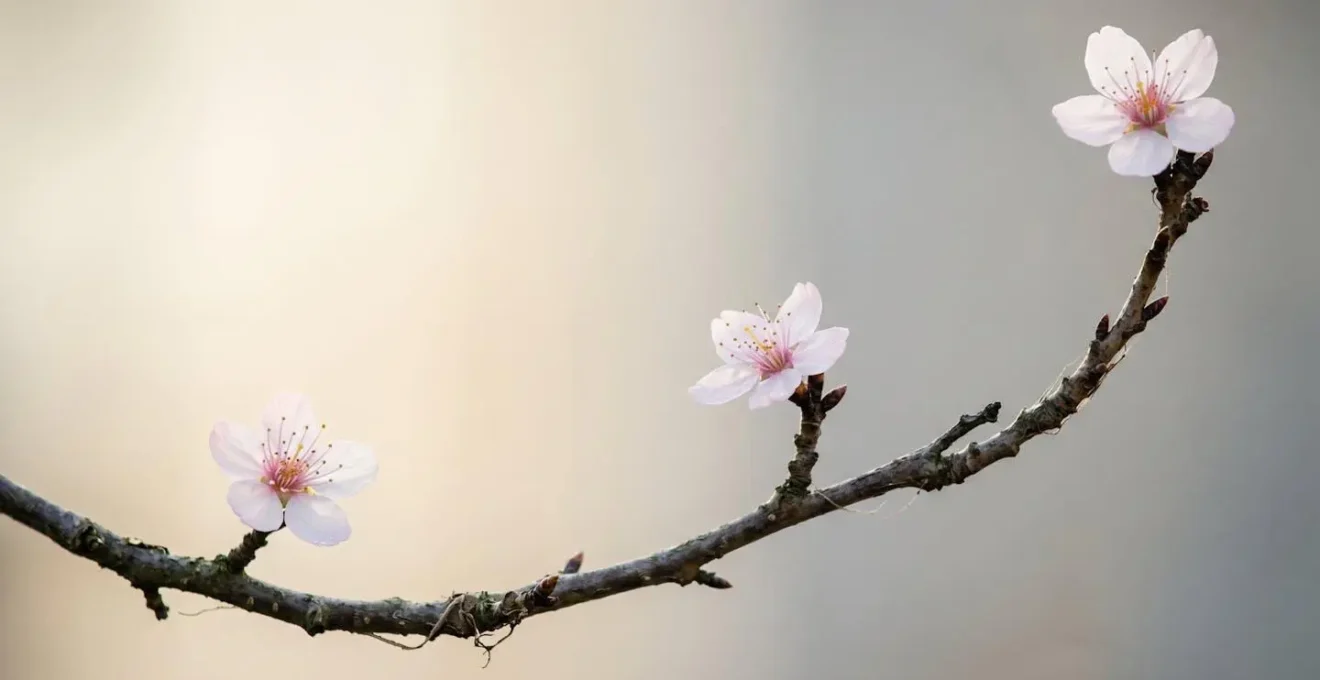
As the image demonstrates, the empty space is not passive; it actively shapes our perception of the botanical forms. It directs the eye, creates pathways, and imparts a feeling of tranquility and focus. The goal is not to show how many flowers you can use, but how few you need to make a powerful statement. Letting your composition breathe is the first step toward creating work with real presence and sophistication.
How to Find Your Unique Floral Voice in a Crowded Market?
Technical skill can be learned, but an artistic voice must be discovered. In a market saturated with fleeting trends and imitation, developing a signature style is not just an artistic pursuit—it’s a commercial imperative. A unique voice is what transforms your work from a commodity into a brand, allowing you to connect with clients on an emotional level. But this voice is not found by looking outward at what others are doing; it is found by looking inward at your own sensibilities and convictions.
Your voice is the consistent thread that runs through your work. It’s your preference for certain color palettes, your love for the untamed gesture of foraged branches, or your inclination toward minimalist, architectural forms. It is the sum of your artistic decisions. As leading florist Amy Marella points out, this self-awareness is the bedrock of a powerful brand:
Your brand starts with the unique style and personality you bring to your work. Are your designs classic and timeless, or do they embrace bold, modern trends? Do you favor lush, romantic blooms or sleek, minimalist arrangements? Understanding your signature style is the foundation of your brand.
– Amy Marella, Building a Brand, Florists’ Review
This isn’t about being different for the sake of it. It’s about authenticity. Start a visual journal. Collect images—not just of flowers, but of art, architecture, fashion, and nature—that resonate with you. Analyze them. What is the common theme? Is it a mood, a color story, a quality of light? This is the raw material of your artistic DNA. This process of self-curation is critical because, according to recent industry analysis, high-value sales are increasingly driven by unique customization, which is the commercial expression of a distinct artistic voice. Your signature style is your most valuable asset.
Why Is Empty Space Crucial for Artistic Floral Composition?
The question of “wire or glue” presents a false dichotomy. Glue is a mechanic of assembly, often a shortcut. Wire, in the hands of an artist, is a tool of sculpture. It is used not merely to fix a stem in place, but to subtly enhance its natural gesture, to defy gravity, or to create a line that would otherwise be impossible. The true artist’s goal is for this manipulation to feel invisible, as if the flower is holding its pose through its own volition. The mechanics should serve the art, not announce themselves.
Forget basic wiring that constricts a stem. Advanced techniques are about creating internal or integrated support that becomes part of the design’s magic. The objective is to move beyond simply forcing a stem into a desired position and toward a more thoughtful intervention that honors the material. This might mean threading a fine wire through a hollow stem to give it a perfect, self-supporting curve, or stitching branches together at a hidden junction point to create an airy, floating structure. The most advanced application is when the wire itself is exposed, used as a deliberate graphic element that adds another layer of line and texture to the composition.
However, the most critical technique is not physical but philosophical: an ethical assessment before any intervention. Does wiring this stem amplify its inherent beauty, or does it betray its natural form? True artistry lies in knowing when *not* to manipulate, respecting the botanical gesture above all else. This discernment is what separates a technician from an artist.
Action Plan: Advanced Wiring for Invisible Support
- Internal Wiring: Thread aluminum wire through hollow stems like tulips or calla lilies to create an internal, completely invisible armature that allows for graceful, self-supporting curves.
- Stitching Technique: Use fine bind wire to “stitch” stems or branches together at strategic, hidden junction points. This creates gravity-defying forms and interlocking structures that appear naturally woven.
- Decorative Wire Integration: Instead of hiding it, use colored aluminum or copper wire as an exposed structural element. Let it become a sculptural, graphic line that contrasts or complements the botanical material.
- Ethical Assessment: Before manipulating, hold the stem and “read” its natural gesture. Ask: Does my intervention honor and amplify this movement, or does it force the stem into a shape that betrays its inherent character?
The Static Shaping Mistake That Robs Your Arrangement of Life
A common mistake among developing florists is to create arrangements that are perfectly balanced but utterly static. They assemble flowers into a predetermined, rigid shape—a dome, a triangle—and in doing so, they strip each stem of its individual life force. An artistic composition, by contrast, is dynamic. It has movement and rhythm; it guides the viewer’s eye on a journey through the piece. This is achieved not by forcing materials into a shape, but by orchestrating their inherent gestures.
Every stem, branch, and bloom has a natural gesture—a direction, a curve, a way it wants to move. A rigid branch thrusts upward, a vine cascades downward, a poppy stem twists with delicate energy. The artist’s job is to recognize and amplify these gestures. Instead of fighting a curved stem to make it straight, celebrate its curve. Juxtapose it with a contrasting straight line to create tension and energy. This is the difference between building a static object and choreographing a dynamic dance.
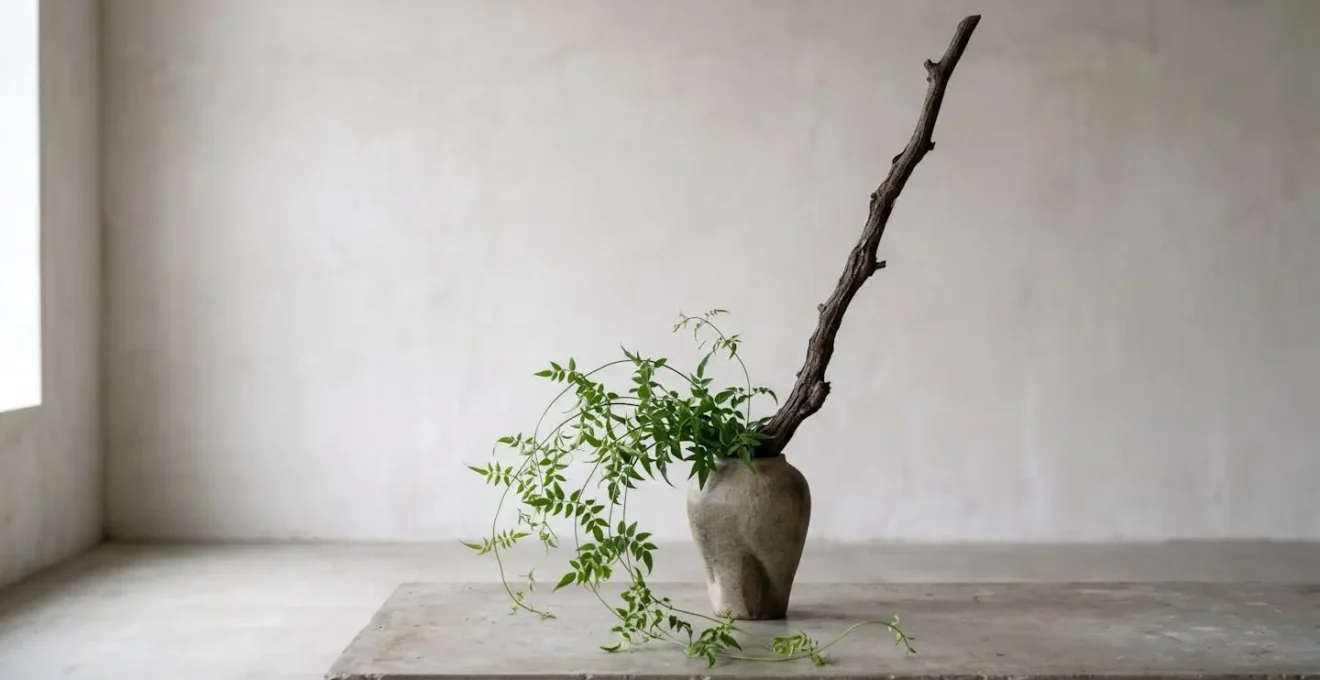
As seen in the image, life is created through the interplay of contrasting forces. A strong, upward line is softened by a cascading element. A delicate texture is placed against a bold form. This creates a visual pathway that the eye instinctively follows. The goal is to create layered rhythms—fast and slow, strong and gentle—that make the arrangement feel alive and breathing. This can only be achieved by letting the materials themselves lead the design, moving beyond the static geometry of elementary arranging.
Where to Find Rare Botanicals That Define High-End Artistry?
The pursuit of “rare” materials often sends florists searching for expensive, imported, and exotic blooms. This is a limited and unsustainable view of rarity. True high-end artistry is defined not by the price tag of a flower, but by the uniqueness of the artist’s vision and their ability to source materials that no one else has. The most coveted botanicals are often not found at the wholesale market, but in your own environment—if you know how to look.
This is a paradigm shift from buying to seeing. It means cultivating relationships with local specialty growers, private gardeners, and even arborists who can provide access to specimens that never enter the commercial supply chain. It’s about seeing the sculptural potential in a “past-prime” hellebore with its moody, faded colors, or the exquisite line of an architectural branch pruned from a neighborhood tree. This approach is not only more sustainable but also imbues your work with a powerful sense of place. This shift in consumer mindset is growing, as floral industry trend analysis shows that “consumers increasingly want to know their purchases are supporting local flower farmers and coming from sustainable farm sources.”
This hyper-local, relationship-based sourcing allows you to build a truly unique botanical palette that cannot be replicated. Your work becomes a reflection of a specific time and place, filled with materials that carry a story.
Case Study: Sustainable Sourcing Through Local Alliances
Pioneering floral artists like Tobey Nelson have redefined sourcing by moving away from the traditional supply chain. Instead of simply buying, they build collaborative alliances with a network of local specialty growers, gardeners, and arborists. This strategy gives them access to unique, non-commercial specimens that define their work. The focus shifts from purchasing rare materials to discovering the inherent beauty in unconventional sources, such as foraged items from urban environments, “past-prime” flowers valued for their character, and architectural prunings that offer unparalleled sculptural lines. This approach not only yields a signature palette but also champions a more sustainable, community-focused model of floristry.
How to Use Flowers as Sculpture Rather Than Decoration?
The ultimate goal of a floral artist is to create work that transcends decoration and functions as sculpture. A decorative arrangement is made to beautify a space. A sculptural piece, however, commands space and creates an emotional or intellectual response. It has mass, volume, tension, and a conceptual foundation. It isn’t just *in* a room; it *converses* with the room. This requires a profound shift in intent from the outset. You are not arranging flowers; you are building a form that uses flowers as its medium.
This sculptural approach begins before you touch a single stem. It starts with an abstract concept or an emotion. Are you trying to convey joy, grief, tension, or tranquility? Once the intent is clear, you select botanical materials not for their decorative value, but for their ability to embody that concept through their inherent form, color, and gesture. A contorted branch can speak of struggle; a mass of delicate, airy grass can evoke serenity. As the poet Pablo Neruda so powerfully suggested, this is a form of architecture.
Floral designers are architects of emotion, building arrangements that resonate with the heart.
– Pablo Neruda
To practice this, try working with a limited palette. A monobotanical study, using only one type of flower, forces you to see beyond its identity as a “rose” or “carnation” and focus purely on its sculptural properties of line, texture, and form. Another technique is to explore mass and cantilevering—creating dense, solid forms or self-supporting structures that seem to defy gravity, generating a sense of awe and wonder. In this way, the arrangement becomes an object of contemplation in its own right.
How to Prune a Branch to Reveal Its Essential Line?
In the hands of an artist, pruning is not an act of tidying up; it is an act of revelation. Every branch contains a multitude of lines and forms, but within that complexity lies a single, powerful statement—its essential line. This is the primary energy, the dominant gesture that defines the branch’s character. The artist’s task is to see this line and carefully prune away everything that distracts from it. It is a process of subtraction that clarifies and strengthens the branch’s sculptural power.
This is the opposite of using foliage to “fill.” It is editing with a blade. Look at a complex branch. Squint your eyes. Which line holds the most energy? Which curve is most compelling? This is your essential line. Now, begin to remove the secondary twigs, leaves, and smaller branches that confuse or weaken that primary statement. Each cut should be deliberate. The goal is to create a clean, graphic form that has strength and stability. It is an exercise in creating clarity from chaos.
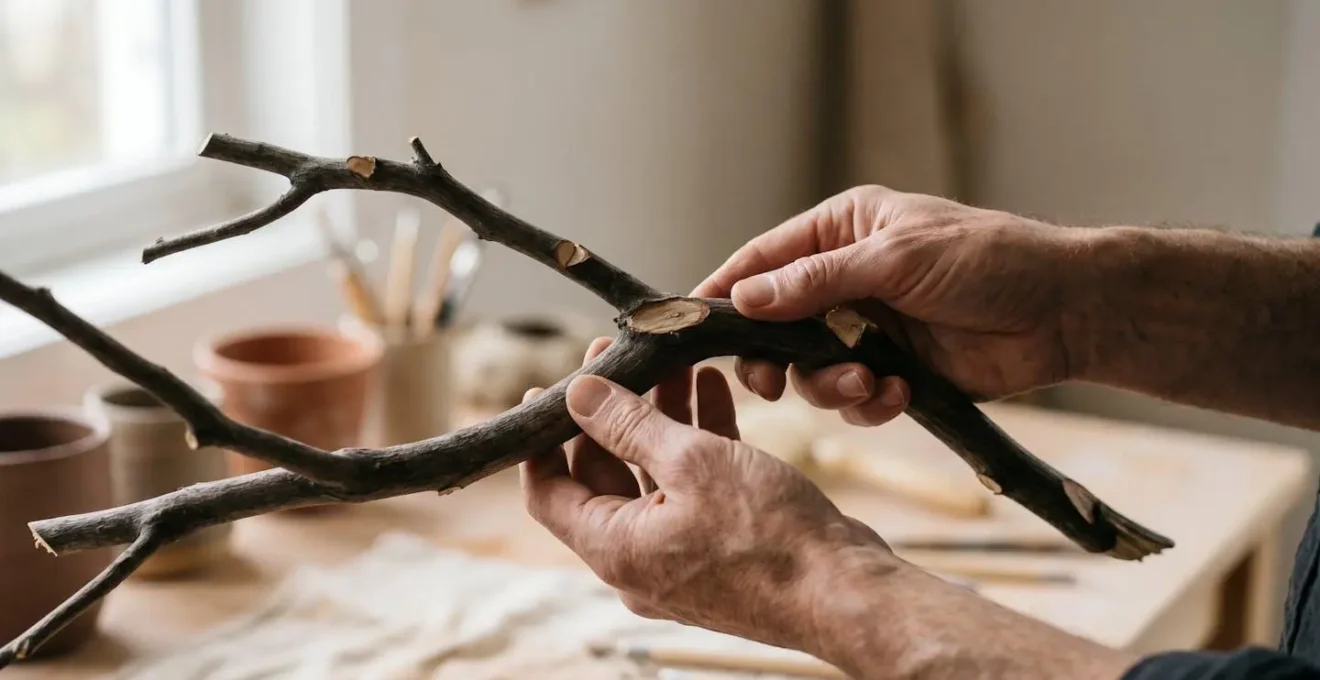
As the image shows, the process is intimate and focused. The hands are not just holding the branch; they are reading it, feeling its form to make discerning cuts. The result is a botanical element that is no longer just a piece of a tree, but a piece of sculpture. This pruned branch can now serve as the primary armature of your design, a powerful line drawing in space around which all other elements will be placed in dialogue. This single, clarified element often has more impact than a dozen unedited stems.
Key Takeaways
- True artistry is subtractive: Master negative space and prune to reveal the essential line rather than simply adding more flowers.
- Develop an authentic voice: Your unique perspective, not trends, is your most valuable asset. Cultivate it by looking inward.
- Think like a sculptor: Treat botanicals as a medium to express form, gesture, and emotion, not just as decoration.
How to Achieve the Organic Modern Look Without Using Floral Foam?
The move away from single-use floral foam is one of the most significant shifts in contemporary floristry, driven by both environmental concerns and a changing aesthetic. This constraint, however, is not a limitation; it is a catalyst for creativity. Achieving the airy, naturalistic, and transparent style of Organic Modern design is almost impossible with the dense, opaque nature of foam. Foam-free mechanics force the artist to think more sculpturally and embrace the support structure as a visible, intentional part of the design.
This is the concept of intentional mechanics. Instead of being hidden, the armature becomes part of the art. A beautiful brass kenzan (pin frog) gleaming through clear water in a glass vessel is not something to conceal; it is a celebrated element of the design’s clean, minimalist aesthetic. A tangled nest of chicken wire or an interlocking structure of branches (a “living armature”) provides support while contributing its own organic texture and line to the lush, garden-style composition.
Case Study: The Moss Roulade for Foam-Free Installations
For large-scale works like wedding arbors, artist Tobey Nelson has championed the moss roulade technique. As detailed by Team Flower’s educational resources, this reusable mechanic involves wrapping wet sphagnum moss tightly in floral netting to create a sausage-like form. This matrix holds stems securely while providing a natural source of humidity, allowing for arrangements to be prepared up to 36 hours in advance. Critically, it creates the transparent, layered aesthetic central to Organic Modern design, where the mechanics are visible and become an intentional, textural part of the composition itself.
Working foam-free encourages a more natural placement of stems, respecting their individual gestures and creating the sense of movement that is a hallmark of the style. It is a method that demands more thought and intention, but the result is work that is not only more sustainable but also more artistically honest and visually sophisticated. Embracing these techniques is essential for any artist wanting to create work that is both contemporary and conscious.
The journey from a competent arranger to a true floral artist is a profound internal shift. It is the conscious decision to move beyond decoration and to engage with botanicals as a sculptural medium. It requires you to cultivate a critical eye, an authentic voice, and a deep respect for your materials. By mastering the art of subtraction, embracing intentional mechanics, and learning to see the gesture in every stem, you unlock the ability to create work that does more than adorn a space—it creates a feeling, tells a story, and resonates with the soul. Start today by picking up a single branch and asking not “Where does this go?” but “What does this want to say?”