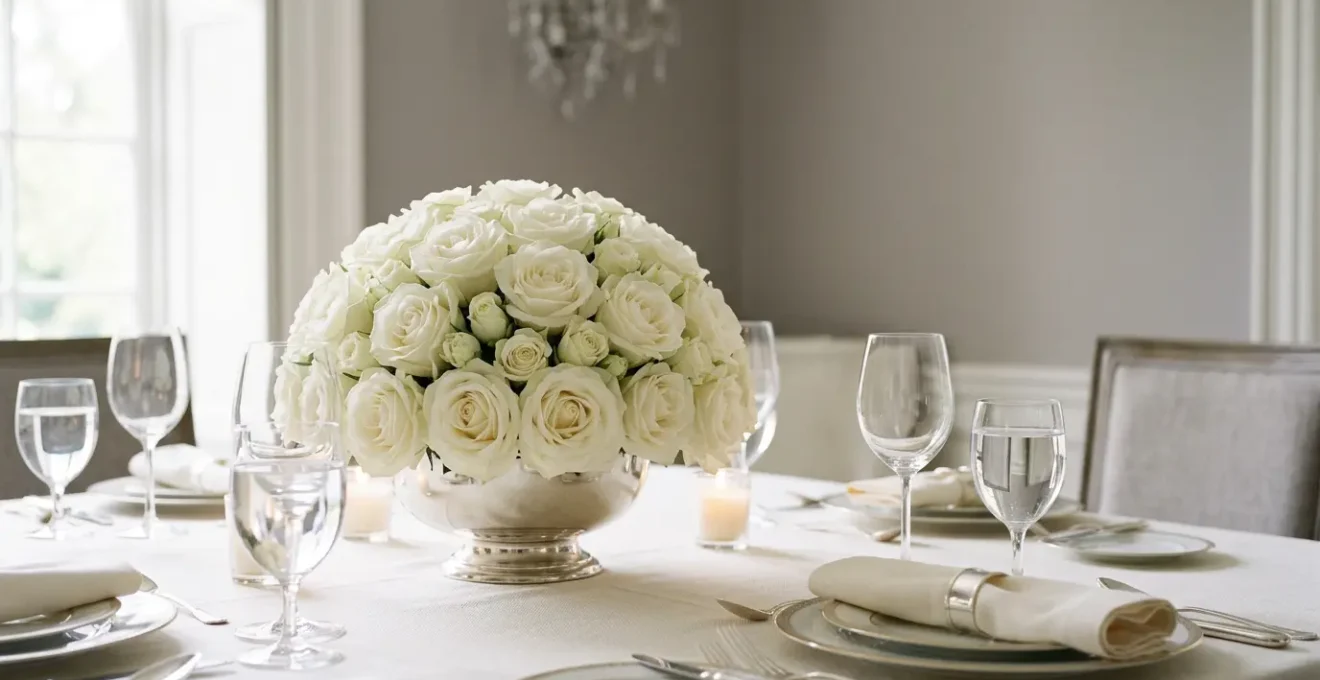
Crafting a formal dome is an exercise in discipline, not creativity; its success hinges on underlying principles of physics and geometry.
- The luminosity of white flowers in low light is a scientific advantage (albedo), not merely an aesthetic choice.
- An arrangement’s stability relies on precise structural mechanics, from foam preparation to stem-grade selection.
- Perfect symmetry is not a suggestion but a mathematical goal achieved through rigorous technique.
Recommendation: Master the foundational rules of structure and visual weight before attempting any creative interpretation; true luxury is born from precision.
The host of a truly formal dinner understands that every element on the table is a declaration of intent. The weight of the silver, the crispness of the linen, and, most critically, the centerpiece. A classic dome arrangement is not merely a collection of flowers; it is the silent, elegant arbiter of the evening’s tone. Many assume that creating such a piece is a matter of acquiring beautiful blooms and arranging them pleasingly. This is a profound misunderstanding of the art form.
This is not an art of whimsical placement but a science of structural integrity and visual physics. The classic dome, particularly in the Biedermeier tradition, is an architectural feat in miniature. Its perfection is not accidental; it is engineered. The common approach of simply filling a space with color ignores the foundational principles that separate a passable bouquet from a breathtaking statement piece. The secret lies not in what you see, but in the unseen structure and the disciplined rules that govern it.
To deviate from these principles is to invite chaos—a lopsided profile, a wilting bloom, a jarring color that disrupts the harmony of the entire tablescape. But what if the “rules” were not restrictive, but liberating? What if understanding the science behind the beauty was the key to achieving flawless, high-society elegance every time? This guide does not offer suggestions; it provides the non-negotiable doctrine of constructing a perfect dome arrangement. We will dissect the geometry, the physics of color and light, and the uncompromising standards of material selection that are the bedrock of timeless floral design.
This article provides a structured exploration of these core tenets. The following summary outlines the key principles we will dissect to elevate your understanding from amateur enthusiast to disciplined creator.
Summary: Constructing the Perfect Classic Floral Dome
- What Is the Concentric Circle Technique in Formal Arranging?
- Why Is All-White the Gold Standard for Formal Events?
- How to Secure Foam in a Shallow Urn for Heavy Arrangements?
- Mirror Image: How to Ensure Two Altar Vases Are Identical?
- Why You Must Use Grade A Roses for Formal Pavé Designs?
- Why Does the Eye Drawn to Red Flowers First on a Table?
- Why Do Dark Flowers Need to Be Placed Lower in an Arrangement?
- How to Design a Wedding Ceremony Floral Concept That Ties the Venue Together?
What Is the Concentric Circle Technique in Formal Arranging?
The concentric circle technique is the foundational blueprint for achieving mathematical precision in a classic dome. It is not an optional guide; it is the architectural plan upon which the entire structure rests. This method, perfected in the Biedermeier style which uses concentric patterning, involves creating a grid of circles on the surface of the floral foam. Each circle serves as a precise guideline for a new ring of flowers, ensuring uniform spacing, controlled height gradation, and a perfectly hemispherical shape. This is not about approximation; it is about systematic, deliberate placement. The outermost circle defines the arrangement’s final diameter, while the innermost circle marks the apex.
By inserting flowers row by row along these pre-determined lines, you eliminate guesswork and the risk of an asymmetrical or lopsided final product. This technique forces a disciplined approach, compelling the designer to consider each stem’s role within the larger geometric framework. The result is an arrangement that is pleasing from every angle, embodying a sense of order and intentionality. The concentric method is the very definition of building an arrangement from the inside out, ensuring the internal logic dictates the external beauty.
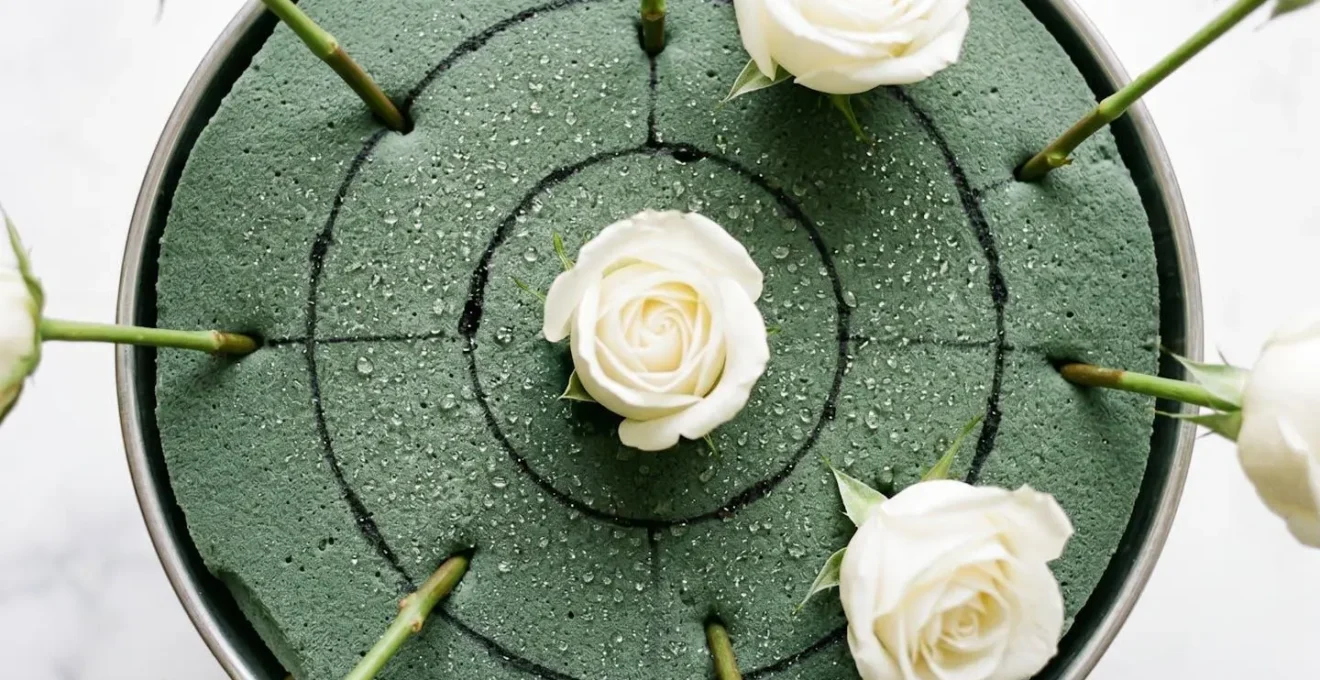
As the blueprint shows, the dome is not a free-form sculpture but a carefully plotted construction. This geometric underpinning is what gives the classic dome its inherent sense of balance and harmony, a principle eloquently stated by floral analysts:
It has infinite lines of symmetry, making it a symbol of the divine symmetry and balance in nature.
– Keepsake Floral Design Analysis, Designing in Circles – Keepsake Floral
Ultimately, this technique transforms the act of arranging from an art of chance to a science of certainty. The dome’s flawless curvature is not a happy accident; it is the direct and inevitable result of adhering to the strict geometry of the concentric circle. This is the first and most critical rule of formal dome construction.
Why Is All-White the Gold Standard for Formal Events?
The preference for all-white floral arrangements in formal, high-society settings is not a matter of fleeting fashion or simplistic taste. It is a strategic decision rooted in science, symbolism, and tradition. The primary reason is a principle of visual physics: white flowers possess the highest albedo, or light-reflecting capability. In the often low-light, candlelit ambiance of a formal dinner, white arrangements do not fade into the background; they become luminous. They catch and reflect every flicker of light, appearing to glow from within and creating an atmosphere of ethereal elegance.
This scientific advantage is why professionals insist on white. As noted by horticultural experts, “White flowers have the highest albedo, meaning they reflect the most light. In low-light formal dining settings they appear luminous and glow.” This quality ensures the centerpiece remains a prominent, graceful focal point throughout the evening, rather than a dark mass on the table. It is a choice of practicality as much as aesthetics, designed to perform under the specific conditions of a formal event.
Beyond physics, the all-white palette carries an unparalleled symbolic weight, cultivated over centuries of royal and state functions. It signifies purity, opulence, and timelessness, a tradition cemented by its use in the most significant of ceremonies.
A Legacy in White: The Royal Standard
The tradition of white as the ultimate symbol of formal elegance is deeply rooted in royal protocol. White flowers were famously featured in Queen Elizabeth II’s 1953 coronation bouquet and remained her favorite throughout her life. This standard cascaded into the iconic bridal bouquets of society figures like Grace Kelly and Catherine, Princess of Wales, cementing all-white florals as the definitive statement of opulence, purity, and timeless tradition in the most formal of events.
Choosing all-white is therefore not a safe or uninspired choice. It is a confident, deliberate decision to align with a legacy of elegance, leveraging both the laws of physics and the weight of history to create an atmosphere of unmatched sophistication. It is the gold standard because no other color performs its function with such grace and authority.
How to Secure Foam in a Shallow Urn for Heavy Arrangements?
The most beautiful arrangement is a catastrophic failure if it tips over. For a classic dome, with its significant weight of water-laden foam and dense blooms, structural integrity is paramount. Securing the floral foam, especially in a traditional shallow urn, is a non-negotiable engineering task. The primary method relies on a combination of friction fit and a taped grid. The first step, often overlooked by amateurs, is to carve the dry foam block to fit snugly within the urn’s opening *before* soaking. This initial friction is the first line of defense against wobbling.
Once the foam is soaked and placed, the critical step is to create a secure grid using waterproof floral tape. This tape is not merely placed over the foam; it is anchored firmly to the dry rim of the urn itself. The standard is a criss-cross or “tripod” pattern that creates downward pressure, locking the foam block in place. This taping technique effectively makes the foam and the urn a single, unified unit, preventing the entire arrangement from tipping under its own weight or during transport. This is the professional standard for ensuring stability.
For particularly large or heavy arrangements, such as those intended for an altar or a grand entryway, an additional layer of mechanical support is required. This is where an understanding of advanced floristry mechanics becomes essential. As one expert from Mississippi State University Extension notes, “Some florists use a layer of chicken wire on top of fresh flower foam, especially in large-scale arrangements. The added rigidity keeps large stems in place.” The chicken wire is molded over the foam and taped securely to the vessel, creating a robust cage that provides hundreds of additional support points for heavy stems like hydrangeas or thick-stemmed roses.
This combination of friction, taping, and, when necessary, a wire cage, is the triad of structural stability. It is an unseen but utterly critical component of formal design. To neglect these mechanics is to build a beautiful house on a foundation of sand—an unacceptable risk in any high-stakes setting.
Mirror Image: How to Ensure Two Altar Vases Are Identical?
In formal design, particularly for settings like a wedding altar, a mantelpiece, or flanking a grand doorway, the use of paired arrangements is common. The standard here is not simply two “similar” arrangements; it is the creation of two perfectly identical, mirror-image pieces. Achieving this level of precision is a hallmark of a master florist and requires absolute discipline, not artistic license. Success is predicated on process, not intuition. The first rule is to work on both arrangements simultaneously, side-by-side. This allows for constant comparison at every stage of construction.
The process begins with identical mechanics: two identical urns, two identically sized and secured blocks of foam. From there, one must create and adhere to a strict “floral recipe.” This means counting every single stem. If the left arrangement receives twelve white hydrangeas, the right must also receive twelve. If the recipe calls for twenty-five roses, each arrangement gets exactly twenty-five. There is no room for variance. You must methodically place one type of flower at a time, alternating between the two vases. Place three key hydrangea stems in the left vase to establish the shape, then immediately replicate that exact placement in the right vase.
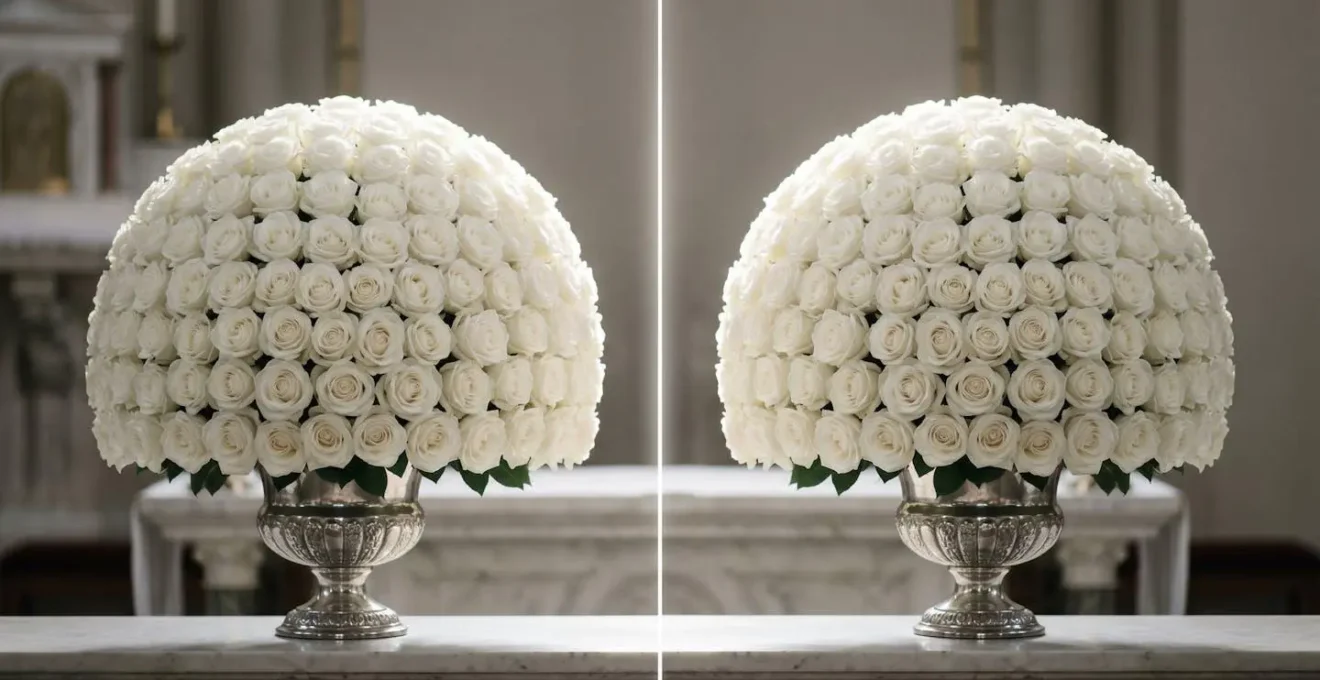
Height, width, and angle are obsessively controlled. Use a ruler or marked dowel to ensure the apex of both domes is at the exact same height. The outermost flowers must extend to the same diameter on both pieces. You are not “decorating”; you are duplicating. Each stem placed in the left arrangement must have its identical twin placed at the mirrored position in the right arrangement. This requires a level of focus and systematic execution that leaves no room for error. The final test is to view them from every angle—front, back, and sides—to hunt for and correct any minute discrepancies.
This rigorous, methodical process is the only way to achieve the perfect bilateral symmetry demanded by formal aesthetics. It is a testament to the florist’s skill and discipline, demonstrating a control over the medium that transcends simple decoration. The goal is an effect of such perfect harmony that the viewer perceives the two arrangements as a single, unified, and flawlessly balanced composition.
Why You Must Use Grade A Roses for Formal Pavé Designs?
In the world of high-society floristry, not all flowers are created equal. The distinction between grades is not a trivial matter for retailers; it is a fundamental pillar of design quality. For techniques like pavé or a seamless classic dome, where flower heads are set tightly together to create a single, uninterrupted velvety surface, the use of Grade A roses is not a preference—it is a structural necessity. A Grade A (or Grade 1) classification is a technical standard indicating superior quality. This includes not just the absence of blemishes but specific physical metrics, such as a stem length exceeding 60cm and a minimum cane diameter, ensuring a robust and healthy flower.
The defining characteristic of a pavé design is its perfect, uniform texture. This effect is immediately shattered by a single inferior bloom. A smaller head creates a gap, a discolored petal introduces a visual flaw, and an inconsistently opened bud breaks the seamless curve. Lower grade roses (Grade B or 2) are plagued by these inconsistencies: smaller heads, blemishes, and uneven bloom stages. Using them for a pavé design is a fool’s errand. One flawed rose can compromise the integrity of the entire surface, requiring the designer to use more flowers to hide imperfections, ultimately negating any initial cost savings.
This is not just a matter of aesthetics but of professional efficiency and financial viability, as a direct comparison reveals.
The Economics of Perfection: Grade A vs. Grade B
Professional florists understand that while Grade A roses may cost 40-60% more upfront, they are more cost-effective for high-end designs. When creating pavé arrangements, using Grade B roses inevitably leads to a high discard rate due to blemishes and size variance. One floral group analysis found that designers often need to purchase 30-50% more stems of a lower grade to find enough perfect blooms and to conceal the flaws of others. This not only eliminates the price advantage but also increases labor time. For a flawless, uniform surface where every bloom must be perfect, Grade A is the only economically and aesthetically viable choice.
Therefore, the insistence on Grade A is not snobbery; it is a requirement dictated by the technique itself. It ensures that every single component of the arrangement meets the minimum standard for perfection, guaranteeing the flawless, luxurious finish that is the hallmark of a true formal design. To compromise on the grade is to compromise the entire piece from the outset.
Why Does the Eye Drawn to Red Flowers First on a Table?
The human eye is not a neutral observer; it is a sophisticated instrument with inherent biases. In the context of a floral arrangement, color is not just an aesthetic choice but a tool to direct attention, and no color commands attention more powerfully than red. The reason for this is rooted in the physics of light and the biology of human perception. Red has the longest wavelength in the visible spectrum. This physical property means it is the fastest color for our brains to process, giving it the highest “visual weight” of any hue. A single red bloom in a sea of white is not just a spot of color; it is a powerful focal point that the eye cannot ignore.
This is why, according to color theory and visual perception research, a red flower will always be perceived first. A designer who understands this does not use red casually. In a formal, all-white arrangement, the introduction of a single, perfectly placed deep red rose is a masterful, deliberate act. It is a declaration of a focal point, drawing the viewer’s eye exactly where the artist intends. However, this power must be wielded with extreme restraint. Overuse of a high-wavelength color like red can quickly overwhelm the senses, transforming a sophisticated design into something aggressive and unbalanced.
For formal dining, the rule is one of strategic scarcity. The accepted ratio is approximately 95% neutral colors to 5% accent color. This means using one, perhaps three, perfect red blooms as a deliberate accent, not incorporating red throughout. The red should be placed at a key visual point, such as the very center of the dome or at a position dictated by the golden ratio (roughly two-thirds from the base), to create a single, sophisticated point of interest. To do otherwise is to create visual noise, a fatal flaw in the disciplined world of formal design.
Using red is like using a potent spice in fine cuisine: a small, precise amount elevates the entire creation, while a heavy hand ruins it. Understanding the physics of why the eye is drawn to red is the key to using it with the requisite elegance and control.
Why Do Dark Flowers Need to Be Placed Lower in an Arrangement?
The principle of visual weight extends beyond the high-impact nature of red. It applies to all colors and even the form of the flowers themselves. In floral design, dark colors are perceived as “heavier” than light colors, and large, dense blooms (like a fully open rose) are heavier than airy, delicate ones (like baby’s breath). A successful arrangement respects this perceived weight, distributing it in a way that feels natural and stable to the human eye. The cardinal rule is to place visually heavier elements low and central in the arrangement.
Placing dark, heavy flowers at the base of the dome grounds the arrangement, giving it a sense of stability and a solid foundation. Conversely, placing them at the top or edges makes the arrangement feel top-heavy and precarious, creating a subtle but distinct sense of visual unease for the viewer. This principle mimics the natural world, where darker, denser elements are typically found closer to the ground. As the Laavish Flower Academy succinctly puts it, the rule is to “Always try to use lighter materials and colours towards the outside of the design and heavier material and colours in the centre towards the inside of the design.”
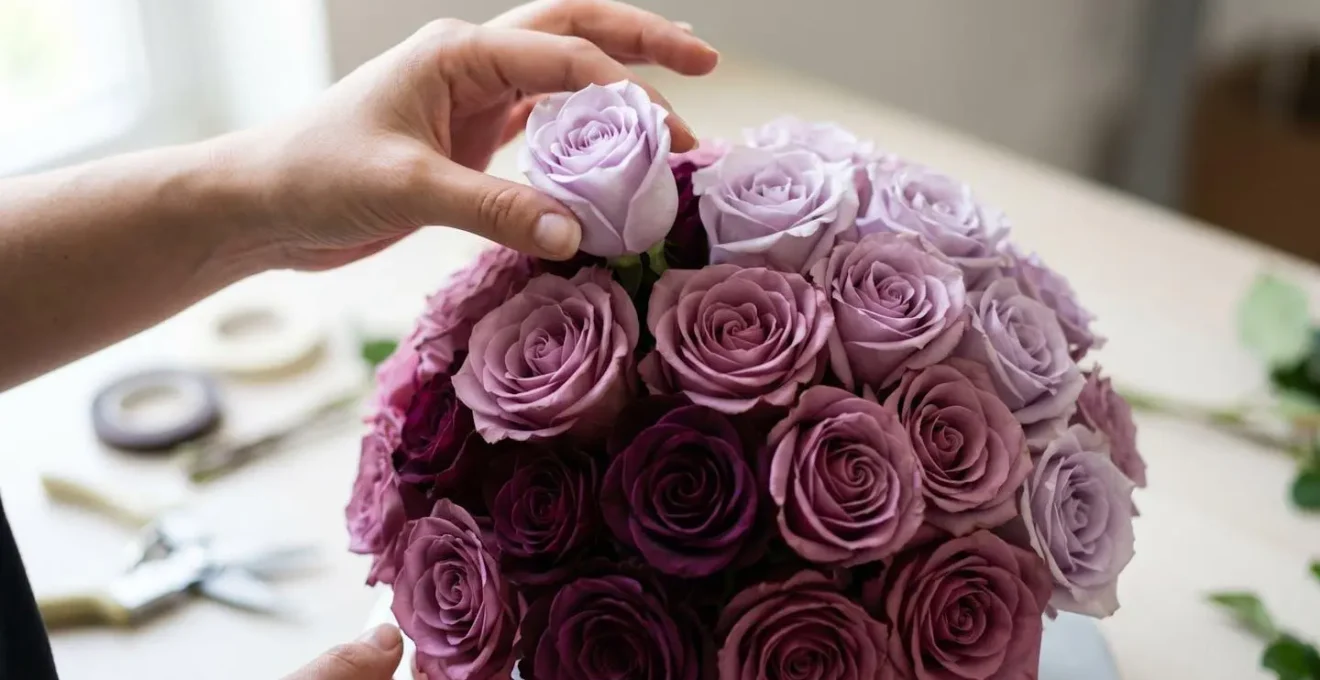
This creates a natural gradient, with the arrangement transitioning from dark to light as it moves from the core to the periphery. This not only ensures visual stability but also creates depth and dimension. The darker flowers in the center appear to recede, while the lighter flowers on the edges seem to come forward, enhancing the dome’s three-dimensional, spherical quality. An arrangement that inverts this rule—placing light flowers at the bottom and dark ones at the top—will always look “wrong,” even if the viewer cannot articulate why.
This is not a stylistic suggestion; it is a fundamental law of composition. A stable visual foundation is as critical as a stable physical one. By concentrating visual weight at the bottom and center, the designer creates a piece that is not only physically balanced but also psychologically satisfying and harmonious to behold.
Key takeaways
- Symmetry is Mathematical: A flawless dome is not a result of artistic flair, but of the disciplined application of the concentric circle technique, creating a geometric blueprint for perfection.
- White is Scientific: The choice of an all-white palette for formal events is rooted in physics; white’s high albedo makes it luminous in low light, a functional choice for elegance.
- Structure is Paramount: The stability of a heavy arrangement depends entirely on unseen mechanics, from a friction-fit foam base to a securely taped grid, ensuring physical integrity.
How to Design a Wedding Ceremony Floral Concept That Ties the Venue Together?
A truly masterful floral concept does not exist in isolation. The principles used to construct a single, perfect dome arrangement must be expanded to address the entire environment. The goal is to create a cohesive aesthetic that ties the venue together, making the floral elements feel like an integral part of the architecture and decor, not a series of disconnected afterthoughts. This is achieved through a strategy of “echo and repeat,” where the main centerpiece acts as the “hero” or anchor piece, establishing the floral vocabulary for the entire space.
This hero arrangement, typically the one on the main dining table or a central welcome table, contains the full “recipe” of flowers, colors, and textures. All other “satellite” arrangements throughout the venue—smaller pieces on sideboards, mantels, or in powder rooms—must then echo this vocabulary. They should be simplified versions, using only two or three key elements from the main recipe. This creates a sense of rhythm and continuity, guiding the eye through the space and reinforcing the central theme.
Cohesion is further strengthened by mirroring elements already present in the room. The material of the urn should echo metallic accents; a silver urn to match wall sconces, a brass one to complement a chandelier. A subtle color from the drapery or upholstery can be introduced as a minor accent in the floral palette. This level of detail creates a bespoke, integrated design. For a formal dining experience, a dome arrangement is a natural focal point for round tables, but its scale must be correct; a height of 8-12 inches is appropriate for a table seating 4-6 guests, allowing for conversation across the table.
To implement this cohesive strategy effectively, a clear plan is essential. The following checklist outlines the “Echo and Repeat” methodology for unifying a room’s design around a central floral concept.
Action plan: Echo and Repeat Strategy for Cohesive Room Design
- Hero arrangement: Position your main dome centerpiece as the ‘anchor’ on the dining table—this sets the floral vocabulary for the entire space.
- Satellite arrangements: Create 2-3 smaller, simplified versions for sideboards, mantels, or powder rooms using only 2-3 key flower varieties from the main dome’s recipe.
- Architectural mirroring: Choose an urn material that echoes metal accents already in the room (brass urn to match chandelier, silver to match sconces).
- Color integration: Incorporate one subtle color from wallpaper, upholstery, or drapery into your floral palette (e.g., hint of blush if room has pink undertones).
- Tablescape cohesion: Match the texture of the urn to the china pattern, or coordinate a specific flower color to napkin fabric for a unified luxury dining experience.
Armed with these non-negotiable principles—from the geometric blueprint and the physics of light to the uncompromising standards of material and the discipline of cohesion—you now possess the knowledge to create an arrangement of true distinction. Your next formal dinner can be defined not just by its menu, but by a floral aesthetic founded on timeless, unimpeachable elegance.