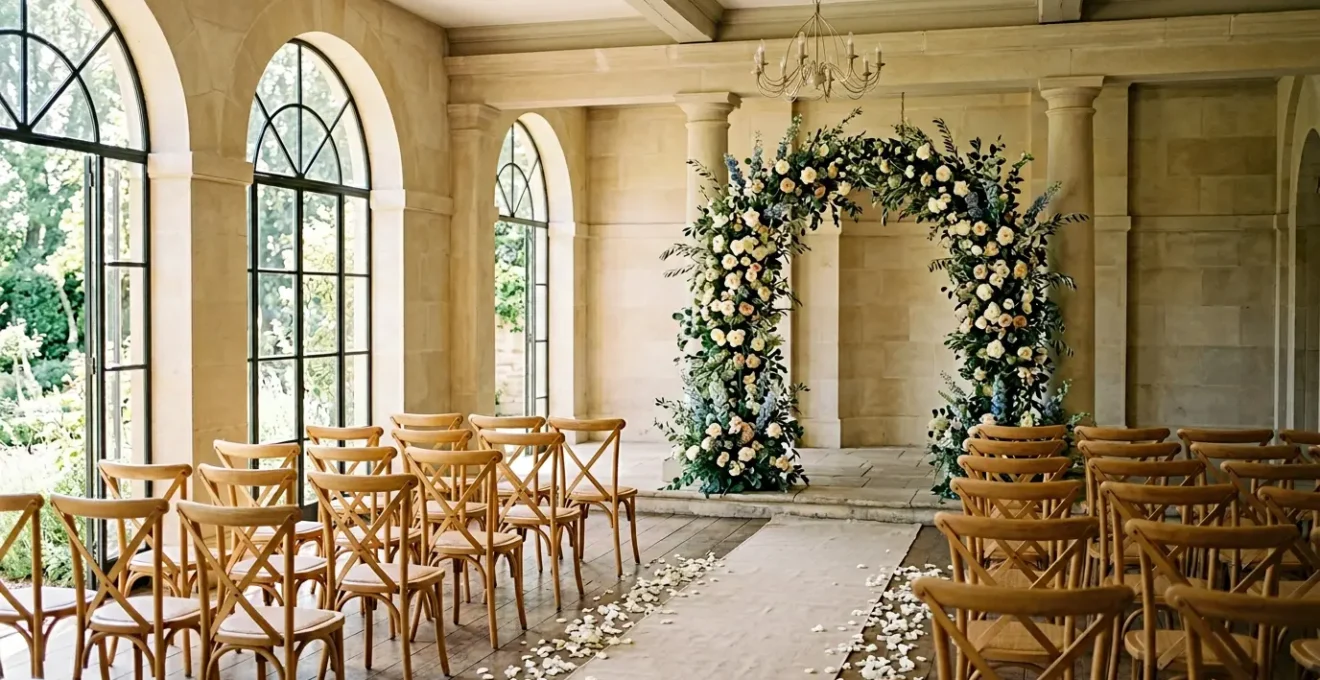
Creating a photogenic wedding floral design isn’t about the flowers you pick, but the visual story you tell with them.
- True cohesion comes from treating florals as architecture that interacts with your venue, not just as decoration.
- Strategic planning for scent, scale, and repurposing is far more impactful than budget alone in achieving a high-end look.
Recommendation: Think like a stylist: start with your venue’s story and build a botanical narrative around it.
The vision is clear: a breathtakingly beautiful ceremony, where every element flows together in perfect harmony. You’ve pinned countless images of lush floral arches and petal-strewn aisles. But when it comes to translating that dream into reality, the advice often falls flat. You’re told to match your colors, consider the season, and maybe reuse some arrangements. These tips, while practical, barely scratch the surface. They treat flowers as isolated accessories rather than what they truly are: the living, breathing thread that can weave your entire venue into a cohesive, atmospheric masterpiece.
The real secret to a wedding floral concept that feels intentional and looks stunning in photographs lies in a shift in perspective. It requires moving beyond simply picking pretty blooms and embracing the role of a design strategist. This involves thinking about floral architecture, the sensory experience, and the logistical choreography behind the scenes. Planning for your florals isn’t a last-minute decision; experts recommend booking your florist 9 to 12 months in advance, precisely because a great concept requires this level of strategic thought. The most common mistake is underestimating how botanicals can sculpt space, guide the eye, and tell a story.
But what if the key wasn’t about having a bigger budget, but a smarter blueprint? What if the most impactful designs aren’t the most expensive, but the most thoughtfully integrated? This guide abandons generic advice to give you a stylist’s framework. We will deconstruct the core principles of creating a unified floral narrative, from scaling your ceremony’s focal point to ensuring the sensory experience is delightful, not overwhelming. We will explore how to make pragmatic choices that maximize beauty and budget, and how to carry that visual story seamlessly from the “I do’s” to the final toast.
This article provides a complete blueprint for thinking about your wedding florals cohesively. From the grand architectural statements to the delicate personal touches, you’ll find the strategies needed to create an unforgettable botanical experience.
Summary: Designing a Cohesive Wedding Floral Concept
- How to Scale Your Floral Arch to Frame the Couple Perfectly?
- Petals or Runners: Which Aisle Decor Withstands the Bridal Train?
- Why Peonies in December Will Blow Your Wedding Budget?
- The Scent Mistake That Makes Guests Faint in Small Chapels
- How to Move Ceremony Flowers to the Reception Without Guests Noticing?
- Teardrop or Waterfall: Which Shape Suits a Ballgown Dress?
- Poppies and Daisies: How to Keep Fragile Wildflowers Alive for a Wedding?
- How to Create Visually Stunning Centerpieces That Don’t Block Conversation?
How to Scale Your Floral Arch to Frame the Couple Perfectly?
The floral arch is more than a backdrop; it’s the primary frame for the most photographed moment of your wedding. Its success hinges on one crucial element: architectural scale. An arch that’s too small gets lost in the venue, while one that’s too large can dwarf the couple. The goal is to create a structure that feels like a natural, intentional extension of the space, drawing every eye to the ceremony’s heart without overwhelming it. This is where principles of design, like the golden ratio, elevate a simple decoration into true floral architecture.
Instead of aiming for perfect, blocky symmetry, a more dynamic and visually pleasing composition often involves asymmetry. By clustering focal blooms slightly off-center and allowing for areas of “negative space” with lighter greenery, you create a natural flow that guides the viewer’s gaze. This technique feels more organic and sophisticated, transforming the arch from a static prop into a dynamic art installation. The arch shouldn’t just sit in the space; it should interact with it.
This close-up of a well-designed arch demonstrates these principles in action. Notice how the main floral cluster is not dead center, and how the design tapers gracefully, creating a visual path that leads the eye across the structure. This is the essence of intentional design.
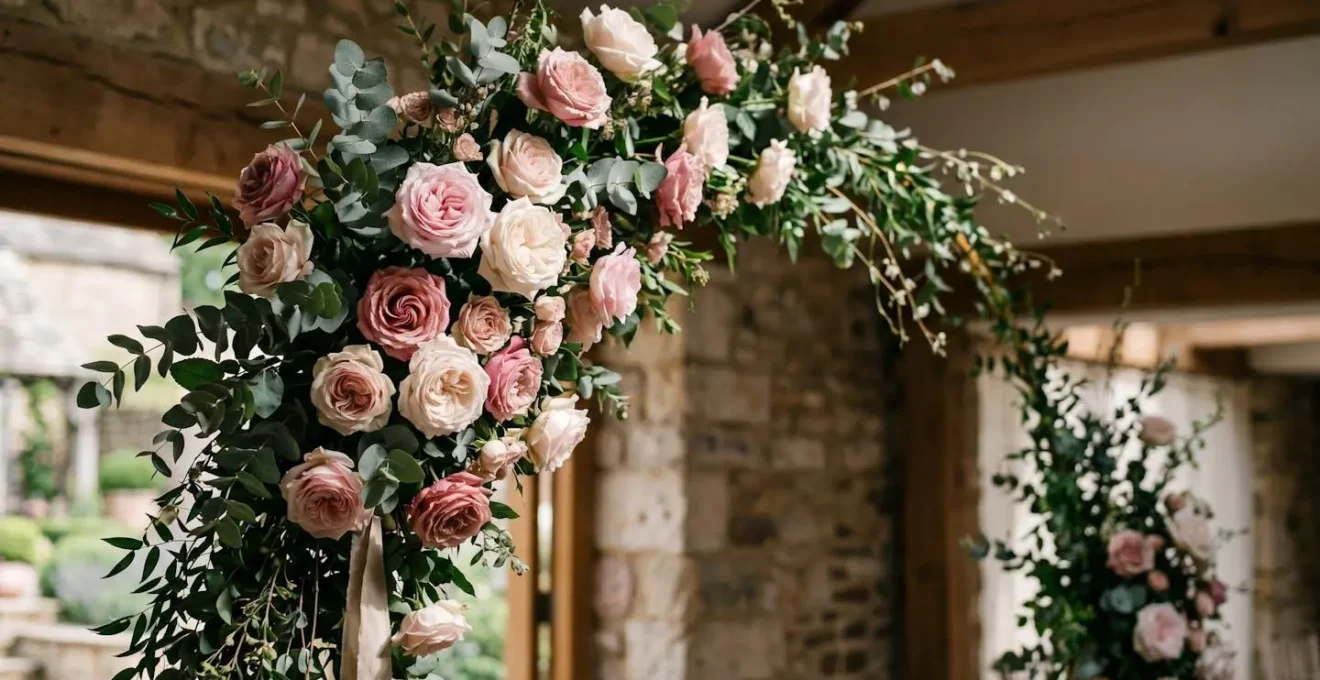
As you can see, the composition feels balanced yet dynamic. The key is to test the design not just from the photographer’s perspective, but also from the guests’ point of view. Ensure that from the front row to the back, the arch frames the couple without obstructing the view of your loved ones. Ultimately, the perfect arch is a harmonious blend of art, mathematics, and the unique character of your chosen venue.
Your Action Plan: Applying the Golden Ratio to Floral Arch Proportions
- Calculate the ideal arch height using the 1.5-1.6 ratio – if your venue ceiling is 12 feet, aim for an 8-foot arch height to create harmonious proportions.
- Position your focal blooms one-third of the way across the arch (not dead center) to follow the golden ratio’s spiral pattern and draw the eye naturally.
- Test the ‘First-Person View’ by standing in guest positions (front row, middle, back) to ensure the arch frames without obstructing sightlines.
- Integrate the arch with existing venue architecture – use pillars, windows, or doorways as structural anchors for a more organic, intentional design.
- Create asymmetry and negative space intentionally – leave open space on one side to draw the eye to the couple more effectively than perfect symmetry.
Petals or Runners: Which Aisle Decor Withstands the Bridal Train?
The aisle is the path that begins your visual narrative, leading guests’ eyes—and the bride—towards the ceremony’s focal point. The choice of decor here is critical, as it must be both beautiful and functional. The classic image of scattered petals is romantic, but in practice, it often fails the durability test. Loose petals are easily disturbed by wind, get crushed by the first members of the bridal party, and can cling to or even stain a delicate bridal train, creating a messy and unpredictable look in photos.
The primary challenge is finding a solution that maintains its integrity from the first bridesmaid to the final “I do.” While loose petals offer a soft, organic feel, their lack of structure is a significant drawback. An alternative gaining favor for its resilience and visual impact is the embedded petal runner. This technique involves securing petals (often high-quality silk for durability and cost-effectiveness) to a fabric base, creating a solid, stable surface that doesn’t shift, blow away, or get trampled into oblivion.
Case Study: The Embedded Petal Technique
To solve the issue of aisle decor destruction, one bride undertook a DIY project that provides a powerful lesson in durability. She created a stunning 28-foot ombre aisle runner by meticulously hot-gluing 10,000 silk petals onto a muslin cloth base. According to her experience shared on a popular wedding forum, this method resulted in a high-impact visual that completely resisted disturbance from the bridal party. The “embedded petal” design prevented the mess of loose petals, was immune to wind, and posed no risk of staining dresses. This approach delivered a premium look for a fraction of the cost of fresh petals and offered a perfectly pristine aisle throughout the entire ceremony.
Comparing the options side-by-side reveals a clear winner for couples prioritizing a flawless, photogenic look. While greenery runners offer a good middle ground, the embedded petal runner provides the best of both worlds: the lush look of petals with the structural integrity of a traditional runner.
| Feature | Loose Petals | Embedded Petal Runner | Greenery Runners |
|---|---|---|---|
| Durability Against Foot Traffic | Poor – destroyed by first bridesmaid | Excellent – glued petals stay in place | Good – smilax and eucalyptus resilient |
| Bridal Train Compatibility | Poor – petals stick to dress, cause staining | Good – smooth surface, minimal snagging | Variable – can snag delicate fabrics |
| Wind Resistance (Outdoor) | Poor – blows away easily | Excellent – secured to backing | Good if properly weighted |
| Cleanup Ease | Difficult – scattered petals everywhere | Easy – roll up in one piece | Moderate – remove in sections |
| Repurpose Potential | None – trampled and unusable | High – can be framed or reused | Moderate – can move to reception |
| Estimated Cost (96-foot aisle) | $200-300 (29,000 fresh petals) | $60-150 (DIY with silk petals) | $150-400 (fresh greenery) |
| Setup Logistics | Requires blocking aisle, last-minute placement | Can be laid hours before ceremony | Best placed 2-4 hours before ceremony |
Why Peonies in December Will Blow Your Wedding Budget?
Few flowers capture the romance of a wedding quite like the peony. Its lush, ruffled petals make it a perennial favorite. However, desire for this bloom often clashes with a hard reality: seasonality. Requesting peonies for a December wedding is a classic example of how a single floral choice can disproportionately inflate your budget. Flowers, like produce, have peak seasons, and demanding them out-of-season comes at a steep premium. Florists must source them from halfway across the world, often South America or New Zealand, incurring significant costs for refrigerated air freight.
This isn’t just a minor price hike. Data on seasonal flower availability shows that out-of-season premium blooms like peonies can command a 200-300% price premium compared to their in-season cost. A stem that might cost $5 in May could easily skyrocket to $15 or even $25 in the winter. Beyond the price, the quality is often compromised. Out-of-season flowers can be smaller, less vibrant, and have a higher mortality rate during transit. This forces florists to order more than needed to account for potential losses, further driving up the final bill for the couple.
This doesn’t mean you have to abandon your dream flower. The secret lies in a strategic, stylist-approved approach: the “Strategic Stem Rule.” Instead of trying to fill every arrangement with expensive, out-of-season peonies, use them surgically. Allocate just a few high-impact stems where they will be most appreciated and photographed—the focal points of your bridal bouquet. For volume and texture elsewhere, lean on luxurious in-season alternatives. Flowers like garden roses or ranunculus can offer a similarly lush, multi-petaled aesthetic at a much more reasonable price point, allowing you to achieve the desired look without decimating your budget. Understanding the true cost components is key to making an informed, strategic choice.
Your Action Plan: Calculating the True Cost of Out-of-Season Flowers
- Factor 1: Per-stem price – Out-of-season peonies in December cost $15-25 per stem compared to $5-8 in May (their natural season).
- Factor 2: Import shipping fees – Flowers must be flown from New Zealand or South America in refrigerated planes, adding significant freight costs.
- Factor 3: Higher mortality rate – Out-of-season blooms have lower quality, smaller sizes, and higher risk of non-delivery due to transit damage.
- Factor 4: Limited color selection – Only standard varieties available off-season; the full range of colors and sub-varieties only exists during peak season.
- The Strategic Alternative – A detailed guide on wedding bouquet costs recommends the ‘Strategic Stem Rule’: incorporate just 3-5 high-cost peonies where they matter most (bridal bouquet focal points) and substitute with in-season garden roses or ranunculus for volume elsewhere, achieving the same lush aesthetic at a fraction of the cost.
The Scent Mistake That Makes Guests Faint in Small Chapels
A cohesive floral concept engages more than just the eyes; it creates a complete sensory experience. Scent is a powerful, often-overlooked element of floral design that can either enhance or completely derail the atmosphere of your ceremony. While the fragrance of fresh flowers is one of their greatest charms, a high concentration of potent blooms in an enclosed, poorly ventilated space can quickly become overwhelming. This is the most common sensory mistake in wedding design, particularly in small, historic chapels or intimate indoor venues.
Certain flowers are notorious for their powerful fragrances. As the team at Luxe Locks Studio points out in their guide to floral selection, some choices carry more risk than others. Their expertise highlights the need for a careful approach to scent.
Blooms like lilies, tuberose, hyacinth, and certain varieties of jasmine carry strong fragrances that can quickly dominate an enclosed space. Heavy floral scents compete with food, trigger headaches, and linger far longer than expected, especially during long ceremonies.
– Luxe Locks Studio, Flowers to Avoid at Your Wedding
The intensity of floral scents is also amplified by environmental factors. Heat and humidity are major culprits; a temperature increase from 65°F to 75°F can make flowers seem 40-50% more fragrant. The solution isn’t to avoid scented flowers altogether, but to create a balanced “Scent Blueprint.” This involves a strategic selection of low-pollen, low-scent flowers for the bulk of your indoor arrangements, saving the more fragrant blooms for open-air spaces or as subtle accents. Flowers like hydrangeas, orchids, and modern rose varieties offer stunning visuals with minimal olfactory impact, making them safe and elegant choices for creating a pleasant atmosphere for all guests, including those with allergies or sensitivities.
Your Action Plan: The Hypoallergenic Floral Index for Enclosed Spaces
- Low-Scent, Low-Pollen Winners: Hydrangeas, ranunculus, orchids (sticky pollen, rarely airborne), most modern roses, lisianthus, calla lilies, and tulips.
- Moderate Scent (Use Sparingly): Garden roses, peonies, freesia, stock, and sweet pea – beautiful fragrance but keep quantities limited in small venues.
- High-Risk Flowers to Avoid in Small Chapels: Oriental and Stargazer lilies (intensely fragrant, trigger migraines), tuberose (overpowering in enclosed spaces), hyacinth (sweet scent causes headaches), gardenias (heavy fragrance despite low pollen).
- Scent Amplification Factors: Temperature above 75°F and humidity above 60% intensify floral scents by 40-50%, so consult with your florist about venue ventilation and climate control.
- The ‘Scent Radius’ Rule: Place potent flowers only in open, high-ceiling areas or outdoor spaces, and pair them with scent-absorbing greenery like eucalyptus to moderate intensity.
How to Move Ceremony Flowers to the Reception Without Guests Noticing?
Maximizing your floral budget while maintaining a cohesive look throughout your wedding day is the hallmark of a brilliant design strategy. The most effective way to achieve this is by planning for your ceremony flowers to have a “second life” at the reception. However, this is not about haphazardly moving a few arrangements. It’s a sophisticated process of logistical choreography that begins in the initial design phase. For the transition to be seamless and invisible to guests, the arrangements must be conceived as modular, multi-purpose pieces from the very start.
This “design-for-movement” philosophy is a game-changer for budget allocation. It allows you to invest in premium, high-impact flowers for the ceremony, knowing they will also serve as key decor elements at the reception. The critical window for this transition is the cocktail hour—a built-in “blind spot” where guests are occupied elsewhere, allowing a dedicated team to execute the move without breaking the event’s magical flow.
Case Study: The Modular Design Method for Dual-Use Florals
Top wedding florists champion the concept of modular design for maximum impact and value. As detailed in expert advice on setting a floral budget, one highly successful approach involves creating ceremony pieces with their repurposing in mind. For example, aisle markers are designed as full, 360-degree arrangements that can be lifted directly onto guest tables as centerpieces. The grand floral arch is constructed in detachable garland sections, which are then used to adorn the reception bar or cake table. Large altar arrangements are specifically designed at the correct height to become decor for the sweetheart or head table. This strategic foresight means the most beautiful and expensive flowers are enjoyed in multiple locations, effectively doubling their value and creating a powerful, unified visual narrative across the entire event.
Executing this requires a detailed plan. A “decoy strategy” is another professional trick: placing one new, dramatic floral installation at the reception entrance captures guests’ attention. Dazzled by this new element, they are far less likely to notice that the aisle arrangements they just walked past are now beautifully gracing their dinner tables. This combination of modular design and psychological redirection ensures the transition is not only efficient but truly invisible.
Your Action Plan: Crafting the Floral Transition Blueprint
- Timeline Detail: Specify exact repurposing window (typically 30-45 minutes during cocktail hour) and assign a dedicated team (coordinator + 2 assistants).
- Movement Map: Create a labeled diagram showing which pieces move where – e.g., ‘8 aisle arrangements → guest tables 1-8, arch garlands → bar backdrop, altar florals → head table.’
- Responsibility Assignment: Designate who moves each element (avoid using bridesmaids; this is a vendor/coordinator task to prevent dress damage).
- Design-for-Movement Specs: Use lightweight, handled containers for aisle pieces; build arch components that detach easily; avoid glued or wired installations that can’t be safely moved.
- The Decoy Strategy: Invest in one new, high-impact floral installation at the reception entrance (that wasn’t at the ceremony) to capture guest attention and make them oblivious to familiar pieces appearing elsewhere.
Teardrop or Waterfall: Which Shape Suits a Ballgown Dress?
The bridal bouquet is the most personal floral element of the day, an extension of the bride’s style and the centerpiece of her ensemble. Its design should not happen in a vacuum. To create a truly cohesive and photogenic look, the bouquet’s shape and scale must be in direct conversation with the silhouette of the wedding dress. For a dramatic ballgown, with its full skirt and fitted bodice, this choice is particularly crucial. The wrong bouquet can create visual clutter or get lost, while the right one balances the gown’s volume and enhances the bride’s overall silhouette.
The two classic contenders for a ballgown are the teardrop and the waterfall bouquet. A teardrop bouquet is more compact and structured, with a rounded top that gently tapers to a point. Its controlled shape complements the formal structure of a ballgown without competing with it. It’s an excellent choice for a bride with a heavily embellished or detailed bodice, as it won’t obscure the gown’s intricate work. Its relatively lighter weight also makes it more comfortable to hold for extended periods.
In contrast, a waterfall bouquet is larger, more dramatic, and features a cascade of flowers and greenery that flows downwards. This style has a visually elongating effect on the torso, which can beautifully balance the volume of a ballgown’s skirt, especially for taller brides. However, its larger size and weight require a stronger grip and it can potentially overwhelm a more petite frame or a gown with a very detailed skirt. The choice between them is a matter of balancing proportion, comfort, and the desired visual effect.
The following analysis breaks down the key considerations, helping you determine which shape will best harmonize with your specific ballgown and personal style.
| Bouquet Shape | Visual Effect with Ballgown | Best for Bride Height | Weight & Comfort | Dress Detail Compatibility |
|---|---|---|---|---|
| Teardrop (Compact) | Complements the dress’s curves, adds formal structure | Petite to Average (5’0″-5’6″) | Lighter (1.5-2 lbs), easier to hold for hours | Perfect for heavily beaded/embellished bodices – won’t compete visually |
| Waterfall (Cascading) | Visually elongates torso, balances voluminous skirt | Tall brides (5’7″+) or those wanting height illusion | Heavier (2.5-4 lbs), requires strong grip | Best with simpler bodices to avoid visual clutter |
| Compact Teardrop | Creates elegant contrast without overwhelming the gown | All heights | Most comfortable for extended holding | Lets dress details shine |
| Airy Waterfall | Softens the formality of a grand ballgown | Average to Tall (5’4″+) | Moderate if built with lightweight stems | Works when dress has minimal embellishment |
| Density Consideration | Compact = structured, formal; Airy = romantic, soft | Choose based on overall wedding formality | Density affects weight significantly | Match density to dress fabric weight |
Poppies and Daisies: How to Keep Fragile Wildflowers Alive for a Wedding?
The trend towards natural, bohemian, and garden-style weddings has brought delicate wildflowers like poppies, daisies, and cosmos into the spotlight. Their ethereal, wispy beauty creates a sense of effortless romance. However, this “effortless” look requires significant technical effort behind the scenes. These fragile stems are notoriously prone to wilting and drooping, especially when out of water for extended periods in bouquets and boutonnieres. Keeping them vibrant from the first photo to the last dance requires a professional-level conditioning process known as “hardening off.”
Unlike hardy roses or carnations, wildflowers have delicate vascular systems that lose moisture rapidly. The key to their survival lies in maximizing their hydration before they are ever arranged and providing a hidden water source throughout the day. For hollow-stemmed flowers like poppies, this involves a crucial first step: stem searing. Briefly exposing the cut end to a flame or dipping it in boiling water cauterizes the stem, locking in moisture and preventing the rapid wilting they are famous for. This is a non-negotiable step for ensuring their longevity.
This macro photograph captures the delicate, almost translucent texture of a wildflower stem. It serves as a visual reminder of their fragility and the critical importance of proper hydration techniques to preserve their beauty.
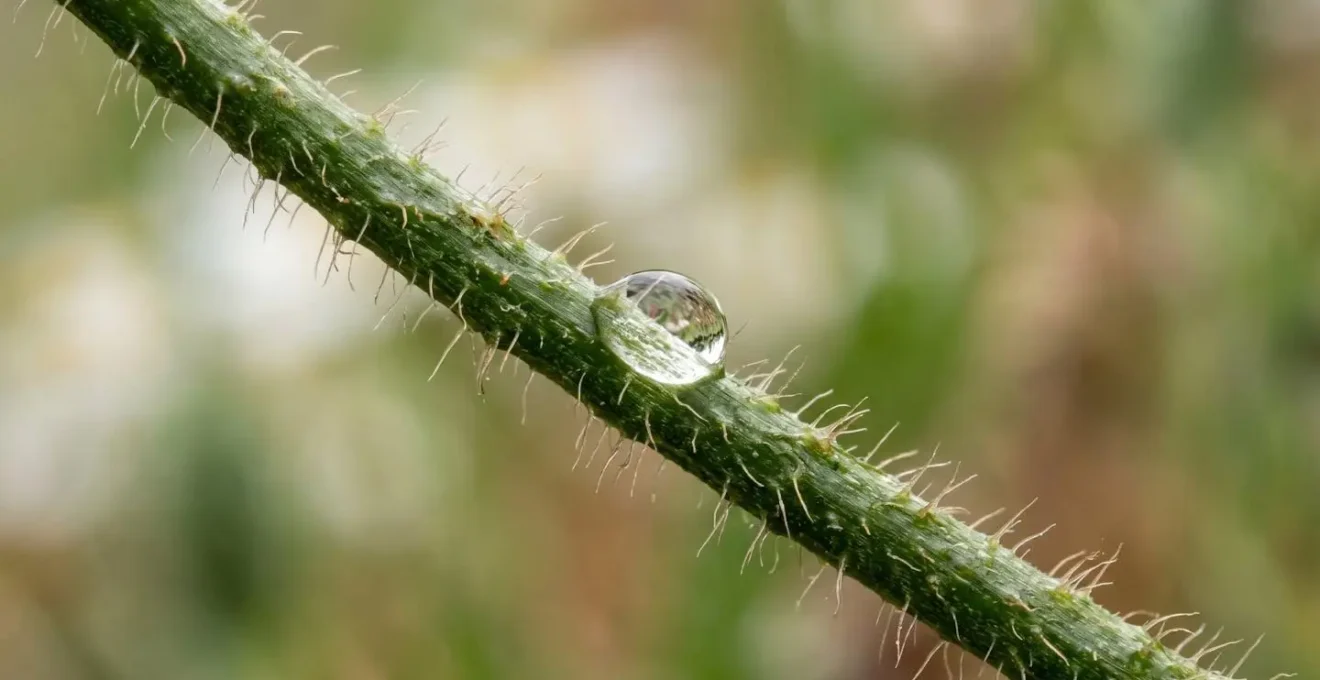
Beyond the initial preparation, a multi-step hydration strategy is essential. This includes a long, cool water soak to allow the stems to drink deeply, and the clever use of hidden water vials or water-soaked cotton within the arrangements themselves. Timing is also paramount. The most delicate blooms should be the very last elements added to any arrangement, ideally on the morning of the wedding, to ensure they are at their absolute peak for the ceremony.
Your Action Plan: Professional Florist’s Hardening Off Process for Delicate Stems
- Step 1 – Stem Sealing (for poppies): Sear the cut end of poppy stems with a flame or dip in boiling water for 3-5 seconds immediately after cutting to seal in moisture and prevent wilting.
- Step 2 – Deep Hydration Soak: Give wildflowers a 24-hour cool water soak in a dark, cool location (55-65°F) before arranging to fully hydrate stems.
- Step 3 – Hidden Hydration System: Incorporate tiny water vials (aqua picks) or water-soaked cotton wrapped in floral tape into bouquets and boutonnieres to provide constant water source for fragile blooms.
- Step 4 – Strategic Placement by Durability: Use hardy yarrow and solidago for boutonnieres and ceremony pieces; reserve delicate cosmos and poppies for table arrangements with direct water access.
- Step 5 – Timing Protocol: Arrange the most fragile wildflowers (daisies, poppies) as close to ceremony time as possible – ideally morning-of for afternoon weddings – to maximize freshness and prevent drooping.
Key Takeaways
- Design with Architecture in Mind: The scale and proportion of your floral arrangements, especially the arch, should complement your venue’s architecture, not just fill space.
- Prioritize Durability for Key Moments: For high-traffic areas like the aisle, choose robust solutions like embedded petal runners over fragile, loose petals to ensure a pristine look.
- Master the ‘Strategic Stem’ Rule: Use expensive, out-of-season flowers surgically in high-visibility items (like the bridal bouquet) and fill volume with beautiful, in-season alternatives to manage your budget without sacrificing style.
How to Create Visually Stunning Centerpieces That Don’t Block Conversation?
The visual narrative that began at your ceremony culminates at the reception, with the centerpieces serving as the primary anchor of your tablescape design. The challenge here is to create something visually stunning and cohesive with your overall theme, without committing the cardinal sin of event design: blocking conversation. A centerpiece, no matter how beautiful, fails if it erects a floral wall between your guests, forcing them to lean awkwardly to speak with the person across from them.
The solution lies in creatively managing height and volume. The golden rule for conversation-friendly design is to keep arrangements outside of the critical sightline zone. This means your primary floral mass should be either very low (under 12 inches) or very high (above 24 inches). Anything in between is a guaranteed obstruction. This principle opens the door to several sophisticated design methods that deliver high impact without sacrificing guest experience.
The “Airy & Elevated” technique is a perfect example of this. By using slender, almost invisible stands to elevate a lush floral arrangement well above eye level, you create a breathtaking “floating garden” effect. This delivers the drama and scale of a tall centerpiece while maintaining a completely open and airy sightline underneath, encouraging connection and conversation.
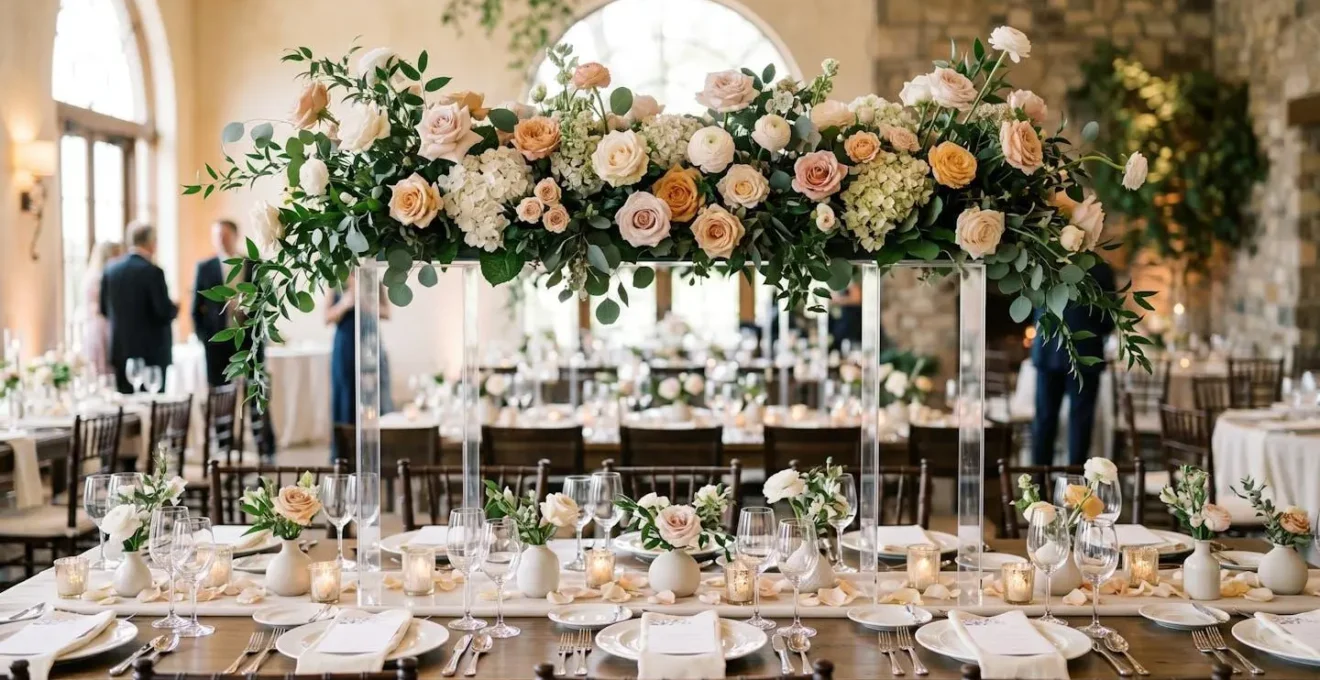
Alternatively, the “Multi-Level Satellites” approach forgoes a single focal point in favor of a curated landscape. A collection of small bud vases, single stems, and very low arrangements woven between candlelight creates a rich, textured tablescape that feels intimate and organic. This method is particularly effective on long, rectangular tables, where it creates a continuous floral moment down the length of the table without a single point of obstruction. Both methods prove that stunning design and social interaction can, and should, coexist beautifully.
Your Action Plan: The Multi-Level Tablescape Design Method
- Technique 1 – Airy & Elevated: Use slender, almost invisible stands (clear acrylic or thin metallic rods 18-24 inches tall) to elevate the main floral mass well above eye level, creating a ‘floating garden’ effect with clear sightlines underneath.
- Technique 2 – Multi-Level Satellites: Forgo a single centerpiece for a curated collection of very low arrangements (4-6 inches tall), bud vases, and single stems woven between candles, creating a lush landscape.
- Technique 3 – Architectural Bridge Arrangements: For rectangular tables, use long, low structures (8-10 inches tall max) that span the table length, creating high visual impact without central height obstruction.
- Technique 4 – Interactive Deconstruction: Design centerpieces made of multiple small bud vases or potted plants with a sign inviting guests to take one home, allowing the centerpiece to gracefully diminish as the night progresses.
- Sightline Test: When seated, guests should be able to make direct eye contact with the person across the table – keep central arrangements below 12 inches or above 24 inches to ensure this.