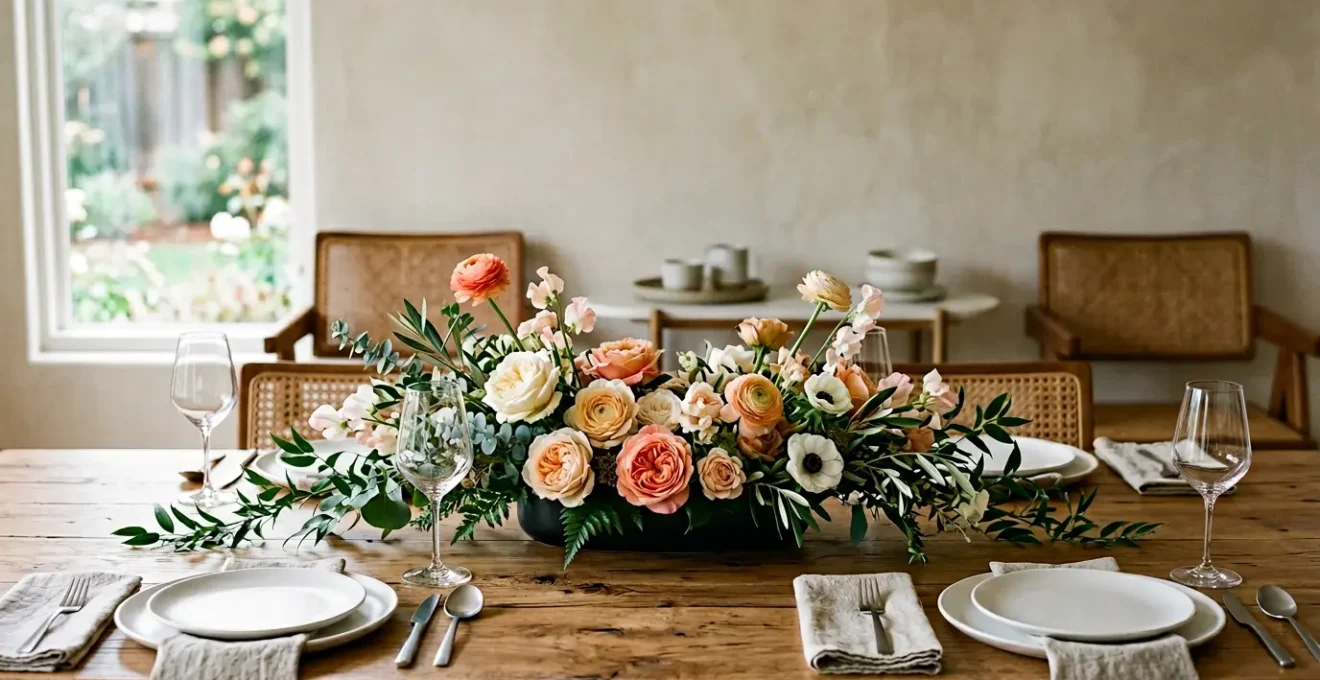
The greatest frustration for any host is a beautiful centerpiece that kills conversation; the solution is to think like an architect, not just a decorator.
- Effective centerpieces use principles of visual rhythm and horizontal design to create impact without obstructive height.
- Scent is a critical design element; overpowering floral fragrances can negatively impact the taste of food, while culinary herbs can enhance it.
Recommendation: Shift your focus from creating a single, tall arrangement to designing a low-profile “tablescape” system that guides the eye and facilitates connection between your guests.
As a host, you orchestrate an experience. You’ve planned the menu, curated the playlist, and set the lighting. Then comes the final touch: the centerpiece. The classic dilemma immediately arises. You crave a lush, ‘wow-factor’ arrangement, but you also know the cardinal sin of tablescaping is a floral fortress that forces guests to play peek-a-boo all night. The common advice is to simply “go low,” but this often leads to uninspired, flat designs that lack the very drama you hoped to create. It seems you must choose between beauty and practicality.
But what if this is a false choice? What if the secret to a stunning, conversation-friendly centerpiece isn’t about sacrificing height, but about rethinking its fundamental purpose? The most successful tablescapes move beyond a single object in the middle of the table. They function as a complete visual system, an architectural element designed to manage sightlines, guide the eye with color and rhythm, and even enhance the gastronomic experience through thoughtful scent-scaping. It’s about creating impact horizontally, not just vertically.
This guide will walk you through the expert principles of creating centerpieces that are both breathtakingly beautiful and perfectly practical. We will explore the psychology of color, the architectural strategy for long tables, the art of layering light, and even the historical language of flowers. Prepare to abandon the idea of the lone, bulky vase and embrace the art of the connected, engaging tablescape.
To help you master this art, this article is structured to guide you from foundational principles to advanced techniques. Explore the sections below to build your expertise step by step.
Summary: The New Rules of Centerpiece Design
- Why Does the Eye Drawn to Red Flowers First on a Table?
- How to Design a Centerpiece for a Long Rectangular Table?
- Votives or Tapers: Which Candle Style Enhances Floral Centerpieces Safely?
- The Fragrance Error That Ruins the Taste of Your Dinner
- How to Assemble a Stunning Centerpiece in Under 15 Minutes?
- What Is the Concentric Circle Technique in Formal Arranging?
- Monochrome or Contrast: What Suits a Patterned Living Room Best?
- Why Did Victorians Fear Sending the Wrong Flower Message?
Why Does the Eye Drawn to Red Flowers First on a Table?
Before considering height or shape, a designer considers a more powerful tool: color. Our eyes are biologically programmed to notice certain colors first, and red sits at the top of this hierarchy. It has the longest wavelength of all colors, triggering a strong, immediate physiological response. On a dinner table, a splash of red acts as a psychological anchor, creating a focal point without a single inch of obstructive height. It’s a way to command attention and create drama in a low-profile, horizontal plane.
Using a color like deep crimson or vibrant scarlet allows you to create visual weight and importance in an arrangement that stays well below eye level. It draws the gaze downward, along the table, rather than upward into a guest’s line of sight. This is the essence of the “psychological sightline”—you are directing your guests’ attention through strategic color placement, proving that visual impact is not solely dependent on vertical scale. A few perfectly placed red blooms can have more presence than a much larger, paler bouquet.
Think of it as visual punctuation. Amidst the neutral landscape of linens, plates, and glassware, a pop of red provides energy and a clear center of gravity for the entire tablescape. It tells the eye where to look without needing to shout. This principle is your first step in moving away from the “bigger is better” mindset and toward a more intelligent, psychologically-driven approach to design.
How to Design a Centerpiece for a Long Rectangular Table?
A long rectangular table presents a unique architectural challenge. A single, central arrangement often feels lost and inadequate, while a continuous, bulky garland can feel like a wall dividing your guests. The expert solution is to abandon the idea of a single centerpiece and embrace the concept of visual rhythm. This involves creating a series of smaller, coordinated arrangements or “vignettes” that are strategically placed down the length of the table. This approach leads the eye on a journey, creating interest and flow without a constant physical barrier.
These vignettes don’t have to be identical. In fact, they are more effective when they vary slightly in composition and container, while sharing a cohesive floral palette. This “theme and variation” approach adds a layer of sophistication. You might alternate between low floral arrangements, clusters of candles, and small bowls of fruit or other textural elements. The key is the intentional negative space between each element, which provides visual breathing room and, crucially, space for shared dishes and wine bottles. This is horizontal architecture in practice.
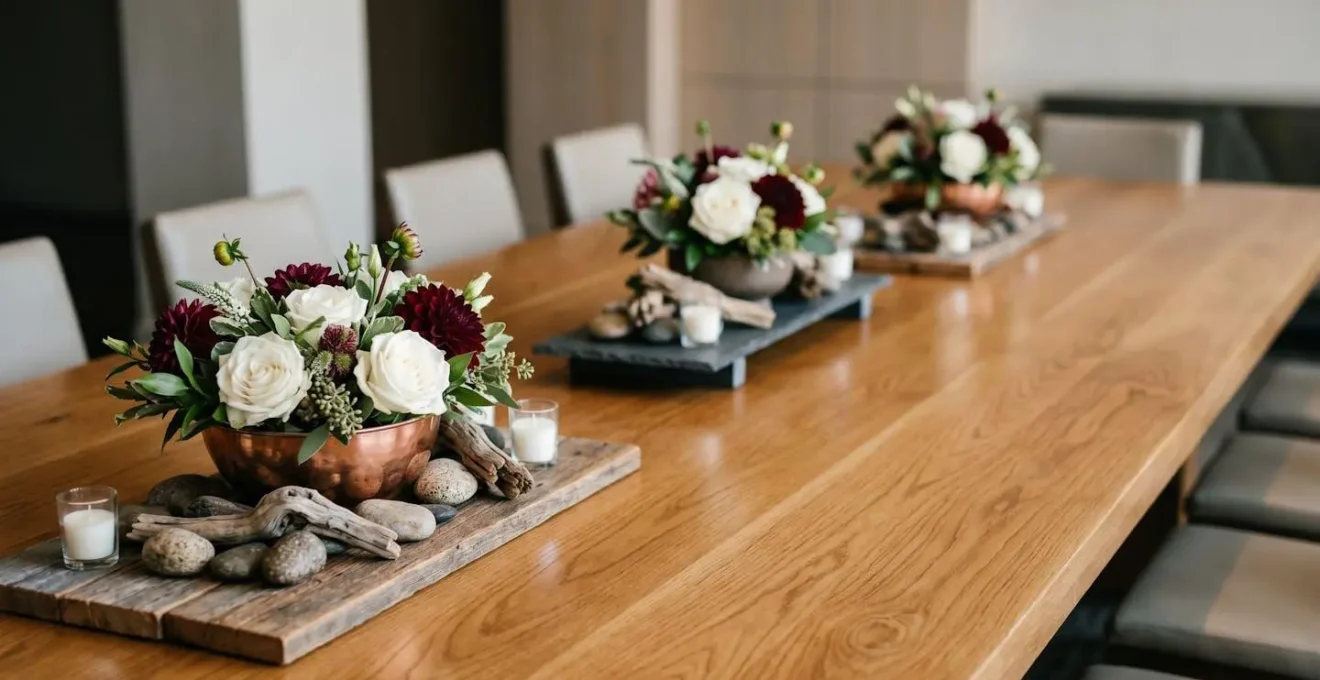
The width of your table is a critical factor in this strategy. A wider table allows for more lush, complex vignettes, while a narrower one demands a more streamlined approach. Here are some professional guidelines:
- For 30-inch wide tables: Use streamlined, narrow centerpieces to maximize guest space while maintaining elegance. Think single bud vases or very small arrangements.
- For 36-inch wide tables: Stagger small to medium floral arrangements, varying heights with a mix of pillar candles, tapers, and votives to create depth.
- For 40-inch wide tables: You have space for lush, full floral centerpieces. This is the ideal width for combining different candle styles within the floral design.
- A critical warning: Avoid continuous, solid garlands on any table narrower than 40 inches. They consume the entire center and leave no functional space for a convivial dining experience.
Votives or Tapers: Which Candle Style Enhances Floral Centerpieces Safely?
Candlelight is non-negotiable for atmosphere, but the choice between tall, elegant tapers and low, intimate votives directly impacts your tablescape’s functionality. The answer isn’t to choose one over the other, but to use them in a layered, strategic way. Tapers provide wonderful vertical drama and a sense of occasion, perfect for when guests arrive and during the first course. However, their height can become an issue. As the experts from the HGTV Design Team memorably state:
Keep your centerpiece tall and thin or below eye level so that your guests are talking to each other instead of the flowers.
– HGTV Design Team, Kitchen Table Centerpiece Design Ideas
This quote perfectly captures the balance. Tapers work when they are “tall and thin,” placed in slender holders that create minimal obstruction. To maximize both safety and sightlines, enclosing tapers in tall glass cylinders or hurricane lamps is an elegant solution. It contains the flame and smoke while maintaining the beautiful vertical line. A crucial safety rule is to ensure no flame can ever contact flammable materials like overhanging greenery.
A sophisticated hosting strategy involves a transition of light. After the first course, the tall tapers can be extinguished and removed, replaced or supplemented by low-profile votives scattered among the arrangements. This lowers the light, creating a more intimate, conspiratorial atmosphere perfect for the main part of the dinner conversation. This layered approach gives you the best of both worlds: initial drama followed by practical intimacy.
- Start with tapers: Use them for initial drama during cocktail hour and the first course.
- Ensure safety: Use hurricane lamps or ensure ample clearance from greenery. Consider high-quality battery-operated options for a worry-free experience.
- Transition to votives: Switch to or add low votives after the first course to create a warm, intimate glow that encourages conversation.
The Fragrance Error That Ruins the Taste of Your Dinner
One of the most overlooked—and most grievous—errors in centerpiece design is a sensory one. A host might choose stunningly beautiful flowers like lilies, hyacinths, or gardenias, only to find their powerful, perfumed fragrance is competing with the aroma of the food. This isn’t just a matter of conflicting smells; it’s a scientific phenomenon. Our senses of smell and taste are inextricably linked through a process called retronasal olfaction. A strong ambient scent can literally change how we perceive flavor.
This is not an exaggeration. High-end restaurants and professional wine tastings strictly control ambient odors for this very reason. When a strong floral perfume fills the air, your brain can’t easily separate it from the food you’re eating. The result? Your carefully prepared roast chicken might take on a confusingly floral note. In fact, research has found that flavor perception varied by up to 50% based solely on the fragrance cues in the environment. Ignoring this is a disservice to your cooking and your guests’ palates.
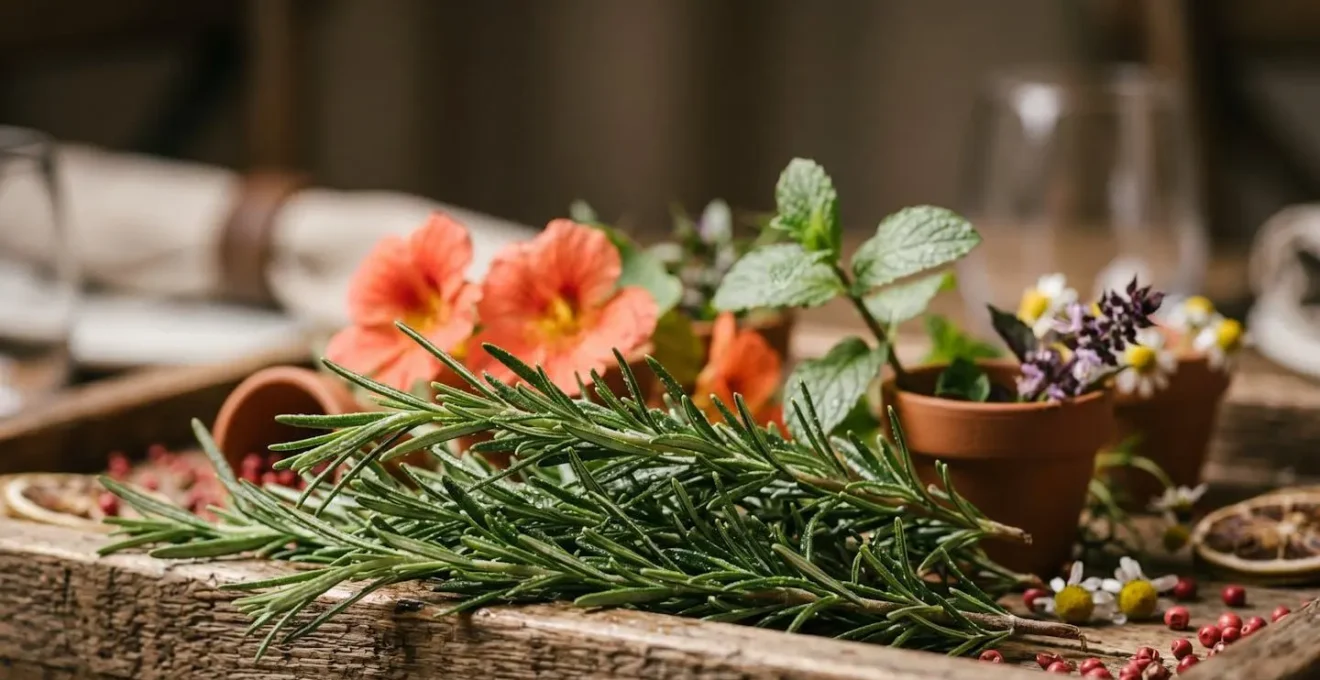
The solution is not to abandon botanicals, but to practice thoughtful “scent-scaping.” Instead of heavily perfumed blooms, opt for flowers with little to no fragrance, such as dahlias, tulips, anemones, or ranunculus. Better yet, create a gastronomic centerpiece by incorporating elements that complement the meal. A low arrangement featuring fresh culinary herbs like rosemary, thyme, and basil, or even edible flowers like nasturtiums and pansies, creates a beautiful, aromatic experience that actively enhances the flavors on the plate rather than clashing with them.
How to Assemble a Stunning Centerpiece in Under 15 Minutes?
A show-stopping centerpiece doesn’t need to take hours to create. With a bit of preparation—what floral designers call “mise en place”—you can assemble a lush, professional-looking arrangement in under 15 minutes. The key is to have all your flowers pre-cut and conditioned, and your vessel (like a low, rectangular trough) filled with water and a floral grid (using tape or a flower frog). When you’re ready to assemble, you simply follow a clear, step-by-step formula that builds the arrangement logically from structure to finish.
This process is about layering textures and forms in a specific order. You start by creating the shape with greenery, then add your main “focal” flowers to establish the design’s heart. After that, you fill in with secondary “face” flowers and add linear elements for shape, finishing with light filler to cover any gaps. It’s a method that ensures balance, depth, and a polished look without any guesswork. For example, using filler flowers like baby’s breath strategically to break up solid masses of green is an expert move, whereas using them in large clumps can look dated. The goal is efficiency and high impact.
Action Plan: The 15-Minute Centerpiece Formula
- Establish Shape (2 mins): Start with longer greenery pieces (like eucalyptus or leather leaf) at the ends of your vessel to define the length. Keep the width to a slim 4-5 inches.
- Build Greenery Base (3 mins): Layer in a second greenery variety with a different texture (like salal) to create depth and cover your floral mechanics.
- Place Focal Flowers (3 mins): Add your largest, most important blooms (like dahlias or protea) first. Use them sparingly (2-3 is enough) to create the main points of interest.
- Add Face Flowers (4 mins): Work in groups of three when placing secondary flowers like roses. Distribute them evenly, varying stem lengths slightly to create a natural look.
- Fill and Finish (3 mins): Use light spray flowers or filler (like waxflower) to fill any remaining gaps and break up solid masses. This is the final touch that makes the arrangement look full and complete.
What Is the Concentric Circle Technique in Formal Arranging?
The concentric circle technique is a classic principle of formal floral design, traditionally used to create large, round, vertical arrangements. The concept is simple: you start with a central flower or a tight cluster of blooms, then add successive “rings” of different flowers radiating outwards, like ripples in a pond. Each ring typically features a different type of flower, texture, or color, creating a highly structured and visually dense composition. This method provides a clear framework for achieving balance and harmony in complex bouquets.
While its origins are in tall, formal pieces, the true genius of this technique lies in its adaptability. A savvy designer can deconstruct this vertical principle and apply it to create a stunning horizontal centerpiece that is perfectly conversation-friendly. Instead of building upwards, you build outwards on a flat plane. You start with a central element—perhaps a single, perfect rose in a tiny bud vase—and then radiate circles of other elements around it directly on the table surface. The outer “rings” could be composed of scattered petals, a circle of votive candles, or a ring of smaller flower heads.
This horizontal application is the perfect solution for hosts who want formal structure and elegance, but without the height. It creates a captivating, top-down view for guests looking at the table, a principle central to French wedding design methodologies. A real-world example demonstrates this perfectly.
Case Study: The Horizontal Concentric Centerpiece
For a wedding at the Angel Orensanz Foundation, a bride re-imagined the concentric technique for long rectangular tables. A line of five sleek cylinder vases was placed down the center of each table. Each vase held a single white rose as the focal point. This central line was then flanked by rows of additional roses radiating outward, forming the inner ‘rings.’ The outermost ‘ring’ was created by a series of glowing votive candles. This brilliantly adapted a classic vertical technique into a low-profile, architectural design that was both modern and conversation-friendly.
Monochrome or Contrast: What Suits a Patterned Living Room Best?
While the title references a living room, this principle of harmony applies directly to the dining table, specifically when you’re working with a patterned tablecloth. A patterned cloth is already a strong design statement, and your centerpiece must either complement it or deliberately contrast with it. The wrong choice can lead to a visually chaotic and jarring tablescape. Your decision between a monochrome or contrasting floral arrangement depends entirely on the effect you wish to achieve: calm sophistication or vibrant energy.
A monochromatic approach is the safest and often most elegant choice. This involves selecting flowers in a single color family, preferably one pulled directly from the pattern on the tablecloth. For example, on a blue and white toile fabric, a simple arrangement of all-white tulips or hydrangeas creates a serene, cohesive look. The centerpiece becomes a quiet, textural extension of the linen, adding sophistication without competing for attention. This strategy allows the pattern of the cloth to remain the star of the show.
Conversely, a contrasting approach can be highly effective if done with intention. This means choosing a floral color that is opposite the dominant color of the tablecloth on the color wheel (e.g., yellow flowers on a purple-patterned cloth). This creates a bold, energetic, and high-impact statement. This choice is best for festive, less formal occasions. The key is confidence. The contrast should feel deliberate and sharp. A weak or “muddy” contrast will just look like a mistake. Ultimately, a crisp white tablecloth remains the most versatile canvas, allowing any centerpiece to shine without conflict.
Key Takeaways
- The best centerpieces facilitate conversation by using horizontal architecture and visual rhythm, not vertical height.
- Scent is a crucial design element; avoid heavily perfumed flowers that compete with food and consider using culinary herbs instead.
- Mastering a quick assembly formula and adapting classic techniques (like concentric circles) horizontally are expert-level skills for any host.
Why Did Victorians Fear Sending the Wrong Flower Message?
Today, we choose flowers for our table based on color, shape, and seasonality. But in the 19th century, the choice of a bloom carried a much heavier weight. During the Victorian era, strict social etiquette discouraged open expressions of emotion, especially those concerning love and desire. In this constrained environment, a complex and secret language emerged: floriography, the language of flowers. A simple bouquet, or “tussie-mussie,” was not just a decoration; it was a coded message.
Floral dictionaries became popular, assigning specific meanings to different flowers. A red rose might mean passionate love, while a yellow one could signify jealousy. The fear of sending the wrong message was very real. A suitor could accidentally insult a potential partner, or a lady could unintentionally signal encouragement where none was intended. Because dictionaries sometimes disagreed on meanings, the risk of misinterpretation was high, adding a layer of thrilling-but-dangerous subtext to social interactions. This floral code was a vital form of communication in a society where direct conversation about feelings was taboo. In fact, historical records indicate the fervor for floriography was strongest during the 63-year period of the Victorian era, from 1837 to 1901.
While we no longer rely on floriography for covert communication, this piece of history reminds us that flowers have always been more than just decoration. They carry inherent meaning and emotion. Thinking about this history can add a new layer of intention to your own choices. Selecting flowers not just for their beauty, but for the subtle, unspoken message they might convey—of celebration, of friendship, of welcome—connects your modern dinner party to a long and fascinating tradition of floral symbolism.
By moving beyond the simple idea of a floral decoration and embracing these principles of architecture, psychology, and sensory design, you can transform your table from a simple dining surface into a dynamic and engaging environment. Your centerpiece will no longer be an obstacle to overcome, but the very element that brings the entire experience together, sparking joy and connection among your guests.