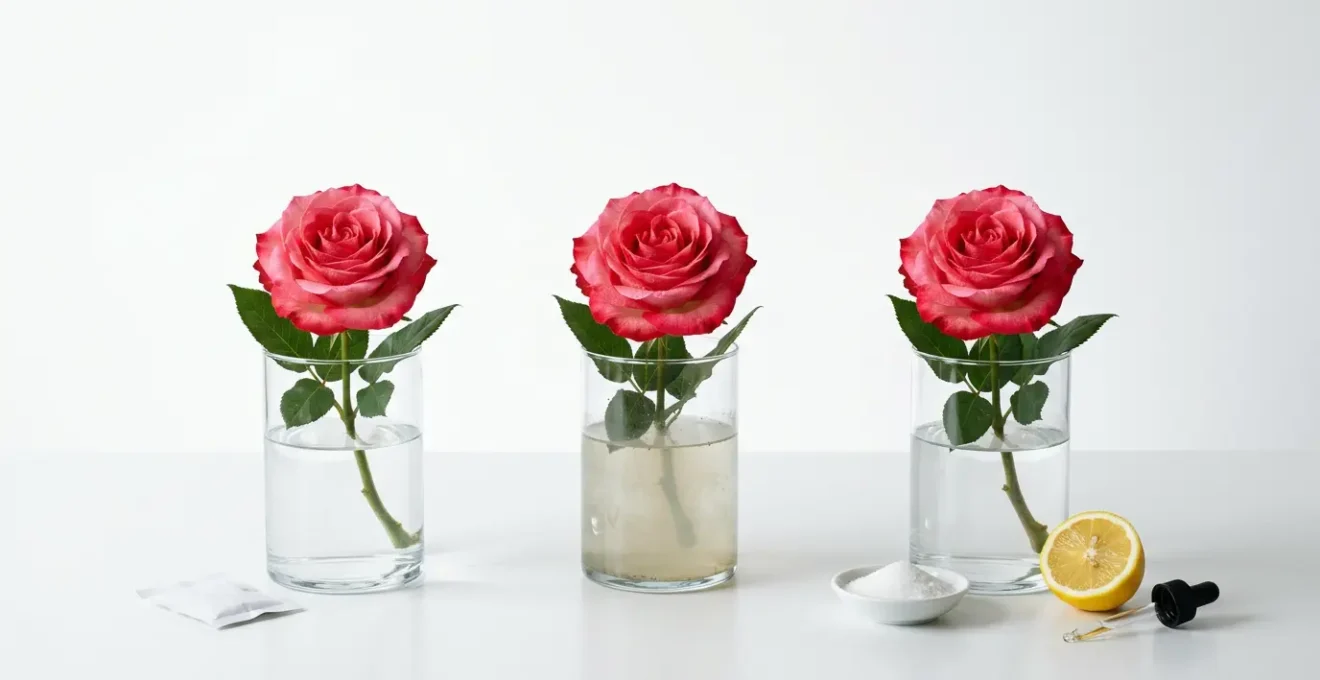
The effectiveness of any flower food—commercial or DIY—hinges not on the ingredients themselves, but on their precise chemical balance and concentration.
- Sugar provides energy, but in excess, it fuels bacterial growth and causes cellular damage.
- Acidifiers optimize water uptake by lowering pH, while biocides are non-negotiable for preventing stem-clogging bacteria.
Recommendation: Treat flower care as a chemical process. Use formulated packets as directed or, if creating a DIY solution, measure ingredients with precision to avoid doing more harm than good.
The sight of a vibrant bouquet slowly wilting on the counter is a familiar disappointment. In an effort to prolong its life, many turn to a mix of household wisdom and online hacks: a spoonful of sugar, a capful of bleach, a spritz of lemon juice, or even a copper penny. These methods are often presented as clever alternatives to the small, mysterious packet of powder that accompanies a professionally arranged bouquet. But are they based on sound science, or are they merely floral folklore?
The fundamental issue with most DIY approaches is not the choice of ingredients, but the complete lack of dosage control. The question isn’t whether sugar can feed a flower, but how much sugar is too much. The debate isn’t about bleach versus vodka, but about achieving the correct concentration of a biocide to inhibit microbial growth without poisoning the plant. The longevity of cut flowers is not an art; it is a science of chemistry, governed by principles of nutrition, hydration, and sanitation.
This analysis moves beyond the myths. We will dissect the chemical function of each core component of flower food, examining the precise mechanisms by which they work—or fail. By adopting the mindset of a chemical analyst, we will evaluate the role of carbohydrates, the importance of pH levels, the efficacy of biocides, and the critical, often-overlooked danger of incorrect concentrations. This is a factual investigation into what truly keeps flowers fresh, proving that in vase water chemistry, dosage is everything.
To provide a clear and structured analysis, this guide breaks down the science behind each component of flower food. We will examine the function and, crucially, the correct application of each ingredient to maximize the vase life of your cut flowers.
Contents: A Chemical Breakdown of Flower Food
- Why Do Flowers Need Sugar to Open (And How Much is Too Much)?
- Why Does Lemon Juice Help Water Travel Up the Stem?
- Bleach or Vodka: What Best Kills Bacteria in Flower Water?
- Is Penny-Pinching on Flower Food Costing You Blooms?
- The Leaf Burn Effect: What Happens When You Add Too Much Food?
- The Sugar Myth That Causes Bacteria Growth in Your Vase
- The Ice Cube Myth That Shocks Orchid Roots to Death
- How to Resuscitate Wilted Hydrangeas in Under 3 Hours?
Why Do Flowers Need Sugar to Open (And How Much is Too Much)?
Once a flower is cut from its parent plant, it is severed from its primary energy source, which it generates through photosynthesis. To continue the metabolically demanding process of opening its buds and maintaining its cellular structure, it requires an external source of carbohydrates. This is the primary role of sugar (typically sucrose or dextrose) in a flower food solution. It serves as a direct energy supply to fuel cellular respiration, allowing the blooms to develop fully and maintain their turgidity.
However, the concentration of this sugar is a critical factor. The common “a spoonful of sugar” advice is dangerously imprecise. Horticultural science provides a much clearer directive. For instance, research from UMass Extension indicates that a 2% continuous sugar supply is optimal for many species, providing adequate energy without adverse effects. This translates to about 20 grams of sugar (roughly 4 teaspoons) per liter of water—a far more exact measurement than a random scoop.
The danger of excessive sugar cannot be overstated. When the sugar concentration in the vase water is too high, it creates a hypertonic environment. This triggers a phenomenon known as osmotic stress, where water is actually drawn out of the flower’s cells, leading to dehydration, wilting, and cellular death. A 2025 study on roses found that solutions with high glucose levels (15%) caused accelerated wilting. This is because, beyond causing osmotic stress, high sugar levels create the perfect breeding ground for bacteria, which clog the stem’s vascular system and further impede hydration.
Why Does Lemon Juice Help Water Travel Up the Stem?
The ability of a cut flower to stay fresh is fundamentally linked to its ability to draw water up its stem. This process occurs through a network of microscopic tubes called the xylem. However, for water to move efficiently through this vascular system, the water’s pH must be in an optimal range. Tap water is often neutral or slightly alkaline (pH 7.0 or higher), which is not ideal for water uptake in most cut flowers. This is where an acidifier, like the citric acid found in lemon juice, plays a crucial chemical role.
Adding an acidifier lowers the pH of the vase water. Research indicates that cut flowers absorb water most effectively in an optimal pH range of 3.0 to 5.0. At this acidic level, the water molecules are more readily able to move through the xylem, a process driven by cohesion and adhesion. By optimizing the water’s pH, you are essentially “unblocking” the pathways and facilitating maximum hydration, which helps keep petals firm and prevents premature wilting.
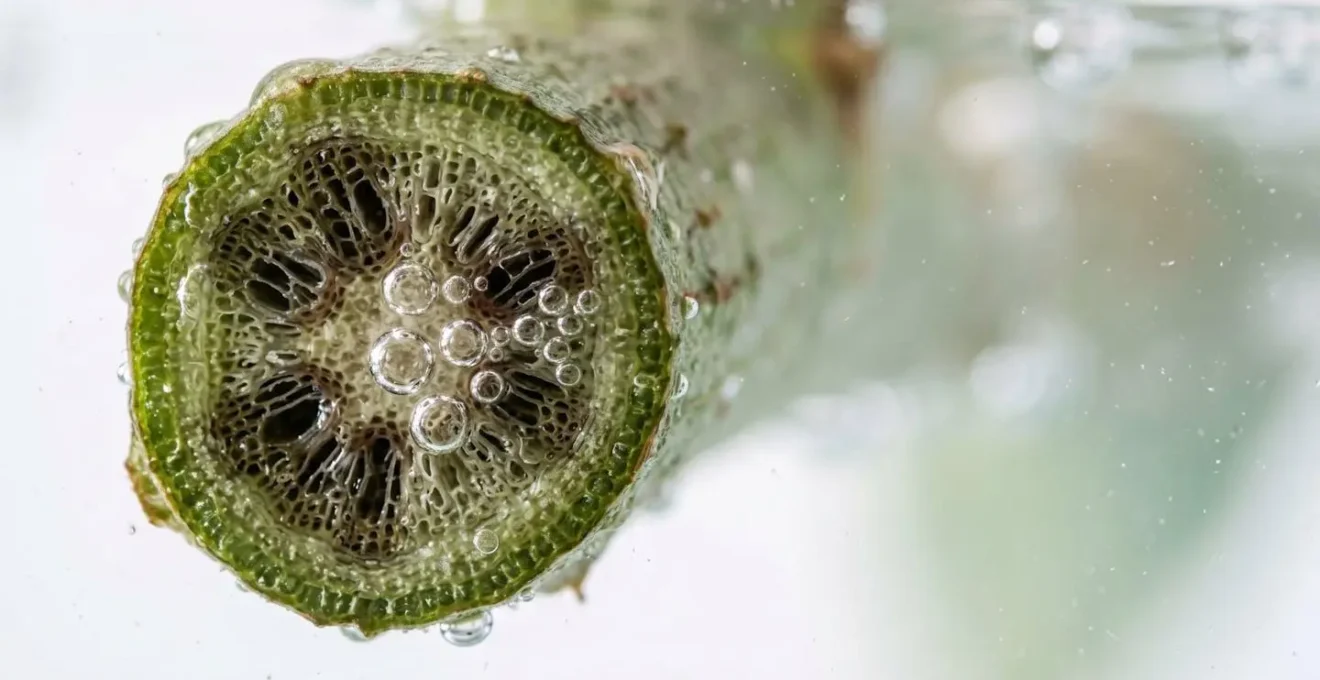
The image above illustrates the intricate structure of the xylem. Any impediment in these channels, whether from air bubbles (embolisms) or bacterial growth, will halt water flow. An acidic environment not only improves water uptake but also helps to mildly inhibit the growth of bacteria, which thrive in more neutral pH conditions. Therefore, the function of lemon juice is not as a nutrient, but as a chemical conditioner that creates the ideal environment for efficient hydration.
Bleach or Vodka: What Best Kills Bacteria in Flower Water?
While sugar provides food and acidifiers improve water flow, neither addresses the single greatest threat to a cut flower’s longevity: microbial proliferation. Vase water, especially when enriched with sugar, is a perfect incubator for bacteria. As these microorganisms multiply, they form a biofilm and physically clog the cut end of the stem, creating a vascular blockage that prevents water from reaching the bloom, leading to rapid wilting regardless of how much water is in the vase.
This is where a biocide becomes an indispensable component of any effective flower food solution. A biocide is simply a chemical agent that kills microorganisms. In DIY recipes, common suggestions include household bleach (sodium hypochlorite) or vodka (ethanol). Both can be effective, but their efficacy is entirely dependent on dosage. From a chemical analyst’s perspective, bleach is the more reliable and measurable agent. It is a powerful, broad-spectrum disinfectant designed specifically to eliminate bacteria.
The key is precision. A few drops are too vague. According to horticultural research, the ideal concentration is incredibly low; for example, horticultural research recommends 50 ppm (parts per million) of bleach. This is equivalent to just 1 ml of bleach per liter of water (or about 1/4 teaspoon per gallon). At this concentration, it effectively sanitizes the water without causing phytotoxicity (poisoning the plant). Vodka can also work, as ethanol is an antiseptic, but its concentration is less standardized, and it can be a food source for some microbes. Bleach remains the more potent and scientifically validated biocide for this application when dosed correctly.
Is Penny-Pinching on Flower Food Costing You Blooms?
While creating a DIY flower food solution from sugar, lemon juice, and bleach is chemically plausible, the persistent challenge remains achieving the correct balance and concentration. Too much sugar fuels bacteria, too little acid fails to optimize hydration, and too much bleach causes stem burn. This is the primary argument for using commercially formulated flower food packets. These products are not marketing gimmicks; they are the result of extensive horticultural research designed to deliver a stable, balanced, and precisely dosed solution.
The MasterClass Editorial Team provides a concise summary of their function, stating:
Flower food packets contain a balanced blend of sugar to feed the flowers, acidifiers to control the pH of the water, and a biocide to eliminate harmful bacteria.
– MasterClass Editorial Team, How to Keep Flowers Fresh: 11 Tips for Preserving Cut Flowers
This three-part formula addresses all primary failure points for cut flowers simultaneously. The results from controlled studies are compelling. For example, a 2026 FloraLife research study found that formulated flower food extended the vase life of roses by 8 days and chrysanthemums by 7 days compared to plain tap water. Many DIY solutions performed only marginally better than water and, in some cases of incorrect dosage, performed worse.
The cost of a packet of flower food is minimal when weighed against the cost of a bouquet that dies prematurely. Skipping the packet to “save” a few cents is a false economy. You are discarding a scientifically optimized tool that provides the correct nutritional and environmental balance needed for maximum bloom longevity. For the skeptic, the evidence suggests that the packet is not treasure, but a highly effective and reliable tool based on sound chemical principles.
The Leaf Burn Effect: What Happens When You Add Too Much Food?
The guiding principle of “dosage is everything” becomes starkly evident when examining the negative effects of overusing flower food. More is not better. Adding two packets of food to a small vase or mixing a solution that is too concentrated can cause significant chemical damage, a condition known as phytotoxicity. This damage often manifests as “leaf burn” or “stem burn,” where the edges of the leaves turn brown or black, and the stem itself can become discolored and soft.
This occurs because an excessively high concentration of salts and sugars in the water creates severe osmotic stress, pulling moisture from the plant tissue and causing cellular collapse. As the FloraLife Research Team succinctly puts it:
Too much causes stem burn and reduces vase life.
– FloraLife Research Team, Flower Food Effectiveness is In the Mix
Beyond the general concentration, specific chemical sensitivities can also lead to leaf burn. Water quality itself can be a factor. For example, some municipal water sources have high levels of fluoride, which is toxic to certain flower varieties. In these cases, even a correctly dosed flower food can contribute to a total mineral concentration that is too high. As water quality research indicates that high fluoride levels can damage sensitive flowers like gerberas, tuberoses, and gladiolas, using filtered or distilled water can be a solution for these specific types. Always follow the packet’s instructions for the volume of water, as this ensures the final solution has the intended, safe concentration.
The Sugar Myth That Causes Bacteria Growth in Your Vase
One of the most pervasive and damaging myths in home floristry is that adding only sugar to vase water is a beneficial act. The logic seems sound: flowers need energy, sugar is energy, therefore sugar water is good for flowers. This reasoning is dangerously incomplete. While it’s true that flowers use sugar for metabolic energy, dumping sugar into water without a corresponding biocide creates a perfect storm for rapid decay.
Plain sugar water is a feast for bacteria, yeast, and other microorganisms present in the air, on the vase, and on the flower stems themselves. This microbial population explodes, consuming the sugar and fouling the water within 24-48 hours. The result is a cloudy, smelly mess that is actively harmful to the flowers. This bacterial bloom creates a slimy biofilm that clogs the xylem, completely blocking water uptake. The flower effectively dies of thirst in a vase full of water.
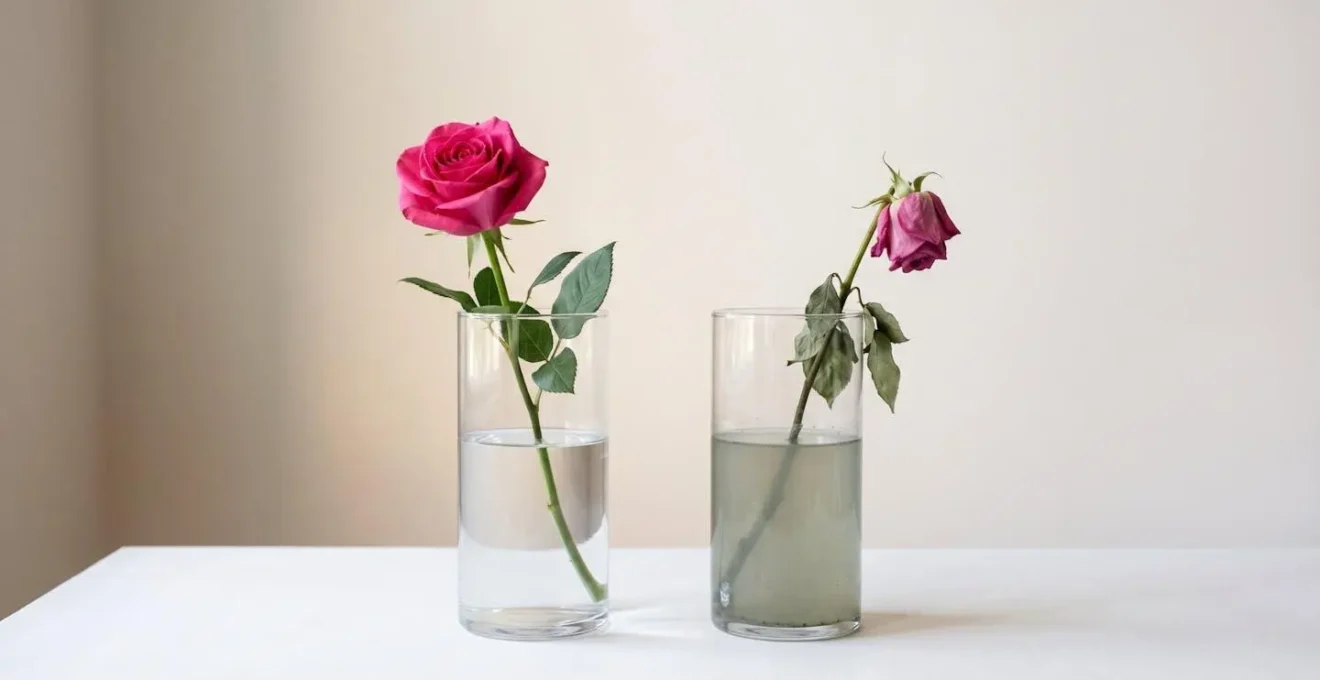
The visual contrast is undeniable. A vase with a balanced flower food solution (containing a biocide) remains clear, allowing for unimpeded water flow. A vase with only sugar water quickly turns murky as the bacterial colony grows. In this scenario, the sugar does far more harm as a bacterial fuel source than it does good as a flower nutrient. This is why a biocide is not an optional add-on; it is a required component to make the sugar usable for the flower instead of for the microbes. Without it, you are actively accelerating the demise of your bouquet.
The Ice Cube Myth That Shocks Orchid Roots to Death
The “ice cube method” has become a popular marketing tactic for watering orchids, suggesting that a few ice cubes provide a slow, measured release of water. From a botanical and chemical perspective, this practice is highly detrimental, especially for tropical plants like Phalaenopsis orchids. These plants evolved in warm, humid environments, and their root systems are not adapted to withstand freezing temperatures. Applying ice directly to the roots can cause cold shock, damaging the delicate root tissue (the velamen) and impairing its ability to absorb water and nutrients.
This myth of using cold to prolong life is the opposite of techniques used to revive many types of cut flowers. When flowers like roses wilt, florists often use a specific method involving warm water to resuscitate them. Placing the stems in lukewarm water, around 100-110°F (38-43°C), for an initial period of hydration helps them absorb water more quickly. The warmer temperature makes the water less viscous and can help dislodge small air bubbles in the xylem, improving flow. After this initial warm bath, they are returned to cool or room-temperature water for longevity.
The general rule is that most standard cut flowers prefer room-temperature water. Bulb flowers like tulips and daffodils are an exception and do benefit from cooler water, as it slows down their metabolism and development. However, the extreme cold of ice is rarely beneficial and is particularly harmful to the living root systems of tropical houseplants. The best practice is always to provide water at a temperature that mimics a plant’s natural environment, not to shock it with extremes.
Key Takeaways
- The Trio of Power: Effective flower food is a precise three-part formula: sugar (energy), acidifier (hydration), and biocide (sanitation).
- Dosage is Not a Suggestion: The concentration of each component is critical. Too much of any ingredient, especially sugar or bleach, is toxic to the flower.
- Bacteria are the Enemy: The primary cause of premature wilting is vascular blockage from microbial growth. A biocide is non-negotiable.
- pH Matters: Flowers drink best in slightly acidic water (pH 3.0-5.0), a condition rarely met by plain tap water.
How to Resuscitate Wilted Hydrangeas in Under 3 Hours?
Hydrangeas are notorious for their dramatic wilting, often seeming to collapse overnight. This is not necessarily a sign of death, but of acute dehydration. Unlike many other flowers, hydrangeas lose a significant amount of moisture through their large, porous petals—a process called transpiration. When they cannot draw water up the stem fast enough to replace what is lost through the petals, they wilt. Fortunately, their structure also allows for a rapid revival method that bypasses the stem entirely.
The most effective way to resuscitate a severely wilted hydrangea is through full submersion. This technique allows the massive surface area of the flower head to absorb water directly, rehydrating the cells quickly and dramatically. It’s a botanical emergency procedure that can often yield results in just a few hours. The key is to act as soon as you notice wilting. The longer the cells remain dehydrated, the more permanent the damage becomes. Following a clear plan is essential for success.
Action Plan: The 3-Hour Hydrangea Revival
- Prepare the Bath: Fill a clean sink or a large basin with lukewarm water. Cold water can shock the flower, while hot water can damage it. Lukewarm is ideal for rapid absorption.
- Submerge the Bloom: Gently place the entire hydrangea head, face down, into the water. Ensure all petals are fully submerged. You may need to place a light object on the stem to keep it from floating up.
- Wait and Watch: Leave the flower to soak for at least 30-60 minutes. For severely wilted blooms, this may extend to 2-3 hours. You will begin to see the petals firm up and regain their structure.
- Re-cut and Rest: Once the bloom looks revived, remove it from the water. Give the stem a fresh, sharp cut at an angle. Immediately place the hydrangea in a vase of fresh, cool water, preferably with flower food.
- Maintain High Humidity: To prevent a relapse, you can lightly mist the petals with water for the first few hours after revival. Keep the flower away from direct sunlight and drafts, which accelerate dehydration.
This submersion method is a powerful tool, demonstrating that understanding a specific flower’s unique biological needs is just as important as general chemical principles. It serves as a final reminder that effective flower care is an application of targeted science.
By moving beyond myths and applying these factual, chemical-based principles, you can significantly extend the life and beauty of your cut flowers, transforming disappointment into lasting enjoyment.