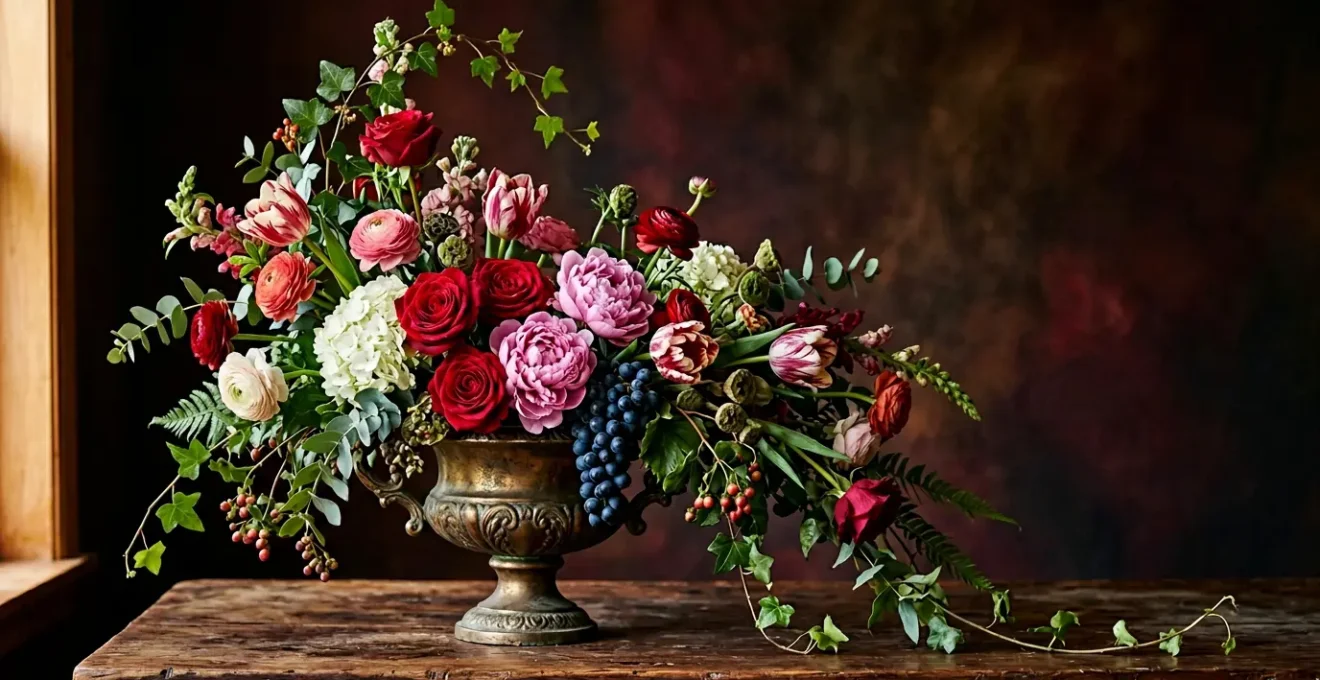
The essential difference between Baroque and Flemish floral design lies not in the flowers used, but in their philosophical approach to space and narrative.
- Baroque arrangements are dynamic, sculptural actors using dramatic S-curves and asymmetry to engage with and shape the energy of a room.
- Flemish designs are dense, painterly compositions—contained, idealized worlds meant to be studied like a still-life canvas.
Recommendation: To truly master these styles, learn to analyze an arrangement’s use of negative space and its intended narrative—is it performing for an audience or inviting private contemplation?
For any student of art or design, understanding the lineage of floral arrangement is to understand shifts in cultural aesthetics, philosophy, and even social conduct. When we look at the grand, overflowing arrangements of art history, it is easy to see them as interchangeable displays of abundance. The common advice often reduces the distinction between Baroque and Flemish styles to a simple visual cue: one features a dramatic S-curve, the other is a dense, rounded mass. This observation is correct, but it is merely a symptom of a much deeper ideological divide.
But what if the true difference lies not in the forms themselves, but in their philosophical intent? This exploration posits that Baroque arrangements function as theatrical sculpture, dynamic actors on the stage of an interior, while Flemish compositions are more akin to painterly studies, contained universes within a frame. One actively projects energy and narrative into a space; the other draws the viewer inward to a meticulously crafted, idealized world. This distinction is the key to truly seeing and differentiating these foundational styles.
This guide will deconstruct the evolution of classical floral design, examining the forces that shaped their iconic silhouettes. We will trace the journey from the coded messages of the Victorian era to the sculptural drama of the Baroque S-curve, the geometric revolution of the 1920s, and the casual rebellion of Constance Spry. By understanding the ‘why’ behind each style, you will develop the critical eye needed to identify, appreciate, and ultimately create arrangements with historical integrity and artistic intent.
Summary: Deconstructing the Great Floral Styles
- Why Were Victorian Arrangements So Round and Tightly Packed?
- How to Create the ‘S’ Curve Line in Classical Arranging?
- Geometric Leaves: How the 1920s Changed Floral Silhouettes?
- The Chaos of Constance Spry: How Casual Became Chic?
- How to Use Flowers as Sculpture Rather Than Decoration?
- Symmetry or Asymmetry: Which Layout Suits a Traditional Mantelpiece?
- What Is the Concentric Circle Technique in Formal Arranging?
- How to Practice Ikebana to Find Mental Clarity?
Why Were Victorian Arrangements So Round and Tightly Packed?
The characteristic dense, round form of Victorian floral arrangements was not an aesthetic accident but a direct reflection of the era’s social codes. In a society governed by strict rules of propriety, flowers became a primary vehicle for silent, coded communication. This “language of flowers,” or floriography, was an immensely popular system where each bloom held a specific meaning. The tight, compact structure of the arrangements, particularly the handheld “tussie-mussies,” served a functional purpose: it was a vessel for a complex, layered message. Each flower was a word, and the bouquet was a sentence.
The sheer popularity of this practice is staggering; a historical review notes that by the late 1800s, nearly one hundred floriography dictionaries had been published to help navigate this intricate floral lexicon. The design’s focus was not on dynamic lines or interaction with space, but on the clear presentation of these symbolic elements. The round shape provided a neat, legible canvas where each flower could be seen and its meaning deciphered. The arrangement was an object to be read, a contained emotional world rather than a sculptural statement.
A tussie mussie was sometimes tied with a ribbon, but could also be carried in a cone-shaped, decorative silver holder, still used today for some bridesmaid bouquets.
– Biltmore Estate, Tussie Mussies and the Victorian Language of Flowers
This emphasis on legibility and containment created a style that was inherently static. The energy was internal, found in the symbolic interplay between the blooms. Unlike the outward-facing drama of the Baroque, the Victorian arrangement was a private conversation made public, its value derived from its symbolic content rather than its formal expression.
How to Create the ‘S’ Curve Line in Classical Arranging?
The ‘S’ curve, often called the “Line of Beauty,” is the defining characteristic of the Baroque style and its primary tool for creating sculptural drama. To create this line is to move beyond mere decoration and begin to sculpt with organic materials. The process is about establishing a foundational, dynamic gesture that will guide the entire composition. This is achieved not by forcing materials into shape, but by selecting and enhancing their natural tendencies.
The key is to build a strong framework. Begin with a tall container that allows for the graceful downward sweep of the curve’s lower portion. The initial line is established using elements that possess an inherent curvature, such as flexible willow branches or the sweeping fronds of an Areca Palm. These materials form the “spine” of the arrangement. Subsequent flowers and foliage are then placed to follow and reinforce this primary movement, creating a sense of continuous, flowing energy. The composition becomes a narrative of motion, guiding the viewer’s eye along a serpentine path.

This technique treats the arrangement as a three-dimensional object that actively engages with the space around it. The ‘S’ curve creates negative space that is just as important as the floral mass itself, carving out voids and generating a sense of dynamic tension. Mastering this line is the first step toward understanding flowers as a sculptural medium.
Your Action Plan: Forging the Hogarth S-Curve
- Select the Vessel: Choose a tall container to properly accommodate the lower, downward-curving portion of the design.
- Establish the Foundation: Use naturally curved branches like Areca Palm or curly willow to establish the foundational S-shaped line.
- Enhance the Curve: Gently bend and flex leaf stems using the heat of your hands to intensify and form a graceful, pronounced curve.
- Mind the Proportions: Place the upper curve so it is longer than the lower one for a visually stable and elegant proportion.
- Reinforce the Movement: Follow the established curved lines with flowers, using their heads and stems to reinforce the S-shape’s flow.
- Harmonize and Balance: Add transitional plant materials and foliage to strengthen balance, fill gaps, and create harmony throughout the arrangement.
Geometric Leaves: How the 1920s Changed Floral Silhouettes?
The arrival of the Art Deco movement in the 1920s and 1930s marked a radical departure from the organic, nature-imitating forms of the past. Influenced by the Machine Age, industrialization, and a fascination with geometric purity, floral design underwent a profound transformation. The soft, flowing lines of Baroque and the dense naturalism of Flemish styles were supplanted by a new aesthetic of streamlined, stylized forms and bold geometry. Leaves and flowers were no longer seen as elements to be arranged naturally, but as raw material for creating man-made patterns.
Case Study: The Art Deco Revolution (1920s-1940s)
The Art Deco era reimagined flowers not as organic specimens but as components in a larger geometric pattern. As detailed in analyses of the period, petals were simplified into repeating motifs, and entire arrangements were built on principles of symmetry and stylization. Bold, contrasting colors like bright reds, deep blues, and vibrant yellows replaced the subtler palettes of previous eras. Architecturally significant foliage, especially the sharp, linear forms of palm fronds, became primary structural elements, often paired with geometric vases. This was a fundamental shift, moving from the goal of imitating nature to the goal of imposing a distinctly modern, human-designed order upon it, reflecting the era’s confidence in technology and progress.
This change is most evident in the treatment of foliage. Instead of being used as soft filler, leaves with strong shapes—like palms and aspidistra—became dominant architectural elements. According to Britannica, Art Deco was a design style of the 1920s and ’30s characterized especially by sleek geometric or stylized forms, a principle that floral artists applied with rigor. The resulting silhouettes were sharp, angular, and often symmetrical, reflecting the aesthetics of skyscrapers and modern machinery. It was a moment when floral design ceased to look back at the garden and instead looked forward to the city, embracing a vocabulary of precision, pattern, and powerful lines.
The Chaos of Constance Spry: How Casual Became Chic?
In the mid-20th century, as formal, geometric styles reigned, British floral designer Constance Spry initiated a revolution of her own. She rejected the rigid, stylized conventions of her time and championed a return to naturalism, but with a radical, almost chaotic, twist. Spry’s genius lay in her ability to see beauty in the overlooked and the unconventional. She dismantled the hierarchy of flowers, elevating humble garden foliage, wild hedgerow finds, and even vegetables to the same status as prized roses and lilies. Her arrangements were loose, asymmetrical, and celebrated the inherent character of each plant, including its imperfections.
This approach was groundbreaking. As the London Flower School notes in a profile of her work, her philosophy was one of inclusion and artistic democracy. She deliberately mixed the formal with the informal, creating a style that was both sophisticated and deeply personal. It was a move away from flowers as a status symbol and toward flowers as a form of authentic self-expression.
She democratised the form, marrying traditional flowers of choice with ‘unusual’ and uncelebrated plant material like kale and pussy willow.
– London Flower School, The Pioneering Life of Constance Spry
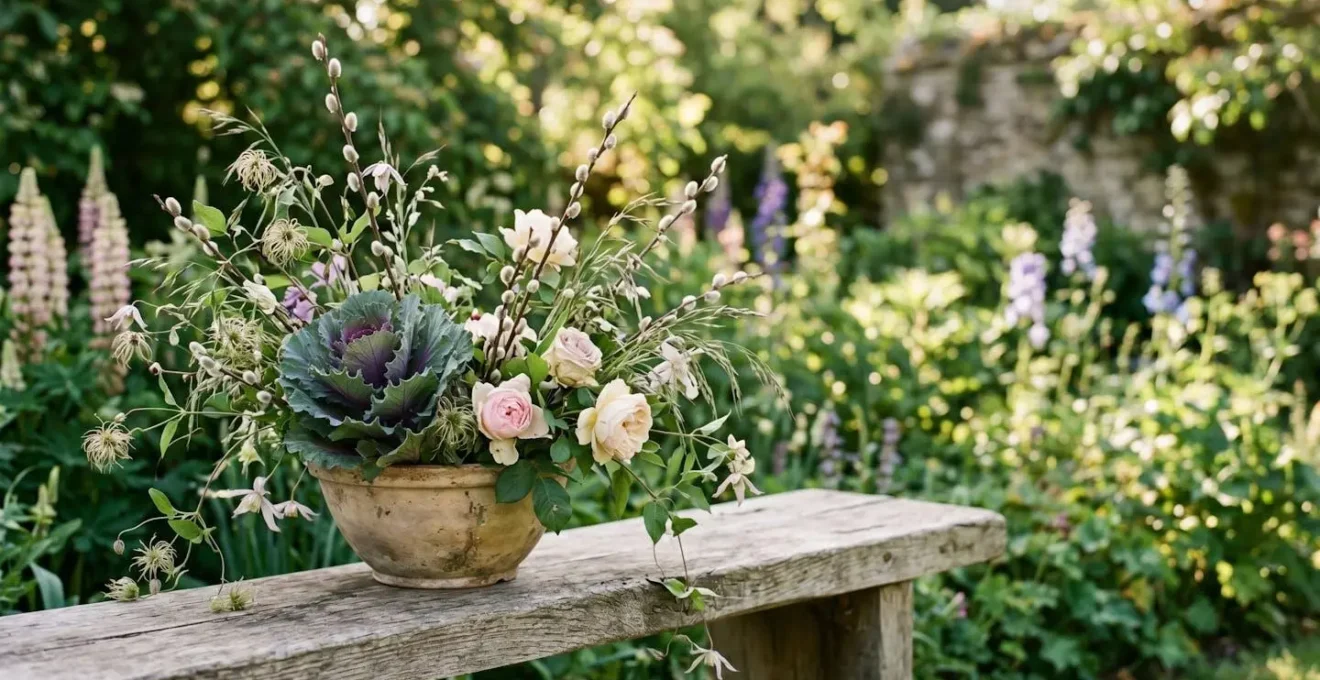
The “chaos” in Spry’s work was, in fact, a highly sophisticated, controlled naturalism. Her arrangements captured the feeling of a garden scooped up and brought indoors, retaining its life, movement, and untamed spirit. By placing kale leaves alongside delicate blossoms in a classical urn, she made “casual” chic. She taught generations of designers that the most compelling arrangements come not from slavishly following rules, but from observing nature closely and trusting one’s own eye.
How to Use Flowers as Sculpture Rather Than Decoration?
To use flowers as sculpture is to fundamentally shift one’s mindset from filling space to shaping it. Decoration is passive; it adorns a surface. Sculpture is active; it commands a space, creates focal points, and directs energy. The Baroque masters understood this distinction implicitly. Their floral arrangements were not meant to simply sit on a table but to participate in the architectural drama of the room. The key to this transformation lies in the mastery of line, movement, and, most critically, negative space.
Study in Practice: Baroque Design as Spatial Sculpture
Floral design of the Baroque period (1600-1700 AD) was intrinsically sculptural. As outlined in floral history analyses, the style was defined by its use of dramatic S-curve lines, large-scale ornamentation, and an emphasis on creating three-dimensional forms that actively interacted with their surroundings. Unlike decorative arrangements that passively fill a void, Baroque compositions used bold, asymmetrical structures to create dynamic tension and a sense of movement. This approach made the empty space around the flowers as significant as the blooms themselves, a principle directly parallel to the theatricality, emotion, and torsion seen in Baroque sculpture of the same period.
The artist and theorist William Hogarth, in his “The Analysis of Beauty,” provided the philosophical underpinning for this approach. He argued that the serpentine S-curve, his “Line of Beauty,” was the essence of vitality. He believed this line was inherently more engaging and beautiful than static, straight lines, which he associated with lifelessness. His insight reveals the core of the sculptural method.
S-shaped curved lines signify liveliness and activity and excite the attention of the viewer as contrasted with straight lines, parallel lines, or right-angled intersecting lines, which signify stasis, death, or inanimate objects.
– William Hogarth, Line of beauty – Wikipedia
Therefore, to arrange flowers sculpturally is to compose with lines of “liveliness and activity.” It requires creating an asymmetrical balance, where the visual weight on one side is countered not by a mirror image, but by a different form or even an expanse of empty space on the other. This makes the entire composition feel alive, as if captured mid-motion.
Symmetry or Asymmetry: Which Layout Suits a Traditional Mantelpiece?
A traditional mantelpiece presents a classic design challenge: it is a strong horizontal line that calls for a vertical counterpoint. The choice between a symmetrical or asymmetrical floral layout will fundamentally define the room’s atmosphere, dictating a mood of either serene formality or dynamic energy. The decision should be guided by the desired narrative of the space. A symmetrical layout speaks of order, stability, and calm, while an asymmetrical approach, rooted in Baroque principles, tells a story of movement, emotion, and theatricality.
A symmetrical design, typically involving two identical or mirrored arrangements on either end of the mantel, creates static equilibrium. The effect is peaceful, orderly, and classically elegant. It reinforces the architectural formality of the room. Conversely, an asymmetrical layout creates dynamic equilibrium. This might involve a single, large arrangement on one side balanced by a smaller visual counterpoint—such as a single candlestick or a small bud vase—on the other. This imbalance forces the eye to travel across the mantel, creating a sense of flow and a narrative that moves through the space.
A third option, the Flemish single-density approach, offers a compelling hybrid. This involves a single, large, dense arrangement placed centrally, which contains its own internal asymmetry and movement. It acts like a still-life painting on the mantel, combining the formal containment of a symmetrical placement with the rich, tumbling internal energy of the Baroque. A recent comparative analysis of these styles breaks down their distinct effects.
| Design Approach | Energy & Narrative | Structural Elements | Visual Effect | Best Application |
|---|---|---|---|---|
| Symmetrical Layout | Creates calm, stability, and formality | Two identical or mirrored arrangements; balanced on both sides of centerline | Static equilibrium; peaceful and orderly mood | Traditional formal settings; desire for tranquility and classical elegance |
| Asymmetrical Baroque Layout | Creates dynamism, emotion, and narrative movement across the mantelpiece | One main arrangement balanced by smaller visual counterpoint (candlestick, bud vase); dynamic equilibrium | Directional flow; story that moves through space; theatrical drama | Rooms seeking movement and energy; baroque or eclectic interiors |
| Flemish Single-Density Approach | Contained yet internally dynamic; lifelike tumbling energy | Single dense arrangement with internal asymmetry; acts as painting on mantel | Combines containment of symmetry with baroque movement; painterly composition | Bridging traditional and dynamic aesthetics; intimate yet visually rich spaces |
Ultimately, the choice depends on the room’s purpose. For a space intended for quiet contemplation or formal gathering, symmetry provides a grounding sense of peace. For a room meant to feel alive with energy and conversation, asymmetry provides the necessary spark of drama.
What Is the Concentric Circle Technique in Formal Arranging?
The concentric circle technique, the defining feature of the Biedermeier style (c. 1815-1848), stands as the ultimate ideological opposition to the Baroque S-curve. Where Baroque design celebrates dramatic, flowing, and aristocratic extravagance, the Biedermeier style embodies order, pattern, and bourgeois precision. It is a historical reaction, trading the wild energy of nature for the controlled logic of man-made geometry. This technique forces a complete re-evaluation of the role of the individual flower within a composition.
Analysis: The Biedermeier Technique
In the concentric circle technique, flowers are meticulously arranged in tight, circular rings of alternating color and texture. Each individual bloom loses some of its personality, functioning instead as a single ‘pixel’ or tessera in a larger floral mosaic. As highlighted in design analyses, the eye is not intended to follow a narrative journey through the design, as in a Baroque piece. Instead, the viewer is compelled to see the arrangement as a single, static, patterned object. This method de-emphasizes the personality of any single flower in favor of its contribution to the overall man-made geometric pattern, reflecting the era’s focus on domestic order and structured design.
This approach represents a complete inversion of the Baroque philosophy. The S-curve is about revealing the ‘liveliness’ inherent in the materials, creating a sense of organic movement. The concentric circle is about imposing a rigid, mathematical order upon those same materials. It is a highly structured, almost architectural form, where the artistry lies in the precision of the pattern and the harmony of the color transitions between rings. It is not a sculpture in motion but a beautifully crafted object of contemplation, valued for its intricate and predictable order.
Key Takeaways
- Baroque arrangements are sculptural, using S-curves and asymmetry to create dramatic movement in space.
- Flemish and Biedermeier styles are painterly and architectural, creating contained, ordered compositions focused on pattern and texture.
- Modern pioneers like Constance Spry and philosophies like Ikebana challenge these traditions, prioritizing naturalism or minimalism over constructed grandeur.
How to Practice Ikebana to Find Mental Clarity?
While Western floral traditions like Baroque have often pursued awe through abundance, the Japanese art of Ikebana offers a path to clarity through subtraction. Practicing Ikebana is less about arranging flowers and more about engaging in a moving meditation. It is an exercise in finding and revealing the essential beauty of a few carefully chosen elements. The goal is not to create a complex, man-made vision but to discover an existing, natural harmony and respectfully present it. This requires a profound shift in perspective from creator to collaborator.
The core philosophy of Ikebana revolves around three key principles: minimalism, asymmetry, and the importance of empty space. The most crucial concept is ‘Ma’ (the sublime void), which posits that the empty space between the elements is as important as the elements themselves. This negative space is not empty; it is charged with energy and meaning, allowing each stem, leaf, and bloom to be seen and appreciated in its own right. The practice also embraces ‘wabi-sabi,’ the aesthetic acceptance of transience and imperfection. An Ikebana arrangement might feature a budding branch, a full bloom, and a withered leaf together to represent the beautiful, fleeting nature of the life cycle.
Comparing this philosophy to the European maximalism of the Baroque period reveals two fundamentally different paths to transcendence. The table below, inspired by design comparisons, highlights these contrasting worldviews.
| Philosophy Element | Ikebana (Japanese Minimalism) | Baroque (European Maximalism) |
|---|---|---|
| Core Philosophy | Minimalism and focus on ‘Ma’ (the sublime void); achieving clarity through subtraction | Overwhelming abundance and maximalism; inspiring awe through complex drama |
| Path to Transcendence | Meditation through simplicity; finding and revealing existing natural harmony | Theatrical spectacle; creating complex, man-made vision imposed on materials |
| Role of the Arranger | Humble meditator; respectfully discovering inherent beauty in minimal elements | Powerful creator; imposing dramatic, elaborate artistic vision onto nature |
| Approach to Impermanence | Wabi-sabi: gracefully accepting transience through buds, open blooms, and withered leaves as aesthetic beauty | Vanitas symbolism: depicting wilting flowers and insects as moralistic warning about life’s fleeting nature |
| Use of Space | Negative space (Ma) is the primary element; emptiness holds meaning | Negative space sculpted by abundance; void shaped by floral mass and movement |
| Material Selection | Few carefully chosen elements; each stem carries profound significance | Abundant, diverse materials; exotic and expensive blooms showcase wealth and status |
To practice Ikebana for mental clarity, one must slow down, observe closely, and listen to the materials. The process involves quieting the mind, selecting only what is essential, and arranging it in a way that creates a peaceful, balanced tension. It is an act of finding clarity in simplicity, not overwhelming the senses with spectacle.
To truly master floral design, move beyond imitation. Begin analyzing every arrangement not for what it is, but for the story it tells, the space it shapes, and the philosophy it embodies. This critical eye is the foundation of true artistry.