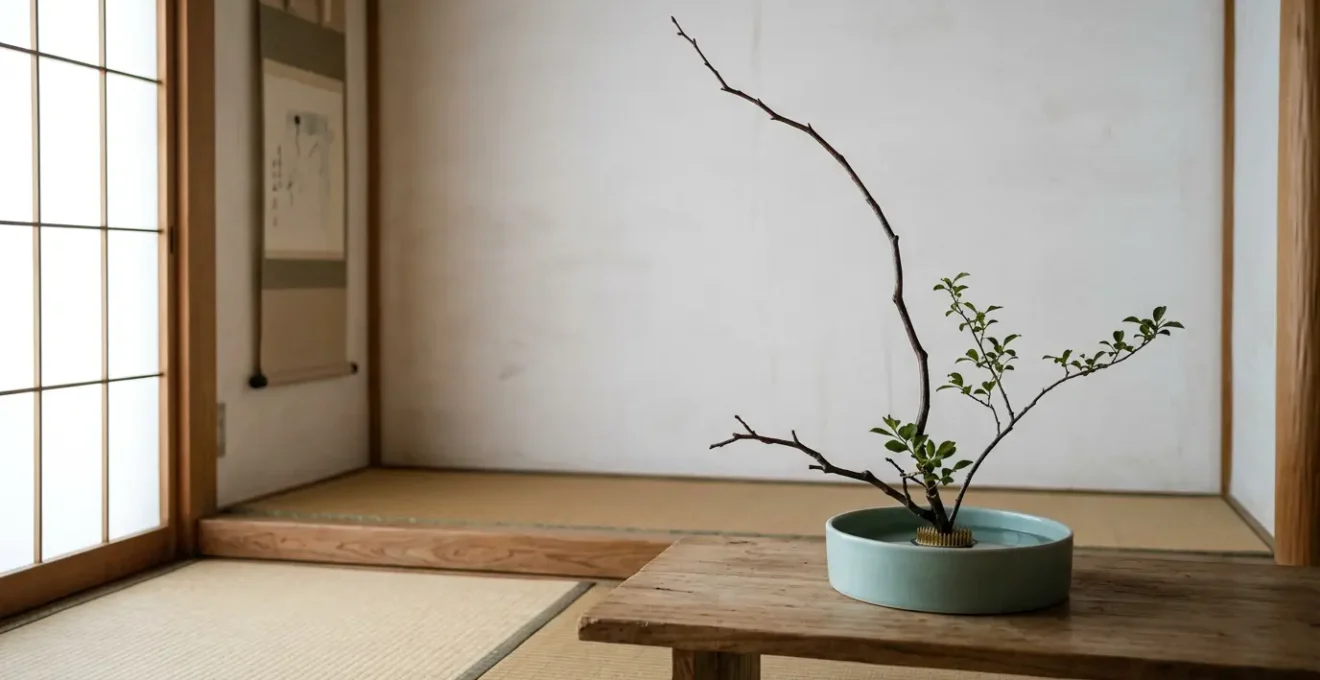
Most assume Ikebana is the Japanese art of arranging flowers. This is incorrect. The arrangement is merely a byproduct, the trace left in the physical world after a rigorous mental exercise. True Ikebana is a spiritual discipline that uses the acts of cutting, placing, and observing botanicals as a method to sculpt the mind. Its goal is not a beautiful object for your table, but a state of profound internal clarity and quiet.
In a world of constant noise and visual clutter, the search for mental quiet has become a desperate pursuit. We are told to meditate, to be mindful, to disconnect. Yet, the mind often resists stillness, grasping for tasks and tangible results. We try to empty our thoughts, but the void feels unnatural, unproductive. This is a fundamental misunderstanding of quiet. Quiet is not an absence of something; it is the presence of structure, intention, and space.
The common approach to floral decoration—filling a vase with a symmetrical burst of colour—is a reflection of this cluttered mental state. It is an attempt to shout down the silence. But what if the true path to clarity was not in adding more, but in the disciplined act of taking away? What if a single branch, a few leaves, and the space between them held a more profound truth than any bountiful bouquet? This is the central tenet of Kado, the “Way of Flowers,” or Ikebana.
This is not a guide to creating pretty arrangements. This is an introduction to a discipline. We will not be “arranging” flowers; we will be using them as a tool to arrange the mind. Through this practice, you will learn that the cut of a stem can be a lesson in decisiveness, that empty space is an active participant in beauty, and that the acceptance of impermanence is the ultimate source of peace. The final arrangement is not the goal; it is the evidence of the work you have done within.
The following principles are not mere steps, but gateways to understanding. Each section builds upon the last, guiding you from the foundational philosophy to the ritual of practice, revealing how this ancient art offers a structured path to a quiet and ordered mind.
Summary: A Master’s Guide to Ikebana as Mental Discipline
- What Do Heaven, Earth, and Man Represent in Your Vase?
- Pin Frog or Foam: Why Is the Kenzan Essential for Water Clarity?
- How to Prune a Branch to Reveal Its Essential Line?
- Empty Space: How Western Minimalism Differs from Japanese Ma?
- Why Must You Only Use Plants That Are Currently in Season?
- Why Is Less More When Styling Modern Coffee Tables?
- Scissors or Knife: Which Tool Prevents Stem Crushing Effectively?
- How to Accessorize a Minimalist Living Room Using Only Botanicals?
What Do Heaven, Earth, and Man Represent in Your Vase?
The first lesson is one of structure. A chaotic mind lacks hierarchy; thoughts of all sizes clamor for attention. Ikebana imposes order through the primary structure of Shin, Soe, and Hikae. These are not just three stems; they are the conceptual framework for organizing your internal world. Shin (天) represents Heaven, the tallest element, the connection to the universal and the spiritual. It is the primary line, the aspirational thought. Soe (人) is Man, the middle element, which mediates between heaven and earth. It is your own perspective, leaning, searching, and in dialogue with the other two. Hikae (地), or Tai, is Earth, the lowest and shortest element, grounding the entire composition in the tangible reality of the here and now.
This trinity forms an asymmetrical triangle, a dynamic structure full of life and movement. Your task is not to create a static, symmetrical fan, but to find a balanced tension between these three forces. As the Ikebana master Mayuka Yamazaki notes, the core principle is about a respectful dialogue with the material. “At the core of ikebana is the notion of letting flowers live,” she explains. “We don’t force them… Instead, a human observes the beauty and flow of each flower and lets the flower shine and live as it is.” By identifying and placing these three elements, you are not arranging flowers; you are sorting your own thoughts into a coherent, meaningful hierarchy.
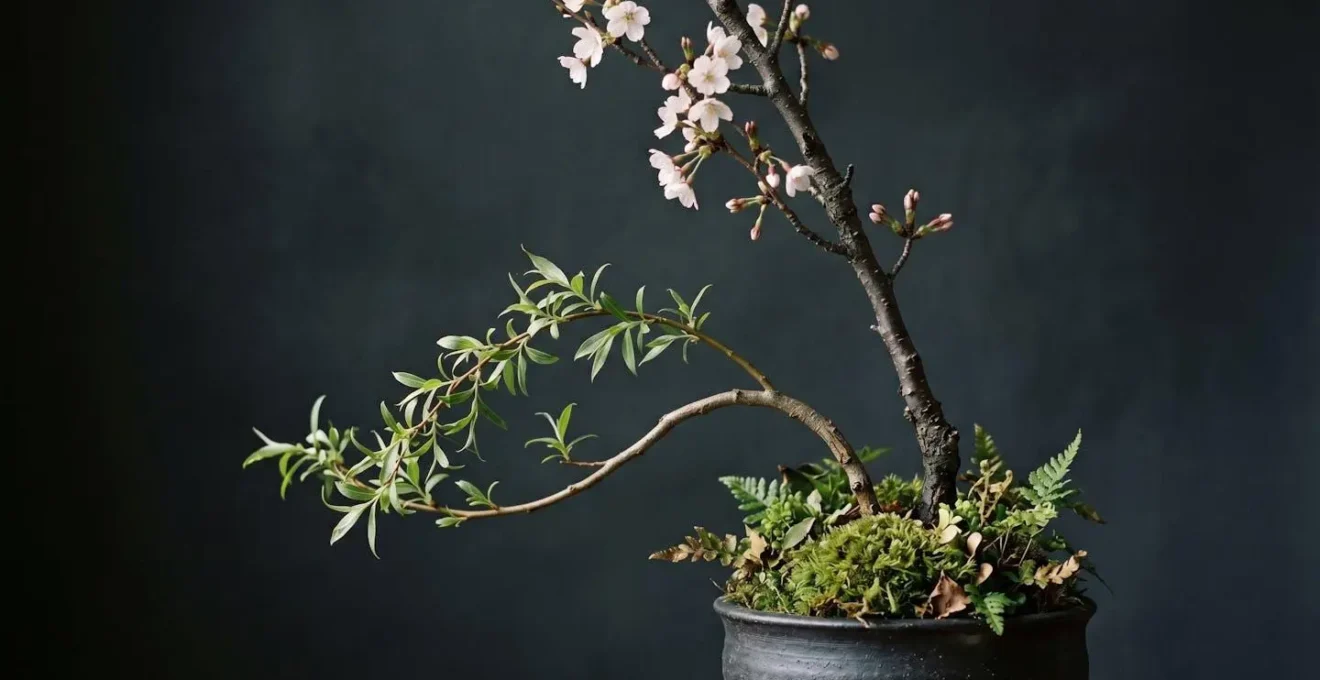
Observe the three stems in the image. They are not competing, but collaborating to define a single, unified form. This is the first step toward mental clarity: to recognize the different levels of your own consciousness—the spiritual, the personal, and the physical—and to arrange them into a relationship of harmony rather than conflict. The vase becomes a microcosm of your own mind, ordered and at peace.
Pin Frog or Foam: Why Is the Kenzan Essential for Water Clarity?
A clear mind requires a stable, pure foundation. In Ikebana, this foundation is literal: the water in the vessel and the tool that holds the stems. The modern shortcut is floral foam, a block of green plastic that crumbles, clouds the water, and chokes the stems. It is a tool of convenience and impurity, and it has no place in this discipline. The traditional tool, the kenzan (剣山) or “sword mountain,” is a heavy base with sharp brass or steel pins. It is a tool of intention.
The kenzan performs two essential functions that are philosophically critical. First, it holds each stem precisely where you decide it should be, demanding commitment to your placement. Second, and more importantly, it allows for an open and clean environment. The pins do not crush the stem’s base, and the heavy metal does not pollute the water. This allows for maximum water and nutrient absorption, which is vital for the plant’s life. As traditional ikebana tool makers confirm, this method extends the life of the arrangement by maintaining the health of the water.
Here, the water becomes a direct metaphor for your mind. A mind cluttered with the debris of indecision and impurity (the foam) cannot be clear. A mind founded on a stable, clean, and intentional base (the kenzan) can achieve and maintain clarity. The choice of tool is not a matter of preference; it is a declaration of purpose. Choosing the kenzan is the first physical act of choosing clarity over clutter. It is heavier, more demanding, and requires more skill, but it provides a foundation of integrity. This integrity is reflected in the pristine water, which in turn reflects the clarity of your own thoughts.
How to Prune a Branch to Reveal Its Essential Line?
Clarity is achieved not by addition, but by subtraction. A branch as found in nature is a chaos of growth—twigs, leaves, and buds vying for light. The novice sees a branch. The master sees the potential for a single, perfect line within it. Your task is to reveal this “essential line” (本質線 – honshitsu-sen). This is perhaps the most crucial act in Ikebana, for it is a direct practice in seeing and extracting essence from complexity.
This is not arbitrary trimming. It is a deep, observational dialogue with the branch. You must hold it, turn it, and observe its natural gesture, its weight, its tension. Where does the energy flow? Which curve or angle holds the most character? The goal is to remove every single element—every leaf, every twig—that distracts from or hides this essential line. Each cut is a decision. It is an act of letting go. There is no undoing a cut; it is a lesson in commitment and living with consequences. This is what we call “The Cut as Decision” (切り – Kiri).
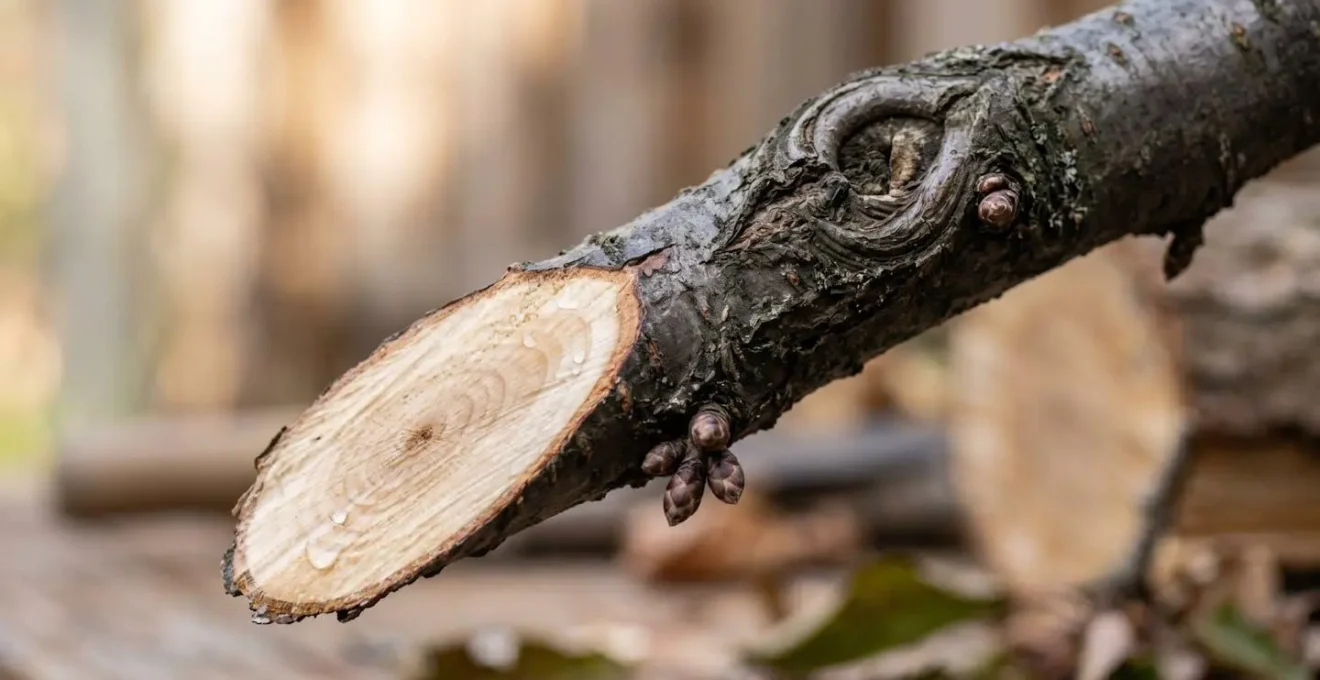
Look at the texture of the pruned branch. The act of pruning has not scarred it, but revealed its character. The removal of the superfluous has given it power and definition. In your own mind, thoughts are like these leaves and twigs. Most are redundant, distracting from a core idea. The practice of pruning a branch teaches you to identify the essential thread of a thought and to decisively cut away all that is not necessary. It is a training in mental economy, precision, and the courage to reduce something to its most powerful form.
Empty Space: How Western Minimalism Differs from Japanese Ma?
The Western mind fears a vacuum. It sees empty space and seeks to fill it. Western minimalism often translates to a cold, sterile emptiness—an absence of things. The Japanese concept of Ma (間) is profoundly different. Ma is not empty space; it is an “activated interval.” It is the pause between notes that gives music its rhythm, the silence between words that gives a sentence its meaning. In Ikebana, Ma is the space created around and between the stems, and it is as important as the stems themselves.
By removing leaves and branches to reveal the essential line, you have begun to create Ma. This space is not a void. It is charged with the potential created by the lines of the stems. It gives each element room to breathe and be seen. It invites contemplation. The Western impulse is to add another flower to fill a “gap.” The discipline of Ikebana is to resist this impulse and to recognize that the gap is an active, essential part of the whole composition. It gives shape and power to what is present.
Isaac Stern described music as ‘that little bit between each note – silences which give the form’… The Japanese have a word (ma) for this interval which gives shape to the whole. In the West we have neither word nor term. A serious omission.
– Alan Fletcher, The Art of Looking Sideways
This concept is the key to uncluttering the mind. A mind filled to the brim with thoughts, with no space between them, is a mind in chaos. Practicing the creation of Ma in an arrangement teaches you to value the quiet intervals in your own thinking. It is in these moments of mental “space” that insight and clarity arise. You learn that power does not come from the volume of thoughts, but from their precise placement and the resonant silence that surrounds them.
Why Must You Only Use Plants That Are Currently in Season?
The discipline of Ikebana is rooted in an honest relationship with time and reality. It resists the artificial and the out-of-place. Therefore, the use of seasonal materials is not a stylistic suggestion; it is a philosophical non-negotiable. To use a tulip in autumn or a chrysanthemum in spring is a falsehood. It is an attempt to impose your will on nature’s rhythm, a sign of a mind that has not yet learned to accept the world as it is.
Using seasonal materials is a practice in accepting the present moment. It forces you to work with what is available, not what you wish you had. This fosters creativity, resourcefulness, and a deep connection to your immediate environment. More profoundly, it is an embodiment of mono no aware (物の哀れ), the gentle, melancholic awareness of the impermanence of all things. An arrangement of cherry blossoms is beautiful precisely because we know it will soon fade. A composition of autumn leaves and seed pods has a deep poignancy because it speaks of the end of a cycle.
This is not a morbid practice, but a liberating one. The philosophical foundations of Ikebana show that practitioners select materials at all stages of life—from the tight bud (the future) to the full bloom (the present) to the drying leaf (the past)—to create a complete and honest portrait of life’s transient nature. By embracing seasonality, you are training your mind to let go of the desire for permanence. You learn to find beauty not in spite of impermanence, but because of it. This acceptance is the very definition of peace.
Why Is Less More When Styling Modern Coffee Tables?
The principles of Ikebana are not confined to a traditional vase. They are a way of seeing the world that can be applied to any space, especially the modern home. The coffee table, often a repository for clutter—remotes, magazines, assorted objects—can be transformed from a surface of chaos into a point of quiet contemplation. This is achieved by treating it not as a table, but as a modern tokonoma (床の間).
A tokonoma is a recessed alcove in a traditional Japanese reception room, a consecrated space for the display of a single, meaningful object: a scroll, a work of art, or an Ikebana arrangement. It is the focal point of the room, a visual anchor of stillness. By applying this thinking, your coffee table ceases to be a utilitarian surface and becomes a stage for intention.
The Coffee Table as a Modern Tokonoma
In traditional Japanese sitting rooms, a ‘toko-no-ma’ is a literal empty space built into the architecture—a display alcove typically filled with a single art object. This principle can be powerfully applied to modern living spaces. Instead of clutter, a coffee table can become a contemporary tokonoma. By placing a single, well-considered Ikebana arrangement on an otherwise clear surface, the table is transformed. It becomes a consecrated focal point for contemplation, drawing the eye and quieting the visual noise of the entire room. The vacant space around the arrangement is as important as the arrangement itself, creating a zone of quiet that elevates the entire living space from a place of mere function to one of intentional beauty.
This does not mean your coffee table must be empty forever. It means that what is placed upon it is done with conscious choice. A single, small moribana arrangement—low and sprawling in a shallow dish—can hold more visual and spiritual weight than a dozen scattered objects. It teaches the eye, and thus the mind, to focus on one point of beauty, to appreciate its form, and to value the clear space surrounding it. You are not “styling” a table; you are creating an altar to clarity in the center of your daily life.
Scissors or Knife: Which Tool Prevents Stem Crushing Effectively?
The physical act of cutting a stem is a critical moment in the practice. A crushed stem cannot draw water, leading to premature death and cloudy water. This compromises the clarity of both the arrangement and the mind. While a knife can be used, the traditional tool is a pair of hasami (鋏), specialized Ikebana scissors with thick, powerful blades designed for making clean, sharp cuts without compressing the stem’s vascular system.
The most disciplined technique for cutting is called mizugiri (水切り), or “water cut.” This is not just a technique; it is a ritual. It involves submerging the end of the stem in water *while* you cut it. This prevents any air from entering the stem’s vessels at the moment of the cut, ensuring an unbroken column of water from the basin to the kenzan. This act, performed with precision and focus, becomes a meditation in itself. It is a practical measure for the flower’s health and a spiritual one for your own focus.
The sounds and sensations of the practice become anchors for the mind. The coldness of the water, the weight of the hasami, the sharp, clean snap of a stem cut correctly—these details pull you into the present moment. The goal is to perform this ritual with such focus that the outside world falls away. The following steps are not a checklist, but a sequence for a moving meditation.
Your Action Plan: The Ritual of Mizugiri
- Fill a shallow basin or bowl with clean, room-temperature water before you begin.
- Submerge the portion of the stem you wish to cut completely under the water’s surface.
- Use sharp hasami to make a clean, decisive diagonal cut while the stem remains submerged.
- Keep the freshly cut stem underwater as you transfer it directly to your vessel, ensuring no air interrupts the water column.
- Listen for the sharp, clean sound of the cut—this auditory feedback confirms your technique and becomes a meditative anchor.
Mastering this simple ritual is to master a moment of pure focus. It is the physical manifestation of providing a clear and uninterrupted path for life, both for the flower and for your own attention.
Key Takeaways
- Ikebana is not decoration; it is a mental discipline where the arrangement is merely evidence of the internal work.
- The core principles—the trinity of Shin-Soe-Hikae, the negative space of Ma, and the acceptance of impermanence—are tools for structuring and clarifying thought.
- Every tool and action, from the kenzan to the mizugiri cut, is intentional and designed to cultivate focus, decisiveness, and a respect for natural forms.
How to Accessorize a Minimalist Living Room Using Only Botanicals?
When the mind has been trained by the discipline of Ikebana, its relationship with its environment changes. The desire to “accessorize” or “decorate” falls away, replaced by an instinct to place objects with intention. A minimalist living room is not a blank canvas to be filled, but a larger vessel to be ordered with the same principles of line, space, and essence. The goal is not to add botanical decor, but to allow a few carefully chosen botanical elements to reveal and amplify the character of the space itself.
A tall, dramatic branch of pussy willow (Shin) can echo and accentuate the vertical line of a window frame. A low, sweeping arrangement in a suiban (Hikae) can ground an airy room, its horizontal line resonating with a low shelf or mantelpiece. The space is no longer just a room; it is a composition, and you are placing elements within it. The botanicals become the Soe, the human element that brings life and dialogue to the architectural Shin and Hikae.
This practice moves beyond aesthetics and becomes a powerful, ongoing form of therapy. It is a way of engaging with the world that reduces anxiety and clarifies thought. In fact, clinical studies demonstrate that subjects show a statistically significant decrease in anxiety scores and respiratory rates after practicing Ikebana. The arrangement is not the cause of this calm; it is the result. The calm comes from the disciplined process: the focus, the decision, the dialogue with nature, the acceptance of what is.
The practice of Ikebana is a lifelong journey. It is a mirror that reflects your inner state. When you are agitated, your arrangements will feel cluttered. When you are at peace, they will be clear and strong. Begin not with the desire to create a beautiful object, but with the intention to quiet your mind. The beauty will follow as an inevitable byproduct.