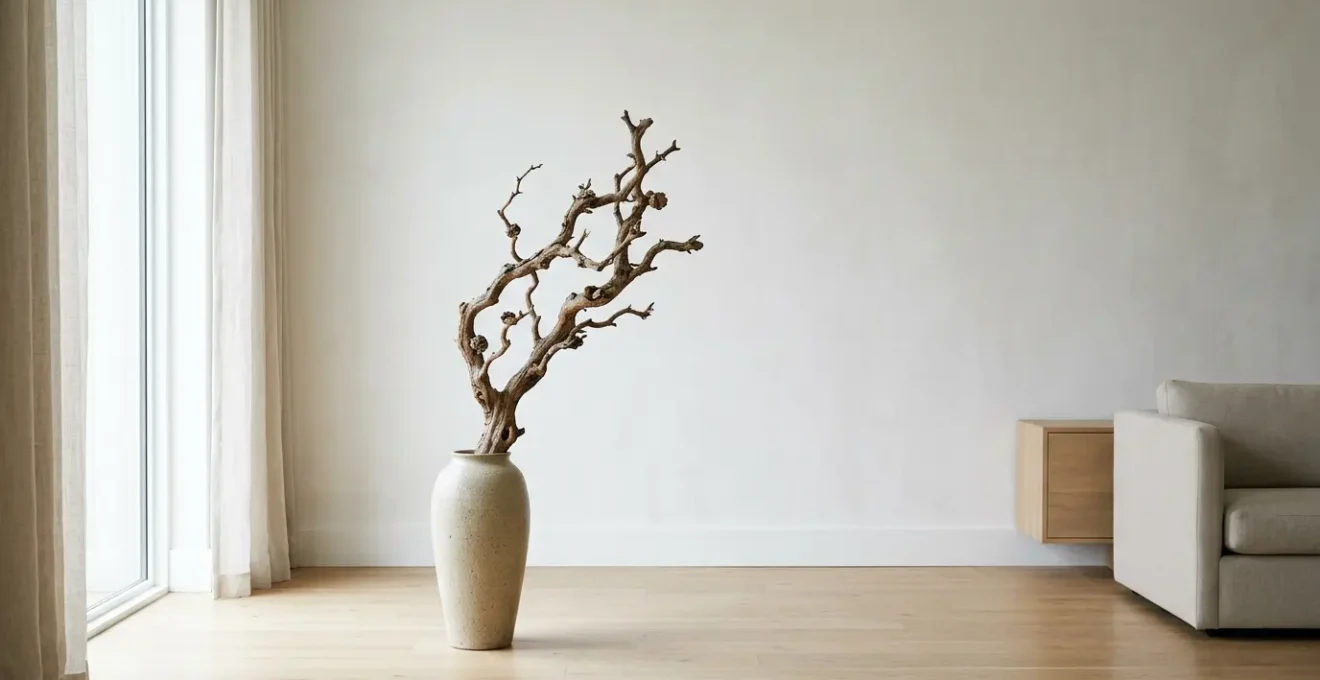
The key to accessorizing a minimalist room with botanicals is to treat the plant not as an object, but as a precise architectural tool for sculpting space.
- A single, structural branch or leaf has more impact than a collection of small plants, as it actively engages with and defines the negative space around it.
- The goal is not to fill emptiness but to give it shape, texture, and intention, transforming it from a void into an active component of the design.
Recommendation: Instead of asking “Where can I put a plant?”, ask “How can this one branch or leaf redefine the lines and volume of this room?”.
The minimalist living room is an exercise in restraint. Clean lines, uncluttered surfaces, and a quiet color palette create a sanctuary of calm. Yet, this austerity can sometimes tip into sterility, a space that feels more like a gallery than a home. The common impulse is to add life with plants, but this often leads to the very visual noise minimalism seeks to eliminate: a clutter of pots, a jungle of competing forms, and a disruption of carefully composed space.
The conventional approach treats plants as decorative afterthoughts—a fiddle-leaf fig in the corner, a row of succulents on the sill. But what if the true potential of botanicals in a minimalist interior lies not in accumulation, but in precision? What if a single living element could do more work than a dozen, by being treated with the same intentionality as a piece of load-bearing architecture?
This guide reframes the conversation. We will move beyond decoration and into spatial design. This is not about adding plants to a room; it is about using botanicals to make a deliberate architectural intervention. We will explore how to use a single stem to define volume, how texture can replace color, and how the empty space around the plant becomes as important as the plant itself. By embracing this disciplined approach, you can introduce vitality and organic softness without sacrificing an ounce of minimalist integrity.
This article details the principles of using botanicals as architectural tools. The following sections break down how to select sculptural elements, manage quantity, and understand the profound philosophy of space that separates mere emptiness from intentional design.
Summary: Botanical Architecture for the Minimalist Home
- Why Is Empty Space Around the Vase as Important as the Flower?
- How to Choose a Structural Branch That Acts as Sculpture?
- White on White: How to Layer Textures Without Adding Color?
- The Quantity Mistake That Turns Minimalism into Mess
- How to Change the Mood of a Minimalist Room Each Season?
- Why Is Less More When Styling Modern Coffee Tables?
- Empty Space: How Western Minimalism Differs from Japanese Ma?
- How to Soften Hard Modern Lines with Organic Floral Shapes?
Why Is Empty Space Around the Vase as Important as the Flower?
In minimalist design, the primary material is not concrete or wood; it is space itself. An object’s value is measured by how it interacts with the void around it. The empty space, or negative space, is not a passive background but an active element that gives the object its power and definition. When you place a single flower in a room, you are not just adding a flower; you are sculpting the air around it, creating lines, shadows, and volumes where none existed before. This approach is grounded in cognitive science; environmental psychology research shows that negative space reduces cognitive load, allowing the brain to process its environment with less effort and a greater sense of calm.
A cluttered mantelpiece forces the eye to jump between objects, creating a low-level hum of visual static. In contrast, a single, sculptural branch against a bare wall commands attention. The wall is no longer just a wall; it becomes a canvas. The space between the leaves and the wall becomes a tangible shape. This is the fundamental principle: the botanical element is the tool, but negative space is the medium. By focusing on the quality of the space you are creating, you shift from a mindset of filling to one of composing.
Negative space helps to reduce cognitive load, which in turn allows the brain to process and interpret content more efficiently. This clarity not only enhances viewers’ focus, but also evokes a sense of calm, order and openness.
– Skillshare Design Psychology Research, What Is Negative Space? Design, Psychology & the Power of Emptiness
Therefore, before choosing a plant, consider the space you wish to activate. Do you want to draw the eye upward with a tall, thin line? Do you want to create a moment of quiet contemplation on a low surface? The purpose of the botanical is to give that empty space a purpose and a voice.
How to Choose a Structural Branch That Acts as Sculpture?
To treat a botanical element as architecture, you must select it for its form, not its foliage. Think of it as a piece of sculpture. A gnarled manzanita branch, a smooth piece of driftwood, or the stark, twisting stem of a curly willow possesses an inherent structural and artistic integrity that a generic houseplant often lacks. The objective is to find one piece with enough character and presence to stand on its own as a focal point. This single element should tell a story through its texture, its lines, and the way it reaches into the space.
When selecting your botanical sculpture, consider these architectural qualities:
- Line: Does the branch have a strong vertical thrust, a gentle horizontal sweep, or a complex, intersecting arrangement of lines? The line will direct the eye and interact with the architectural lines of the room (window frames, ceiling height, furniture edges).
- Form: Observe its overall shape or silhouette. Is it dense and complex, or sparse and elegant? Its form will occupy a specific volume of space, creating mass and presence.
- Texture: The surface quality—be it rough bark, smooth, weathered wood, or the papery feel of a dried flower head—provides tactile contrast to the often smooth, hard surfaces of a minimalist interior.
This approach requires a curatorial eye. Forgo the garden center and look to florists who specialize in unique stems, or even forage for fallen branches (where permitted). The ideal piece feels both natural and intentional, a piece of controlled wilderness brought indoors.

As the image demonstrates, the beauty is found in the detail: the intricate texture of the bark, the way light catches on its edges, and the organic, unpredictable path it carves through the air. This is not mere decoration; it is a volumetric composition in its own right.
White on White: How to Layer Textures Without Adding Color?
A common misconception is that adding life to a minimalist space requires adding color. However, for the purist, a more disciplined and powerful approach is to layer textures within a strictly monochromatic palette. A “white on white” arrangement—using only white flowers, pale foliage, and neutral-toned vessels—forces the focus onto form, shadow, and surface quality. It is an advanced exercise in subtlety, where the dialogue between a waxy magnolia leaf, a feathery gypsophila cloud, and a matte ceramic vase becomes the entire story.
Without the distraction of color, every other quality is amplified. The way light reflects off a glossy leaf versus how it is absorbed by a velvety petal creates a rich, complex visual experience. This is not about creating a sterile, flat composition, but about building depth and interest through nuanced variation. You can introduce silver-toned foliage like dusty miller or the varied green-whites of a caladium to add layers without breaking the monochromatic discipline. The goal is a composition that is quiet but deeply engaging, rewarding closer inspection with a wealth of textural detail.
This technique elevates botanicals from a simple accent to an integral part of the room’s sensory palette, just as a wool throw and a linen cushion work together on a sofa. It proves that visual interest does not depend on a broad spectrum of color, but on the sophisticated interplay of light and material.
Action Plan: Auditing Your Monochromatic Arrangement
- Palette Check: List every botanical element. Ensure they all exist within the white, cream, and pale silver/green family, from pale whispers to more saturated, chalky tones.
- Foliage Audit: Inventory your supporting foliage. Are you using silvery dusty miller for cool tones or structured green ruscus? Ensure it supports, not competes.
- Combination Review: Confront your primary flowers with foliage. A classic pairing like eucalyptus with white blooms offers proven textural contrast and cohesion.
- Finish Analysis: Catalog the finishes. Contrast waxy, glossy leaves with matte, velvety petals and place them against the smooth or rough texture of the ceramic or concrete vessel.
- Integration Plan: Determine where the arrangement will live. The play of textures should be set against a clean backdrop to be fully appreciated.
The Quantity Mistake That Turns Minimalism into Mess
The single greatest error in applying botanicals to a minimalist space is a failure to respect quantity. The instinct to “add more” to solve a perceived emptiness is the very antithesis of minimalism. One plant is an intervention; three can be a statement; ten is just clutter. This is not an opinion but a function of how our brains process information. The more objects in our visual field, the harder our brain must work to filter out the irrelevant ones. According to cognitive studies, this constant filtering increases tiredness and reduces productivity over time.
This is why a collection of small succulents on a windowsill, while charming in another context, is a disaster for a purist’s space. It creates a multitude of small, competing focal points, generating visual static. The minimalist approach favors the power of the singular over the noise of the many. A single, large-scale plant, like a well-chosen Monstera Deliciosa whose perforated leaves create fascinating shadows, serves as an anchor for the entire room. It has the scale and presence to hold its own and engage in a dialogue with the architecture.
The rule is simple: one or two strategic placements are more powerful than a dozen random ones. Each botanical element must have a clear programmatic function. Is it softening a hard corner? Is it creating a vertical line to balance a long, low sofa? Is it serving as the sole focal point on a coffee table? If a plant does not have a clear, singular job, it does not belong. This discipline is what separates intentional design from simple decoration and prevents the minimalist sanctuary from devolving into a messy greenhouse.
How to Change the Mood of a Minimalist Room Each Season?
A minimalist space, with its fixed elements and lack of decorative churn, can feel static. The strategic use of a single botanical element is the perfect mechanism for introducing seasonal rhythm without adding clutter. This is not about elaborate seasonal decorating; it is about a subtle, singular swap that completely realigns the room’s mood. By changing just one vase or one branch, you acknowledge the passing of time and connect the sterile indoor environment to the living world outside.
Think of a single, prominent vessel as a stage. The performance on that stage changes with the seasons, following a clear narrative arc:
- Winter: The focus is on pure structure and form. A bare, gnarled branch of contorted hazel or a few stems of dried cotton balls speak of dormancy and quiet resilience. The beauty lies in the stark, skeletal lines against the winter light.
- Spring: Life returns with a burst of controlled energy. Replace the winter branch with a single stem of quince, forsythia, or cherry blossom. The focus is on the delicate, ephemeral nature of the buds and blooms.
- Summer: The mood shifts to lushness and texture. A single, dramatic monstera leaf, a large hosta leaf floating in a shallow bowl of water, or a stem of giant allium celebrates the peak of growth and vitality.
- Autumn: The theme is color, decay, and harvest. A branch of vibrant maple or oak leaves, a few stems of dried pampas grass, or a cluster of sculptural seed pods introduces warm tones and a sense of graceful decline.
This practice transforms the botanical element from a static object into a dynamic, living calendar. It keeps the room from feeling frozen in time and provides a recurring ritual of renewal. This subtle evolution ensures the minimalist space feels alive and responsive, not rigid and unchanging.
Why Is Less More When Styling Modern Coffee Tables?
The coffee table is the center of gravity in a living room, making it a magnet for clutter. For a minimalist, it is also the ultimate test of restraint. The “less is more” mantra is not about emptiness but about impact. A surface crowded with books, candles, and multiple small objects creates visual noise that negates the table’s form. A single, well-chosen botanical element, however, can amplify the table’s design and serve as the room’s quiet focal point.
The goal is to create a composition, not a collection. On a long, rectangular coffee table, a single, low-slung vessel with a trailing vine like Senecio rowleyanus (String of Pearls) can create a strong horizontal line that complements the table’s geometry. On a round table, a single, sculptural piece like a preserved sea fan or a unique air plant (Tillandsia) in a simple holder can emphasize its circular form. The botanical is not just *on* the table; it is in a spatial dialogue *with* the table.
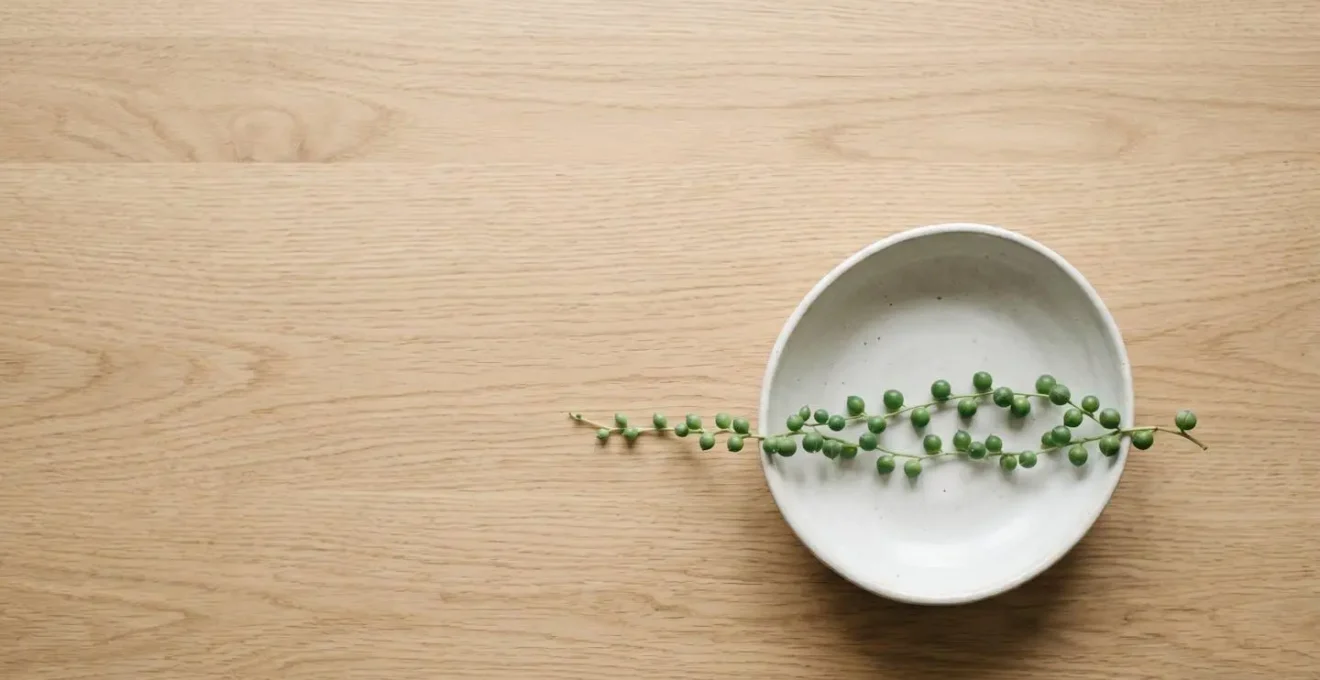
As the overhead view shows, the empty surface area is the hero. It provides the “visual rest” that allows the single botanical to have maximum effect. This singular object is given the space to breathe and to be appreciated as a piece of sculpture. It invites closer inspection rather than contributing to a field of distraction. This is why a single, carefully considered stem of orchids in a simple glass has more power and sophistication than a dense bouquet.
This approach elevates the coffee table from a functional surface for holding things to a plinth for a single, curated piece of living art. It is the ultimate expression of confidence in the principle that one perfect thing is infinitely more impactful than fifty mediocre ones.
Empty Space: How Western Minimalism Differs from Japanese Ma?
In the West, we tend to perceive empty space—or negative space—as a passive void, a background that exists simply to be filled or to provide contrast for the “main event.” It is the absence of things. The Japanese aesthetic tradition, however, offers a profoundly different and more powerful concept: Ma (間). This philosophy is crucial for any minimalist looking to move beyond simple decluttering into a deeper form of spatial design.
Ma is not absence; it is a pregnant pause. It is the interval, the space *between* things, that is itself full of energy and meaning. It is an active, tangible component of any composition. As author Kiyoshi Matsumoto explains, the very symbol for Ma contains the character for “sun” within the character for “door,” suggesting the light that fills the gap.
Ma has been described as a pause in time, an interval or emptiness in space. Even the kanji symbol for Ma combines door and sun. Together these two characters depict a door through the crevice of which the sunlight peeps in.
– Kiyoshi Matsumoto, Skillshare – What Is Negative Space Design Psychology
Western minimalism often focuses on what to remove, an act of subtraction. The application of Ma is an act of composition, where the placement of one object is done to consciously sculpt the space around it. This is perfectly illustrated in the art of Ikebana, Japanese flower arranging.
Case Study: Ikebana as Active Space Design
In traditional Japanese aesthetics, the concept of Ma values the space between things as meaningful in itself. In ikebana, the artist doesn’t just place a branch—they sculpt the empty space around the branch, making it a tangible part of the composition. This contrasts with Western negative space as a passive background, positioning Ma as a pregnant pause full of energy and anticipation where a single branch implies the entire tree and the season.
For the minimalist homeowner, adopting the mindset of Ma means that when you place a single branch in a vase, your primary concern is not the branch itself, but the shape and quality of the space you are creating between the branch, the vase, and the wall. That space is now charged with intention. It is not empty; it is full of potential.
Key Takeaways
- Treat botanicals as architectural tools, not decorative objects, to sculpt space with precision.
- Prioritize a single, structural element over multiple smaller plants to avoid visual clutter and maximize impact.
- Focus on the active negative space (Ma) around the plant; this empty space is a tangible and powerful design component.
How to Soften Hard Modern Lines with Organic Floral Shapes?
Minimalist architecture is often defined by hard, clean lines: the sharp corner of a concrete wall, the rigid grid of a windowpane, the unforgiving horizontal of a low-profile media console. While this geometry creates order, it can also feel severe. The final, masterful touch in botanical styling is to use the soft, unpredictable, organic shapes of plants to deliberately interrupt and soften these lines. This creates a visual dialogue between the rigid and the fluid, the manufactured and the natural.
This is a strategic act of contrast. The wild, cascading form of a trailing plant is made more dramatic when set against a hard, straight edge. The feathery, chaotic texture of a fern is more impactful when contained within a simple, geometric pot. It is this tension between control and wildness that creates a dynamic and sophisticated space. The plant’s purpose is to offer organic relief from the room’s inherent rigidity.
To implement this, think in terms of pairings and deliberate interruptions, as a recent analysis of minimalist plant decor suggests:
- Soften Edges: Use trailing plants like Satin Pothos or trailing ivy. Place them on the edge of a shelf or mantel so their vines cascade down, breaking the hard horizontal line.
- Contrast Forms: Pair the round, coin-like leaves of a Pilea Peperomioides (Chinese Money Plant) against a flat, rectangular concrete or plaster wall for a direct contrast of shape.
- Create Organic Relief: Place a plant with soft, feathery fronds, such as an Asparagus Fern, in front of a sharp-cornered metal bookshelf or window frame. Its form will blur and soften the hard geometry behind it.
This technique ensures the room feels balanced. The architectural structure provides a strong, orderly foundation, while the botanical element introduces a necessary touch of grace, movement, and life. The result is a space that is both disciplined and soulful, achieving a harmony that neither element could create on its own.
To truly master this architectural approach to botanicals, begin by observing your space not as a container to be filled, but as a volume to be sculpted. Choose one surface or corner and make a single, intentional botanical intervention. Evaluate its impact, live with it, and let it teach you the profound power of restraint.