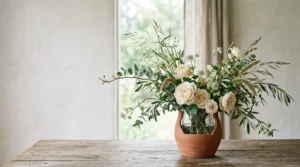
The secret to foam-free organic design isn’t a product, but a set of physical and aesthetic principles.
- Mastering structural mechanics like chicken wire matrices and self-supporting spirals is foundational.
- Embracing natural asymmetry and color theory guides the viewer’s eye and creates an authentic feel.
Recommendation: Start by focusing on one technique, like the spiral, to understand the core physics of building volume and structure without waste.
The desire for airy, wild, and emotionally resonant floral arrangements—the signature of the organic modern style—is stronger than ever. For years, the industry’s default tool for achieving gravity-defying structure has been green floral foam. Yet, eco-conscious designers are increasingly confronting a difficult truth: this convenience comes at a significant environmental cost. The material is a single-use plastic that is not biodegradable and creates harmful microplastic pollution. Environmental research confirms a single block of floral foam contains as much plastic as 10 plastic shopping bags.
Many alternatives are suggested, from chicken wire to flower frogs, but simply swapping one tool for another misses the point. Achieving the organic modern aesthetic without foam is not about finding a direct substitute; it is a fundamental shift in mindset. It requires moving from forcing stems into a static block to understanding and mastering the underlying physics of structural tension, negative space, and natural artistry. It’s about letting the materials themselves create the architecture.
This guide will deconstruct the core mechanical and aesthetic principles behind sustainable, foam-free design. We will explore not just the tools, but the techniques and theories that empower you to create arrangements that are not only beautiful and on-trend but also ethically sound and structurally intentional. It’s time to build arrangements that are truly, deeply, organic from the inside out.
To guide you through this new approach, this article breaks down the essential techniques and principles. The following summary outlines the key pillars of foam-free floral artistry that we will explore in detail.
Summary: The Art of Sustainable Floral Mechanics
- Why Is Chicken Wire the Secret to Airy, Organic Arrangements?
- How to Mix Dried Palms with Fresh Roses for a Boho Look?
- The Weed or Flower Debate: Using Roadside Grasses in High-End Design
- The Off-Center Rule: Why Symmetry Kills the Organic Vibe?
- Terracotta and Sage: How to Build a Palette from Nature?
- Why Is the Spiral Technique Essential for Loose Bouquet Volume?
- The Environmental Cost of Bleached Ruscus and Ferns
- How to Style Dried Flowers Without Them Looking Dusty or Old?
Why Is Chicken Wire the Secret to Airy, Organic Arrangements?
Chicken wire, or floral netting, is the workhorse of foam-free mechanics, but its genius lies not in what it holds, but in what it doesn’t. Unlike dense foam, which suffocates stems and leaves no room for movement, chicken wire creates an invisible structural matrix. This framework of hexagonal cells provides countless anchor points while preserving negative space, allowing stems to breathe and be placed at natural, dynamic angles. This method encourages the airy, light-filled quality that defines the organic modern look.
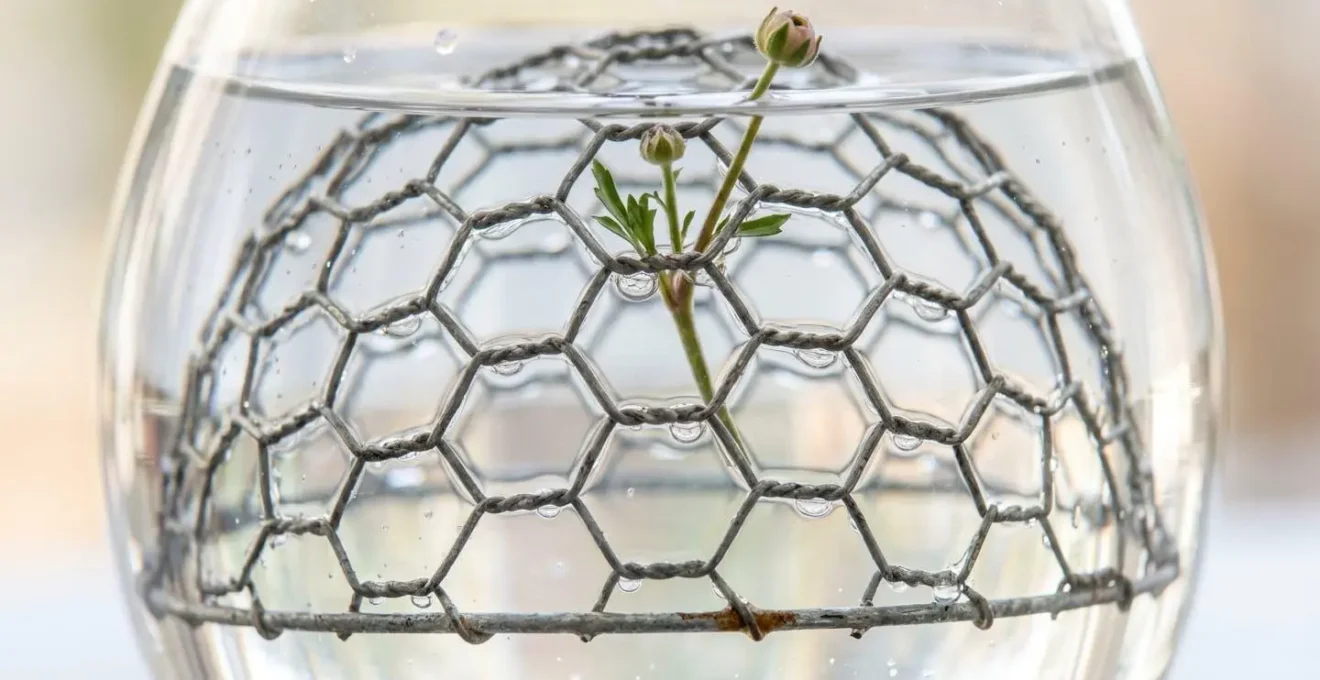
As the image demonstrates, the wire itself becomes a hidden architecture. It allows a designer to build volume and height without density, creating a composition that feels alive and unforced. Furthermore, it is a remarkably cost-effective and reusable tool. Research from Mississippi State University shows that you can find options for as little as 30 cents per foot. To properly use this mechanic, follow a clear process:
- Cut and Shape: Cut a piece of chicken wire roughly twice the size of your vessel’s opening. Form it into a loose, pillow-like dome and tuck it securely inside the container. Ensure it’s tight enough not to shift.
- Establish Structure: Place your heaviest, most structural branches first. These will form the foundational shape of your arrangement and can rest on the vessel’s rim for support.
- Build Outwards to Inwards: Begin placing stems around the outer edge of the wire, angling them outwards to create width. Gradually work your way toward the center, filling in the arrangement and building volume.
- Reuse and Maintain: Opt for coated wire to prevent rust and ensure reusability. After each use, simply rinse the wire thoroughly to remove bacteria and store it for your next design, making it a truly sustainable choice.
How to Mix Dried Palms with Fresh Roses for a Boho Look?
The modern bohemian (“boho”) aesthetic is built on a foundation of textural contrast. It’s a style that celebrates the perfect imperfection of mixing different materials, and no combination captures this better than the pairing of rigid, fibrous dried palms with the soft, velvety petals of fresh roses. This isn’t just a random mix; it’s a deliberate act of intentional curation that tells a story of different lifecycles and surfaces coexisting in harmony.
The key to success is balance. The structural and often muted tones of dried elements, like spear palms or fan palms, create a powerful, sculptural backdrop. They provide the architectural lines and the earthy foundation. Against this, the fresh roses provide a burst of vibrant color, life, and delicate softness. The contrast is what creates the visual interest: the waxy sheen of a rose petal against the matte, fibrous texture of a dried palm leaf. This high-low mix prevents the arrangement from feeling either too static (if all dried) or too conventionally pretty (if all fresh).
To create a successful boho look, think in layers. Use the dried palms to establish the overall shape and height of your arrangement. They are your non-negotiable structural elements. Then, nestle the fresh roses within this framework, allowing them to become the focal point and the heart of the design. Let some roses sit deep within the arrangement for a sense of depth, while others can extend slightly further out to create movement. This push and pull between the enduring quality of the dried and the fleeting beauty of the fresh is the very soul of the boho aesthetic.
The Weed or Flower Debate: Using Roadside Grasses in High-End Design
What one person calls a weed, a designer sees as texture, movement, and authenticity. The inclusion of foraged materials, particularly common roadside grasses, seed pods, and wildflowers like Queen Anne’s Lace, is a hallmark of the organic style. These elements bring a level of uncultivated wildness that you simply cannot replicate with commercially grown flowers. They provide the delicate, airy “filler” that connects the larger focal flowers, creating a soft, meadow-like feel. Their unpredictable bends and natural variations break up the uniformity of a design, making it feel more alive and less constructed.
However, the romantic notion of foraging must be grounded in a strong ethical and safety framework. Responsible design requires more than a good eye; it demands respect for the environment and an awareness of potential hazards. Before gathering any materials, every designer should operate under a strict code of conduct. This ensures that your sustainable practices don’t inadvertently cause harm to local ecosystems or yourself. The most critical principles can be broken down into a forager’s code of ethics.
The Forager’s 3-Part Code of Ethics
- Legality Check: Never forage on private property without explicit permission. Before harvesting from public lands like parks or wilderness areas, always verify local regulations, as many have strict rules against removing any plant material.
- Ecological Responsibility: Adhere to the 10% rule: never take more than a small fraction of what is available in a given patch. This leaves enough for wildlife and ensures the plant population can regenerate. Be able to identify and completely avoid rare or endangered species.
- Safety Protocol: Avoid foraging in areas with a high risk of chemical contamination. This includes the immediate vicinity of major highways (due to vehicle emissions), agricultural fields (pesticide runoff), and manicured public spaces that may be chemically treated.
The Off-Center Rule: Why Symmetry Kills the Organic Vibe?
Nature is perfectly imperfect. While a tree may appear balanced, it is never truly symmetrical. One branch reaches further for light; another is heavier with fruit. The organic modern aesthetic mimics this natural law by rejecting rigid symmetry in favor of dynamic, off-center compositions. A symmetrical arrangement is predictable and static; your eye finds the center and stops. An asymmetrical design, however, creates movement and intrigue, inviting your eye on a journey through the composition.
A symmetrical arrangement stops the viewer’s eye in the center, while an asymmetrical one creates a dynamic path, encouraging the eye to travel through the piece.
– Sustainable Floristry Design Principles, Sustainable Floristry Network Design Philosophy
This principle is about creating a visual pathway. By placing the focal point—the largest flower or most dramatic element—off-center, you create a sense of visual tension. The “empty” space, or negative space, on the other side becomes just as important as the flowers themselves, providing a place for the eye to rest and appreciate the lines of the design. This is often achieved by establishing a high point, a low point, and a middle focal point, creating a subtle triangular shape that guides the viewer’s gaze from one element to the next.
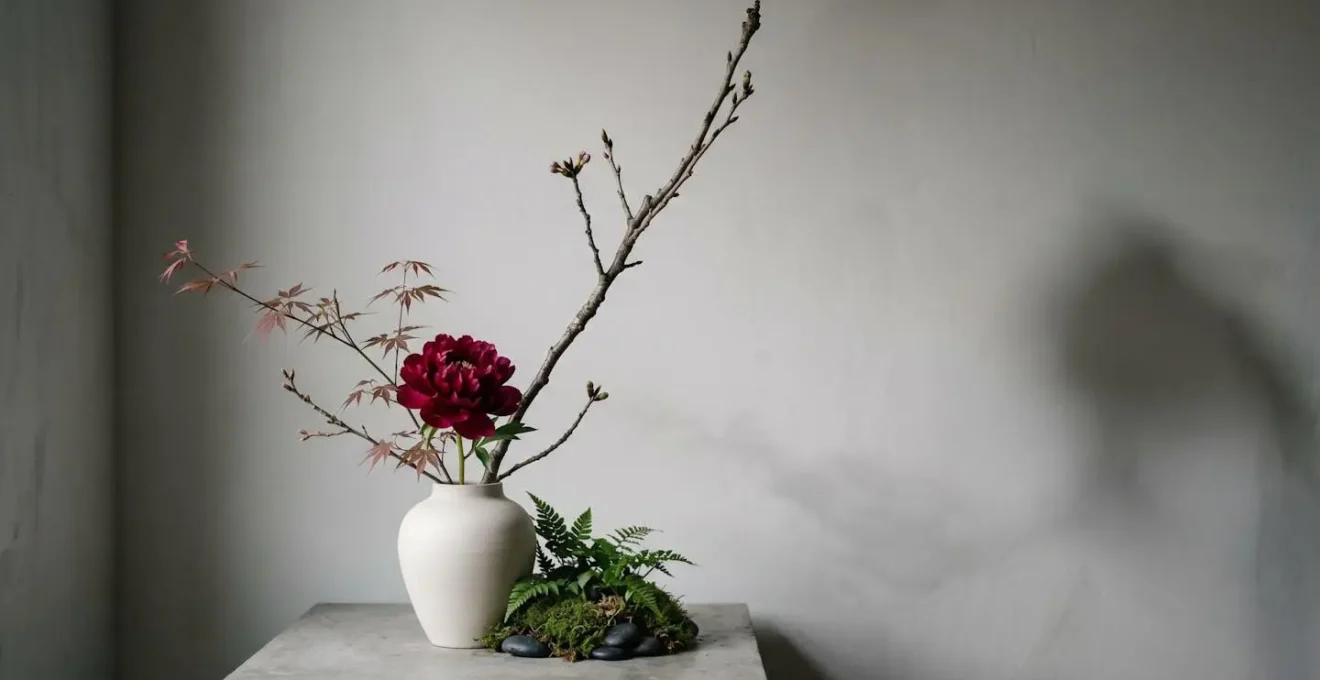
The key is to think about visual weight. A tall, delicate branch on one side can be balanced by a cluster of low, heavy blooms on the other. This creates a sense of equilibrium without mirroring. It’s a more sophisticated and natural way to achieve balance, and it is the absolute cornerstone of making a foam-free arrangement feel intentionally designed rather than just haphazardly placed.
Terracotta and Sage: How to Build a Palette from Nature?
Color is the emotional core of any floral design, and in the organic modern style, the most compelling palettes are borrowed directly from the natural world. Instead of relying on pre-set, artificial color wheels, this approach involves observing and deconstructing the colors of a landscape. Think of a desert at sunset, a foggy coastline, or a forest floor. These environments provide sophisticated, harmonious palettes built on earthy base tones and subtle highlights. A palette of terracotta and sage, for example, directly evokes sun-baked earth and dusty, resilient foliage.
Building a palette from nature is about identifying a dominant color, a secondary color, and one or two accent tones. The most effective way to structure this is by applying the classic 60-30-10 rule, a principle borrowed from interior design that creates a visually pleasing and balanced composition. This rule provides a clear, mechanical framework for translating a natural landscape into a floral arrangement.
Applying this to our terracotta and sage example, the breakdown would be as follows:
- 60% Dominant Color: This is your foundational hue, which sets the overall mood. In this case, various shades of sage green foliage (like eucalyptus, olive branches, or dusty miller) would make up the bulk of the arrangement, establishing the natural, earthy base.
- 30% Secondary Color: This color creates contrast and interest. Terracotta-hued flowers, such as ‘Toffee’ or ‘Cappuccino’ roses, or dried elements like preserved oak leaves, would serve as the secondary color, providing warmth and a clear focal point.
- 10% Accent Color: These are the small, jewel-like pops that elevate the entire design. A touch of creamy white (from lisianthus or ranunculus) or a deep, rich chocolate brown (from chocolate cosmos or dark scabiosa) adds sophistication and depth, preventing the palette from feeling flat.
Why Is the Spiral Technique Essential for Loose Bouquet Volume?
For bouquets and vase arrangements that need to stand on their own without external mechanics, the spiral technique is not just a method—it’s a lesson in structural physics. When executed correctly, this technique creates an interlocking, self-supporting vortex of stems. This internal tension is what allows the flower heads to splay outwards naturally, creating the abundant, loose volume characteristic of the organic style without crushing the delicate stems at the center. It’s the architecture that allows each flower to have its own space to “breathe.”
Case Study: The Spiral as Self-Supporting Architecture
An analysis by Sweet Earth Co. documents how the spiral technique creates a self-supporting structure through applied physics. By continuously placing each new stem at a consistent angle against a central axis, the stems form an interlocking ‘vortex’. This creates internal tension where no single stem bears the full weight. When the finished bouquet is placed in a clear vase, the spiraled stems form a natural grid at the base. This grid acts as its own mechanic, holding every flower in place and eliminating the need for wire or other supports while maximizing volume and airiness.
Mastering this technique requires practice, but the principle is straightforward. Each stem is laid at an angle, and the bouquet is rotated in your hand, so all stems spiral in the same direction. The result is a strong, stable base and a beautifully open top. The following plan breaks down the process into its essential steps.
Action Plan: Mastering the Spiral Bouquet
- Preparation: Prepare all your stems by stripping any foliage that will fall below the binding point (where your hand holds the bouquet). Group flowers by variety for easy access.
- Establish the Core: Begin with 2-3 of your sturdiest focal stems. Hold them in your non-dominant hand; this will be the central axis of your spiral.
- Add and Rotate: Add each new stem at a consistent 45-degree angle to the core stems. After adding a stem, give the entire bouquet a slight turn in your hand. All stems should spiral in the same direction and never cross over each other.
- Place the Locking Stem: As the bouquet grows, the final few stems are crucial. They should be placed firmly against the existing spiral to “lock” the entire structure in place, tightening the vortex.
- Secure and Trim: Once the shape is complete, securely tie the bouquet at the binding point with twine. Trim all stems to your desired length, cutting them at a sharp diagonal to maximize water absorption.
The Environmental Cost of Bleached Ruscus and Ferns
A truly sustainable practice requires looking beyond the obvious problem of floral foam and examining the entire life cycle of our materials. The trend for ethereal, pale, and white-washed dried foliage has led to a surge in chemically bleached products like Italian ruscus, ferns, and pampas grass. While these materials are foam-free, they carry a significant and often invisible chemical footprint that runs counter to the ethos of natural design.
The bleaching process involves harsh industrial chemicals, such as chlorine and peroxide, to strip the foliage of its natural color. The wastewater from this process can pollute local water systems, and the final product, while beautiful, is far from “natural.” This practice is philosophically similar to the problem with floral foam, which also leaches harmful substances. As noted by industry reports, floral foam contains known carcinogens like formaldehyde, which it can release into the water and air. Choosing bleached products is, in a way, trading one environmental problem for another.
The good news is that nature provides a vast catalog of materials that offer a pale, delicate aesthetic without any chemical intervention. Opting for these naturally light-colored or silvery-toned botanicals allows you to achieve the desired look while maintaining complete ethical and environmental integrity. Consider these stunning, unprocessed alternatives:
- Lunaria (Honesty): Offers naturally silvery-white, translucent seed pods that catch the light beautifully.
- Silvery-Green Eucalyptus: Varieties like Silver Dollar and Baby Blue have a natural pale, sage-green coloring and a wonderful aromatic quality.
- Naturally Dried Lagurus (Bunny Tails): These soft, creamy-white grass plumes provide delicate texture without any need for bleaching.
- White Statice: This flower air-dries perfectly, maintaining a crisp white color and a papery texture with zero chemical treatment.
Key Takeaways
- Master the Mechanics: True foam-free design relies on understanding the physics of structural integrity, using tools like chicken wire matrices and self-supporting spiral techniques.
- Embrace Nature’s Rules: The most authentic organic look comes from applying natural principles of asymmetry, negative space, and palettes derived directly from landscapes.
- Think Holistically: Sustainability goes beyond just avoiding foam. It involves examining the entire supply chain, from the ethics of foraging to the chemical footprint of processed and bleached materials.
How to Style Dried Flowers Without Them Looking Dusty or Old?
Dried flowers have shaken off their reputation as dusty, forgotten relics and are now a cornerstone of modern interior styling. The key to their contemporary appeal lies in intentional curation. A modern dried arrangement is not something left to fade in a corner; it is a carefully composed piece of sculpture that plays with texture, form, and light. The primary goal is to make the arrangement look deliberate, clean, and integrated into its space, avoiding the dreaded “attic find” aesthetic.
One of the most effective strategies is to create high-contrast pairings. Place a textured, matte dried arrangement in a sharp, minimalist vessel made of glass or metal. The contrast between the soft, organic forms of the flowers and the hard, clean lines of the container immediately signals a modern sensibility. Similarly, placing the arrangement against a clean, modern backdrop or on a polished surface like marble or concrete enhances this effect. It’s about creating a dialogue between the natural and the man-made.
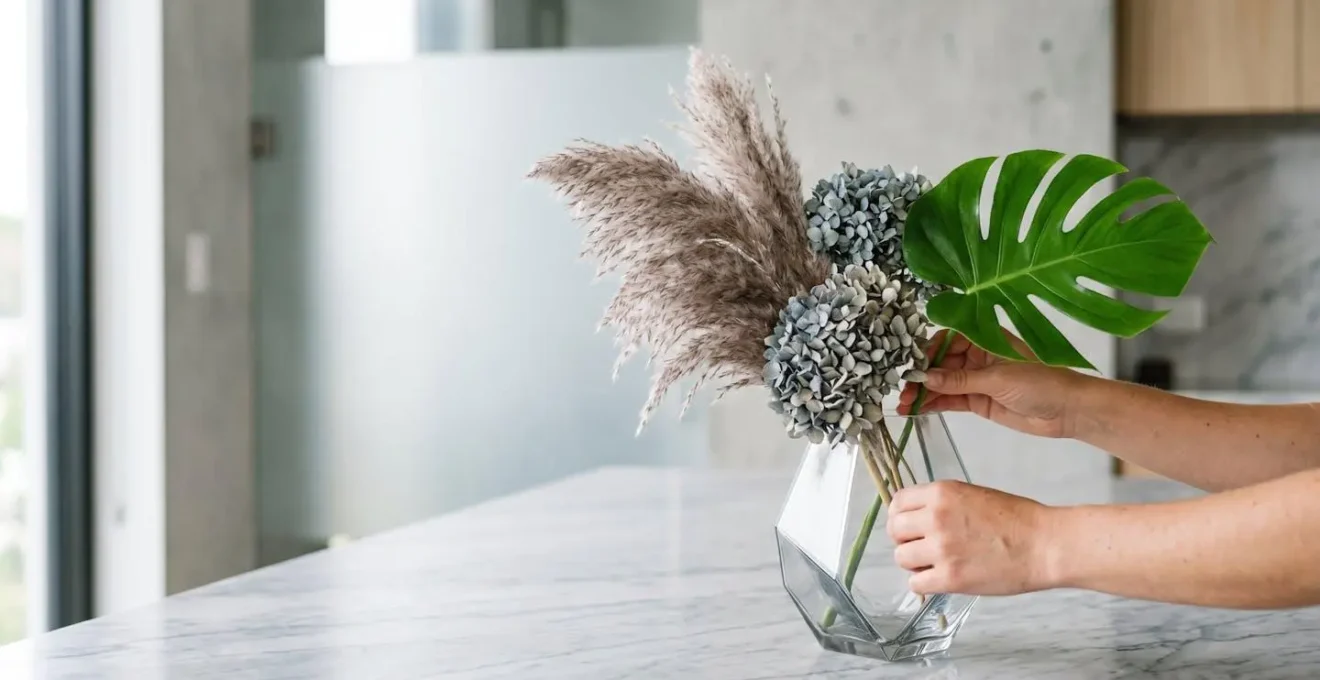
Of course, practical preservation is crucial to maintaining a fresh look. Dust is the number one enemy of dried arrangements, followed by brittleness and fading. A proactive approach to preservation can keep your arrangements looking vibrant and intentional for years. Implementing a simple maintenance protocol is the final step in mastering the art of dried botanicals.
- Seal Upon Purchase: Immediately after buying, lightly spray your dried flowers with an artist’s fixative spray or a specialized floral sealant. This creates a protective barrier that helps repel dust and strengthens delicate elements.
- Strategic Placement: Keep arrangements out of direct sunlight, which causes rapid fading. Also, avoid areas of high humidity (like bathrooms) or directly in front of air vents, which can make them brittle.
- Gentle Cleaning: For dust removal, use a hairdryer on its lowest, coolest setting, holding it at a safe distance. For more stubborn dust, a soft, clean makeup brush can be used to gently whisk it away.
- Annual Refresh: Once a year, assess your arrangement. Prune any elements that have become too brittle or have faded significantly. This is a great opportunity to add a few new seasonal dried finds to refresh the look and maintain its curated appearance.
By embracing these foam-free mechanics and thoughtful design principles, you can begin crafting arrangements that are not only aesthetically stunning but also aligned with a deeper commitment to sustainability. Start experimenting today to transform your floral practice.