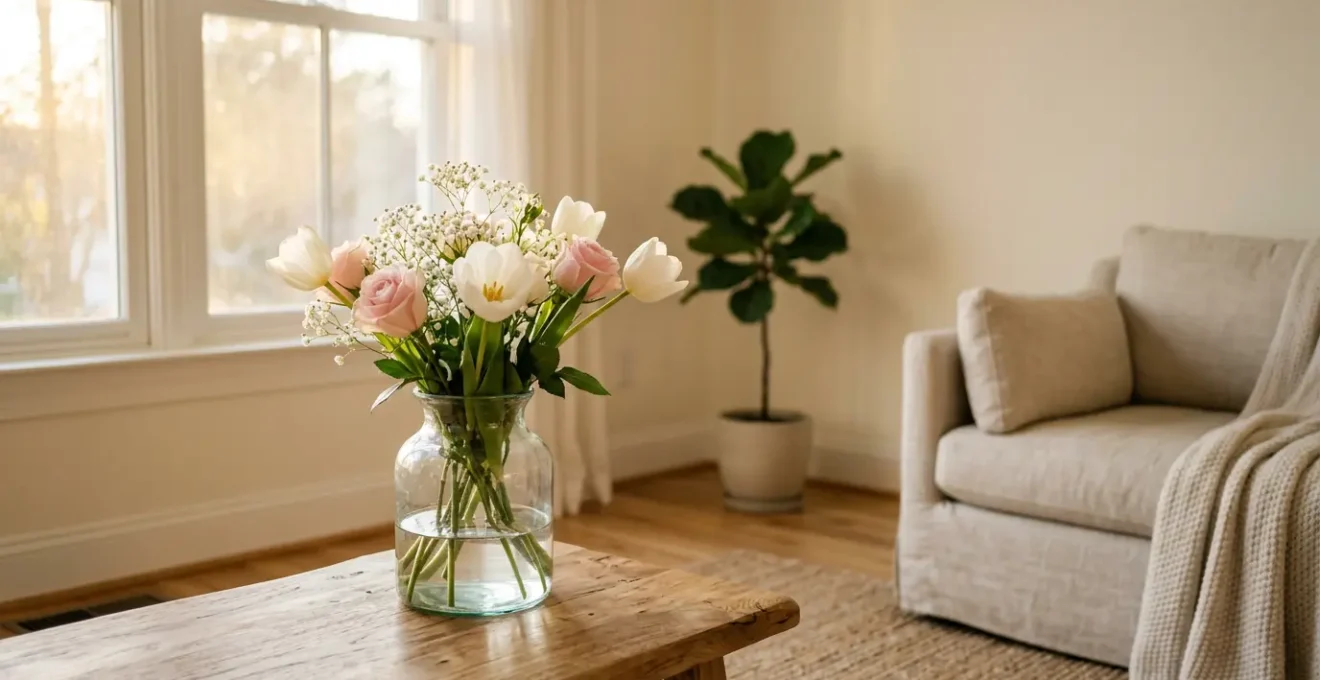
The mood-boosting effect of flowers is a predictable neurological response, not just an aesthetic preference.
- Fresh blooms trigger a state of ‘involuntary attention,’ which actively reduces the cognitive fatigue common in urban environments.
- Their color and texture are not just decorative; they are tools that can be strategically chosen to manipulate ambient light and energy in a room.
Recommendation: Approach floral styling not as simple decoration, but as a deliberate and powerful tool for environmental therapy in your home.
For the busy urban professional, the home is a sanctuary—a place to decompress from the constant cognitive load of city life. We invest in ergonomic chairs, calming paint colors, and minimalist art, all in an effort to architect a more peaceful state of mind. Many believe the gentle ambiance of fresh flowers is a simple, almost quaint, addition to this effort. We know they look beautiful and smell pleasant, but we often underestimate their true power, viewing them as a fleeting luxury.
But what if the profound sense of calm we feel in their presence is not just a passing fancy? What if it’s the result of a deep, biological mechanism hardwired into our brains? The key to unlocking a less stressful home environment might not lie in acquiring another object, but in understanding how to leverage the living, sensory cues of nature. This goes beyond basic color psychology or the vague notion of “bringing the outdoors in.” It’s about a targeted form of cognitive restoration.
This article reframes the conversation. We will move past the platitudes and explore the science of why flowers are such a potent tool for mental well-being in a modern, often sterile, environment. We’ll delve into the neurological processes they trigger, the practical ways to select blooms for specific psychological effects, and the styling principles that can transform the very identity of your space. By the end, you will see flowers not just as decoration, but as an essential element of your personal wellness toolkit.
To help you navigate these insights, we will explore the core mechanisms behind nature’s impact, offer practical guidance for choosing and placing your flowers for maximum effect, and reveal the design principles that turn a simple bouquet into a powerful mood regulator. This guide breaks down the science and art of using flowers to architect a happier, healthier home.
Summary: Why Do Fresh Cut Flowers Improve Mood? The Surprising Science for Urban Homes
- Why Does Having Nature Indoors Reduce Anxiety Levels Rapidly?
- How to Choose Blooms That Boost Energy in Dark Rooms?
- Lilies or Sunflowers: Which Is Better for a Home Office Setup?
- The Placement Mistake That Makes Flowers Wilt in 2 Days
- How to Keep Cut Stems Fresh for Over 10 Days Without Chemicals?
- Why Do Soft Petals Look Better Against Concrete and Steel?
- Why Does the Eye Drawn to Red Flowers First on a Table?
- How to Use Floral Styling to Change the Identity of a Room Instantly?
Why Does Having Nature Indoors Reduce Anxiety Levels Rapidly?
The calming effect of nature is not a placebo; it’s a well-documented neurological phenomenon. When you place fresh flowers in your apartment, you are introducing a powerful set of sensory cues that directly counteracts cognitive fatigue. The rapid reduction in anxiety stems from a process explained by Attention Restoration Theory (ART), which posits that natural environments allow our brains to switch from directed, effortful attention to a state of soft fascination, or involuntary attention.
This mental shift gives the executive functions of our brain—responsible for focus, planning, and problem-solving—a much-needed rest. You don’t have to *try* to look at a flower; its complex patterns and gentle forms capture your attention effortlessly. Research from Cornell University found that as little as 10 minutes in natural settings can significantly reduce stress and anxiety. Bringing that setting indoors provides a micro-dose of this restorative effect throughout the day. This is why a simple glance at a vase of flowers can feel like a mental reset button.
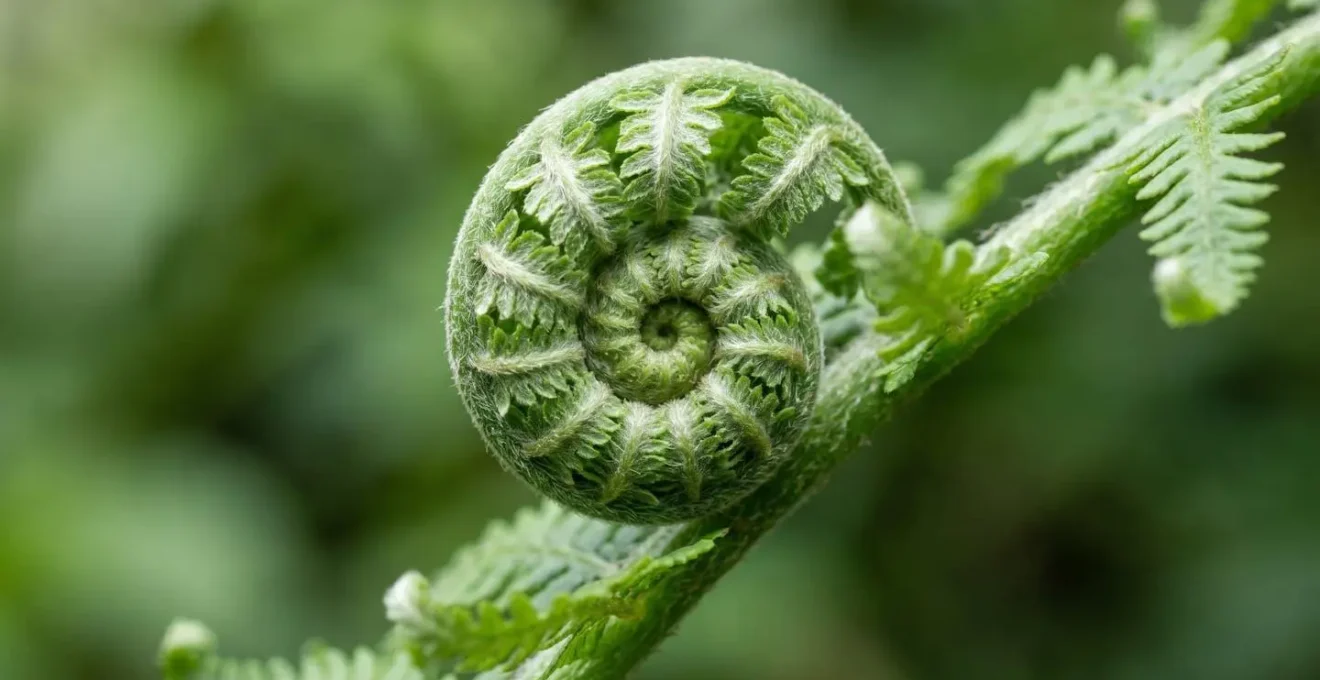
This effect is amplified by the presence of natural fractal patterns—the repeating, self-similar shapes found in leaves, petals, and branches, as seen in the fern frond above. Our visual system is highly efficient at processing these patterns, which makes viewing them inherently calming. As explained by research into the field, this is the core mechanism at play:
Natural environments, filled with panoramic views, fractals, and gentle, engaging stimuli like rustling leaves or flowing water, allow your brain to shift into a state of involuntary attention.
– Attention Restoration Theory research, Nature’s Power to Restore Your Mind
Ultimately, a bouquet is not a static object but a dynamic source of restorative sensory information that gives your over-stimulated urban brain a space to recover.
How to Choose Blooms That Boost Energy in Dark Rooms?
In urban apartments where natural light can be a scarce commodity, the right flowers can do more than just add color; they can physically manipulate and amplify the available light, creating a sense of energy and brightness. The key lies in selecting blooms based on their surface texture and light-reflecting properties, not just their hue. White, yellow, and other pale-colored flowers are the most effective choices for dimly lit spaces.
The science is straightforward: these colors have the highest albedo, or measure of reflectance. Instead of absorbing light, they bounce it back into the room, creating an illusion of greater brightness. But the type of reflection matters. A 2015 study on floral optics revealed a fascinating distinction between the light reflected from a petal’s exterior (ERL) and its interior (IRL). It found that blooms with smooth, waxy surfaces, like tulips or certain roses, produce a higher intensity of ERL.
As the study on the light reflection properties of flower petals discovered, this glossy texture acts like a tiny, organic mirror, scattering ambient light more effectively than petals with a matte or “velvety” finish. While velvety petals might seem richer up close, their microscopic texture traps light, creating depth and saturation at the expense of luminosity. For a dark corner, the goal is maximum bounce. Therefore, choosing a bouquet of white tulips or pale-yellow daffodils with a sheeny surface will literally introduce more reflected light into your room than a bouquet of deep-red, velvety roses.
When selecting flowers for an energy boost in a darker space, prioritize high-contrast, light-colored blooms with a smooth, almost polished finish to make the most of every available lumen.
Lilies or Sunflowers: Which Is Better for a Home Office Setup?
Choosing flowers for a home office isn’t just an aesthetic decision; it’s a strategic one that can impact focus and productivity. Both lilies and sunflowers can enrich a workspace, but they serve different psychological functions. The right choice depends on the specific mental state you want to cultivate. The simple presence of plants is already a proven benefit; a landmark University of Exeter study found a 15% productivity increase in offices enriched with greenery.
As lead researcher Marlon Nieuwenhuis noted, this isn’t a minor improvement: “Enriching a previously Spartan space with plants served to increase productivity by 15% — a figure that aligns closely with findings in previously conducted laboratory studies.” The question, then, is how to optimize that benefit. Sunflowers, with their bright yellow hue and open, upward-facing structure, are powerful energizers. They are visually stimulating and associated with optimism and vitality, making them ideal for combating mid-afternoon slumps or motivating creative brainstorming sessions.
Lilies, on the other hand, offer a different kind of support. Their elegant, sculptural forms provide a point of calm, sophisticated focus. However, their strong fragrance can be a double-edged sword. For some, a subtle scent can enhance the environment, but for many, a powerful floral aroma in a confined workspace can become a significant distraction. Given that the goal of a home office is sustained concentration, a low-scent or unscented flower is often the safer and more effective choice.
This table breaks down the choice based on key productivity-related factors:
| Factor | Sunflowers | Lilies |
|---|---|---|
| Visual Energy | High (Energizing, good for motivation) | Low (Calming, good for focus) |
| Scent Impact | None (No distraction) | High (Potentially distracting, risk of headache) |
| Best For | Creative tasks, fighting fatigue, bright spaces | Analytical tasks, creating a calm atmosphere, minimalists |
For most home office environments focused on sustained productivity, sunflowers are the superior choice. Their non-invasive, visually uplifting presence provides a consistent energy boost without the cognitive distraction of a strong perfume.
The Placement Mistake That Makes Flowers Wilt in 2 Days
You’ve brought home a beautiful bouquet, but within 48 hours, it’s drooping and sad. The most common culprit isn’t the quality of the flowers, but a simple, avoidable placement mistake. Cut flowers are highly sensitive to their micro-environment, and placing them in the wrong spot can drastically accelerate the wilting process. The primary enemy is anything that promotes rapid dehydration or exposure to ethylene gas, a natural plant hormone that triggers aging.
Many of the most common spots we choose for flowers—a sunny windowsill, a kitchen counter next to the fruit bowl, or a mantelpiece above a fireplace—are precisely the worst locations for their longevity. Direct sunlight and heat sources (like electronics, radiators, or fireplaces) cause the petals and leaves to lose water through transpiration much faster than the stems can absorb it. This water deficit is the direct cause of wilting.
Even more insidious is ethylene gas. This invisible compound is released by ripening fruits (especially apples, bananas, and avocados), as well as by gas stoves and even cigarette smoke. Placing your flowers near these sources is like putting them in a hyper-aging chamber. To keep your arrangement vibrant, you must avoid these common environmental traps. Florists consistently advise against these placements:
- Near Ripening Fruit: The ethylene gas released by a fruit bowl is a potent floral-aging agent.
- In Direct Sunlight: The heat and UV rays accelerate dehydration and can scorch delicate petals.
- Close to Heat Sources: Avoid placing flowers near radiators, vents, televisions, or computer monitors that generate warmth.
- In a Draft: Constant air movement, whether from an open window or an air conditioning vent, dramatically increases water loss from the leaves.
The ideal location for cut flowers is a cool spot with bright, indirect light and away from any fruit, drafts, or heat sources. This simple change in placement can often double the life of your bouquet.
How to Keep Cut Stems Fresh for Over 10 Days Without Chemicals?
While avoiding placement mistakes is crucial, proactive care is what allows you to extend the life of cut flowers well beyond a week, often pushing them to 10 days or more without relying on commercial chemical preservatives. With proper care, it’s realistic to expect a high-quality fresh-cut flower lifespan of 7 to 12 days. The secret lies in a few key floristry techniques focused on two goals: maximizing water uptake and minimizing bacterial growth.
The single most important technique is to cut the stems underwater. When you cut a stem in the air, a tiny air bubble (an embolism) can be drawn into the vascular system, blocking the flow of water. Submerging the stem end in a bowl of water while you make the cut prevents this from happening, ensuring an unbroken channel for hydration from the moment it enters the vase. This simple action can dramatically improve a flower’s ability to stay hydrated.
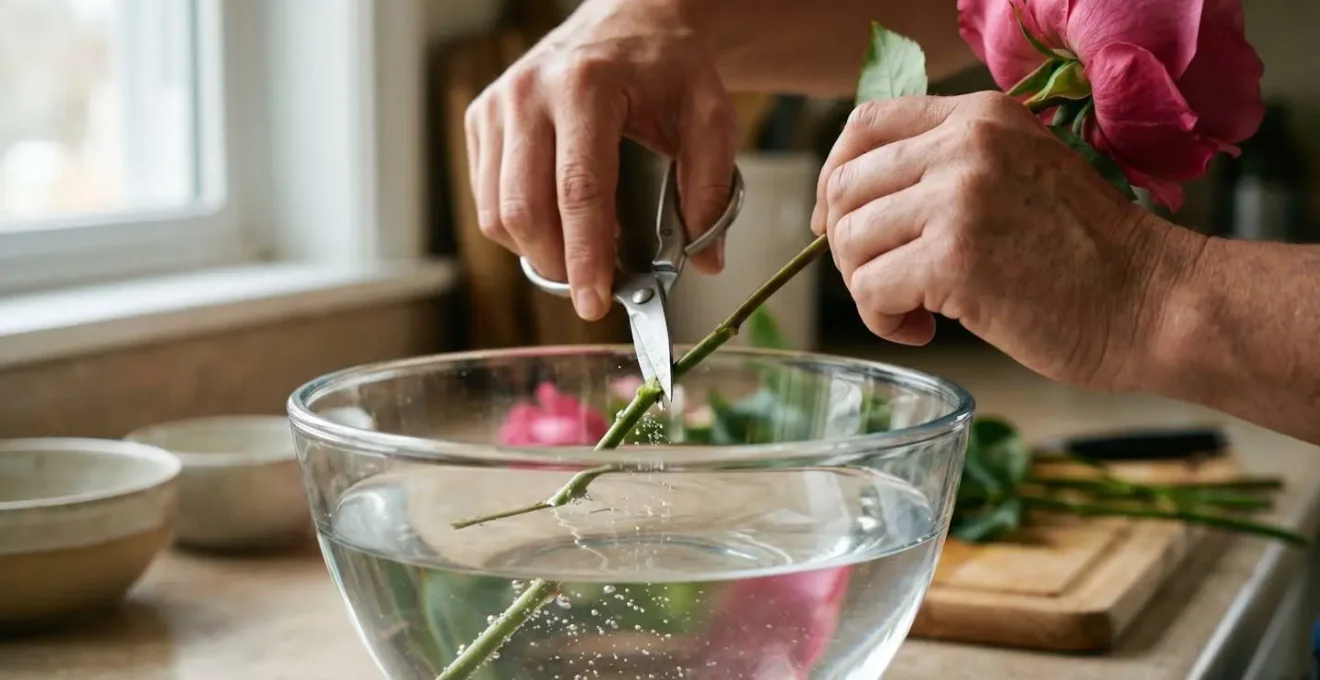
As the image demonstrates, a sharp, 45-degree angle cut is also essential. This increases the surface area for water absorption and prevents the stem from sitting flat against the bottom of the vase, which would block water flow. Combined with a disciplined care routine, these non-chemical methods create an optimal environment for longevity.
Your Action Plan: 10-Day+ Flower Freshness
- Initial Cut and Prep: Immediately upon arrival, fill a bowl with lukewarm water. Submerge the bottom two inches of each stem and, while underwater, use sharp scissors to trim at least one inch off at a 45-degree angle. Remove all leaves that will sit below the waterline in the vase.
- Vase and Water Purity: Use a spotlessly clean vase to prevent bacteria. Fill it with lukewarm water, as it’s absorbed more easily by stems than cold water. Avoid using “flower food” packets if you prefer a chemical-free approach.
- Daily Water Change: This is non-negotiable. Every day, empty the old water and refill the vase with fresh, lukewarm water. Bacteria and their waste products are a primary cause of stem blockage and decay.
- Recut Stems Every 2-3 Days: The cut ends of the stems will begin to seal over time. To maintain maximum water absorption, take the flowers out every two to three days and repeat the underwater re-cutting process.
- Cool Nightly Storage: If possible, move your arrangement to the coolest room in your house (or even a refrigerator, if it’s not set too cold and contains no fruit) overnight. Lower temperatures slow down the flowers’ metabolic rate, conserving their energy and prolonging their freshness.
Consistency is everything. A simple, daily ritual of fresh water and attentive care is far more effective than any single “hack” or preservative packet.
Why Do Soft Petals Look Better Against Concrete and Steel?
In the modern urban apartment, characterized by hard lines, industrial materials like concrete and steel, and a neutral color palette, the introduction of soft, organic flowers creates a striking and deeply satisfying visual effect. This appeal is not merely about adding a “pop of color.” It’s rooted in a neuro-aesthetic principle known as visual tension. Our brains are hardwired to notice and be stimulated by contrast.
When we pair two elements with opposing fundamental qualities—the soft, delicate, and ephemeral nature of a flower petal against the hard, rigid, and permanent quality of a concrete wall or steel table—we create a powerful visual dialogue. This contrast heightens our perception of both materials. The flower appears more delicate and alive, while the industrial surface seems stronger and more solid. This dynamic interplay is inherently engaging for the human eye.
This isn’t just an interior design trick; it’s a way of satisfying a deep-seated cognitive preference. As research in environmental psychology and neuro-aesthetics explains, this juxtaposition is processed by our brain as both fascinating and pleasing.
Our brain is wired to be stimulated by contrast. The pairing of organic, soft, and ephemeral with geometric, hard, and permanent creates a high level of visual tension that is inherently fascinating and pleasing to the human eye.
– Neuro-aesthetics research, Attention Restoration Theory and Environmental Psychology
This principle is why a single, delicate orchid on a raw concrete countertop can have more visual impact than a dense, complex arrangement in a more traditional setting. It leverages the inherent minimalism and “coldness” of the urban environment, turning it into a dramatic backdrop that amplifies the flower’s natural beauty. You are not just decorating a room; you are creating a focal point of compelling contrast that your brain is designed to appreciate.
Therefore, lean into the contrast. Instead of trying to soften your industrial space with an abundance of frills, use single, impactful floral arrangements to create a powerful statement of visual tension.
Why Does the Eye Drawn to Red Flowers First on a Table?
Place a multi-colored bouquet on a table, and your eyes will almost invariably land on the red flowers first. This phenomenon of attentional capture is a powerful tool in floral design and is rooted in both our biology and cultural conditioning. From an evolutionary perspective, the color red is a primary signal. It’s the color of ripe fruit, a sign of energy and reward. It is also the color of blood and fire, signals for danger and alertness. Consequently, our visual system is highly sensitized to detect red in our environment.
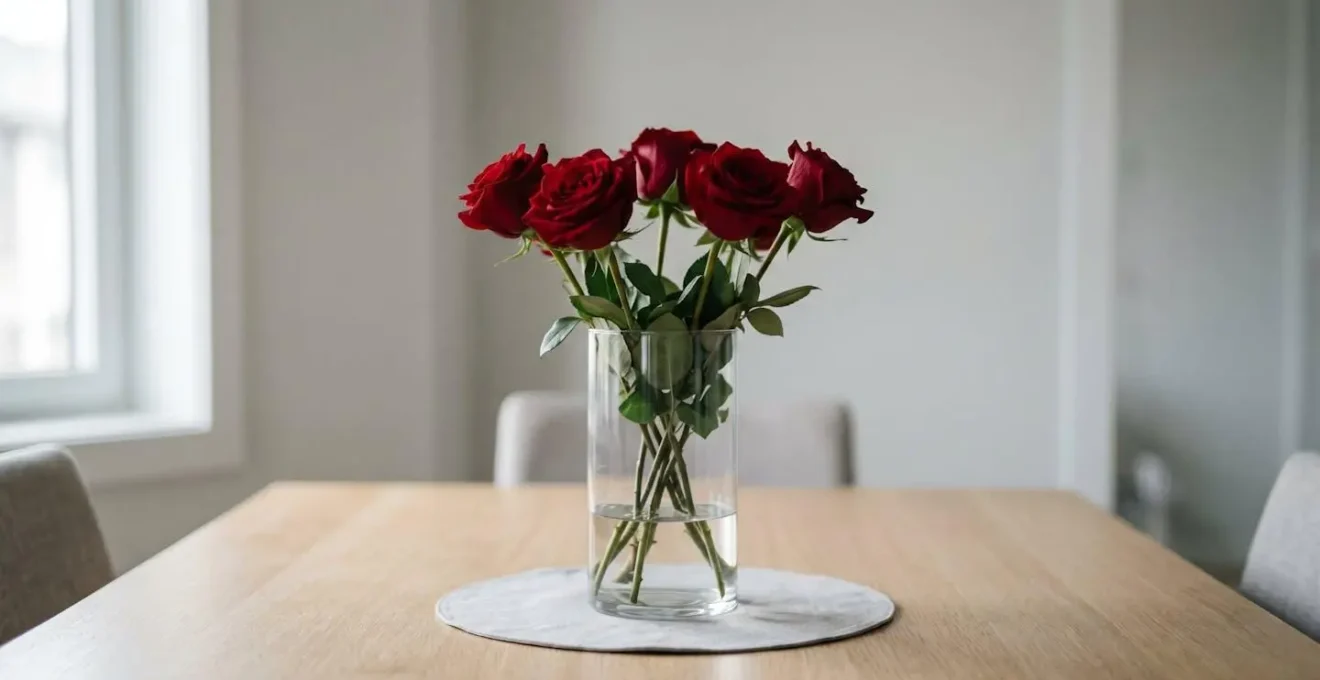
In an interior setting, this biological predisposition means red flowers act as an immediate and powerful focal point, as demonstrated by the striking red roses above. They command attention, drawing the eye and anchoring the entire visual composition. This makes them exceptionally effective for creating a dramatic statement or guiding a viewer’s gaze through a space. While red excels at capturing initial attention, other colors may be more effective at sustaining a positive mood.
Interestingly, while red is a magnet for the eyes, it may not be the ultimate color for mood enhancement. A fascinating 2021 study measuring physiological responses to different flower colors found that while red flowers had a calming effect, yellow flowers were actually the most preferred and induced the most significant improvement in overall mood and vigor. The study, which used EEG and heart rate measurements, concluded that participants tended to become calm during visual stimulation with both yellow and red flowers.
This suggests a two-part strategy: use red for its unparalleled ability to create a focal point and draw immediate interest, but incorporate yellow and other warm colors into the broader arrangement to promote a sustained feeling of well-being. The red flower is the “hello,” while the other colors are the substance of the conversation.
Use red deliberately and sparingly to create drama and direct attention, but balance it with other hues to craft a more nuanced and emotionally supportive environment.
Key Takeaways
- Flowers reduce anxiety by engaging our ‘involuntary attention’, giving our brains a restorative break from the cognitive load of urban life.
- Strategic color and texture choices, like smooth and light-hued petals, can physically brighten a dark room by reflecting more ambient light.
- The visual contrast between soft, organic petals and hard, industrial surfaces like concrete and steel creates a ‘visual tension’ that is inherently pleasing and stimulating to the human brain.
How to Use Floral Styling to Change the Identity of a Room Instantly?
A floral arrangement is not a passive object; it is an active agent capable of instantly altering the perceived identity and emotional atmosphere of a room. By consciously applying the principles of color, form, and placement, you can use flowers as a dynamic styling tool to shift a space from being merely functional to feeling vibrant, serene, or sophisticated. This immediate impact is confirmed by research showing that the presence of flowers triggers a swift and positive emotional response.
Studies consistently show the powerful link between flowers and well-being. As a University of Georgia study found, the benefits are tangible for those who bring flowers into their homes. According to Assistant Professor of Horticulture, Julie Campbell, the effect is clear: “People who purchased flowers in the past year were more likely to report feeling better at home and at work. They experienced improved mood, reduced stress and even better overall morale,” as noted in a UGA report on the subject. This confirms that flowers are a direct pathway to changing how a room *feels*.
To harness this power, think like a stylist. Do you want your living room to feel more energetic and social? Choose a large arrangement with bright, outward-facing blooms like sunflowers or gerbera daisies and place it in a central, visible location. Need your bedroom to be a tranquil sanctuary? Opt for a simple, monochromatic arrangement of white or pale blue flowers with soft forms, like hydrangeas or delphiniums, placed on a nightstand. Want to add a touch of drama and sophistication to your dining area? A tall, sculptural arrangement of calla lilies or a compact cluster of deep red roses will create an immediate focal point.
The “identity” of the room is shaped by these choices. A minimalist space with a single, dramatic orchid communicates intention and elegance. A bohemian living room filled with a loose, wildflower-style mix feels relaxed and creative. By changing the flowers, you change the story the room tells, and you do it in an instant. This is the ultimate expression of flowers as environmental therapy: actively curating your surroundings to support your desired mental state.
Start seeing your floral choices not as a finishing touch, but as the primary tool for defining the mood and purpose of your personal spaces. Experiment with different styles, colors, and placements to discover how profoundly you can shape your home’s atmosphere and, by extension, your own well-being.