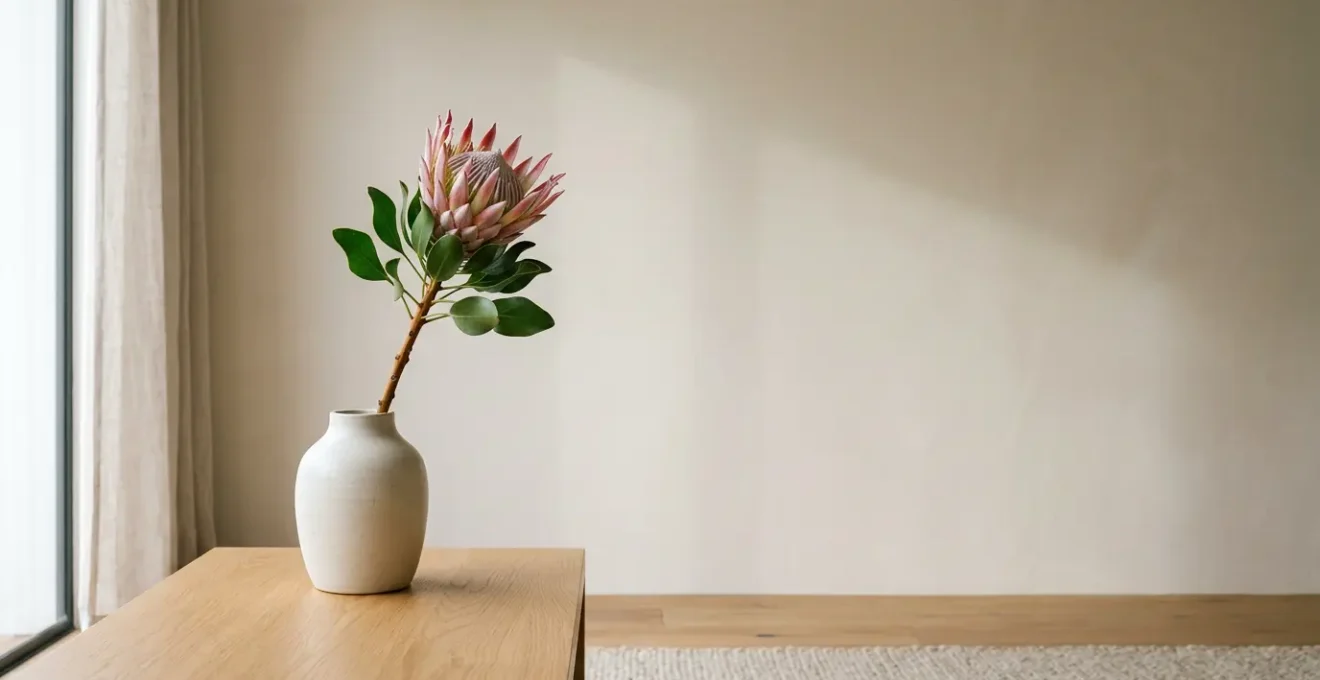
Contrary to popular belief, minimalist floral styling isn’t just about using less; it’s about making empty space a deliberate and powerful design element.
- The visual impact of a single stem comes from its relationship with the space around it, a concept borrowed from the Japanese principle of ‘Ma’.
- Mastering proportion is non-negotiable: a stem that is too short for its vase will always look unintentional and sad, not chic.
Recommendation: Instead of focusing on the flower, focus on the ‘negative space’ it creates. Choose a structural branch or a long-stemmed flower and place it off-center in its vase to create a dynamic, sculptural look.
The desire for a beautiful, curated home often clashes with the reality of a tight budget and the minimalist preference for uncluttered surfaces. We see lush, expensive bouquets in magazines, but for young renters and minimalists, these arrangements can feel both costly and visually overwhelming. The common advice is to simply “buy fewer flowers,” but this often results in a lonely-looking bloom lost in a corner, failing to make the intended sophisticated statement. This approach misses the fundamental point of minimalist design.
The real secret isn’t merely subtraction; it’s about a radical shift in perspective. What if the key to high-impact, low-cost decor wasn’t the flower itself, but the empty space it commands? The art of single-stem styling is not about what you remove, but about what you intentionally create with what remains. It’s about transforming a simple branch or bloom from mere decoration into a piece of living sculpture that actively shapes its environment.
This guide moves beyond the generic “less is more” platitude. We will deconstruct the core principles that make a single stem look chic and intentional. We’ll cover everything from the science of visual simplicity and the mechanics of securing a stem without foam, to the crucial rules of scale and the profound difference between Western minimalism’s emptiness and the ‘active void’ of Japanese design. Prepare to see that single stem—and the space in your home—in a completely new light.
To guide you through this new approach to botanical styling, we’ve broken down the essential concepts and practical techniques. This framework will help you master the art of creating maximum impact with minimal elements.
Summary: The Art of Styling a Single Stem
- Why Is Less More When Styling Modern Coffee Tables?
- How to Secure a Single Stem in a Wide Vase Without Foam?
- Orchid vs. Protea: Which Single Stem Makes the Bolder Statement?
- The Scale Mistake That Makes Single Stems Look Sad Instead of Chic
- When to Rotate Flower Types to Keep Minimalist Decor Feeling Fresh?
- How to Choose a Structural Branch That Acts as Sculpture?
- Empty Space: How Western Minimalism Differs from Japanese Ma?
- How to Accessorize a Minimalist Living Room Using Only Botanicals?
Why Is Less More When Styling Modern Coffee Tables?
The “less is more” philosophy, particularly on a central surface like a coffee table, isn’t just an aesthetic choice; it’s rooted in cognitive science. A cluttered surface bombards our brain with information, creating a low-level but constant “visual noise.” By contrast, a single, well-placed object creates a clear focal point. This drastically reduces the mental effort required to process the scene, a concept known as cognitive fluency. The easier our brains can process something, the more beautiful and pleasing we find it.
This is why a single stem works so effectively in a minimalist interior. It doesn’t compete for attention. Instead, it invites calm and focused appreciation. The simplicity signals order and intention, which contributes to a more serene living environment. In fact, this principle is backed by research showing that limiting everyday choices and sensory inputs helps to conserve cognitive energy and can lead to lower stress levels. An intentionally spare coffee table featuring one sculptural stem becomes a moment of visual rest, not another task for the brain to sort through.
Cognitive fluency is the ease in which information is processed.
– DirectiveGroup, Cognitive Fluency: A Secret to Conversions
Ultimately, a single stem is “more” because it allows both the object and the space around it to be fully seen. It commands attention without demanding it, offering a greater sense of peace and sophisticated control than a dozen flowers ever could.
How to Secure a Single Stem in a Wide Vase Without Foam?
One of the most common frustrations in minimalist styling is a beautiful, heavy-headed flower or a long branch slumping sadly to one side in a wide-mouthed vase. The temptation is to reach for floral foam, but this is an unsustainable and unnecessary choice. Professional floral designers rely on a set of ingenious, foam-free mechanics that create an invisible internal structure to hold stems exactly where they are intended.
For a single heavy stem, the easiest method is to create a natural armature. This involves using a few discreet, less-showy branches (like thin twigs of curly willow or dogwood) to form a subtle, interlocking web just below the water line. You can then slide your main stem into this natural grid, which will hold it firmly in place. This technique not only provides support but also adds a layer of subtle, organic texture inside the vase, enhancing the overall composition.
For those seeking an even more minimalist solution, a simple “floral frog” or ‘kenzan’—a small, heavy base with upright metal pins—can be placed at the bottom of the vase. You simply press the base of the stem onto the pins. This is the traditional tool used in Ikebana and is perfect for securing a single branch at a precise, dramatic angle. Other effective, tool-free methods include:
- Lacing: If using a few stems, interweave them across each other to form a self-supporting, stable structure within an open-mouthed vase.
- Grid Technique: For a clear vase, create a grid pattern across the opening with clear floral tape. This creates small quadrants to guide and hold individual stems.
- Leaning: Allow the stem to lean naturally on the inner edge of the vase. This works best with curved stems where the lean feels intentional and graceful, not like a mistake.
Orchid vs. Protea: Which Single Stem Makes the Bolder Statement?
When selecting a single stem to be the hero of a room, the choice often comes down to two powerhouses: the elegant, architectural Orchid and the dramatic, prehistoric Protea. While both make a bold statement, they do so in very different ways, catering to distinct minimalist aesthetics.
The Phalaenopsis Orchid offers a statement of pure, refined elegance. Its long, arching stem and delicate, symmetrical blooms create a sense of graceful movement. It is the perfect choice for a soft, sophisticated minimalist space. Its primary advantage is its exceptional longevity; a cut Phalaenopsis stem can last up to six weeks in a vase, offering a sustained and delicate beauty that requires almost no maintenance. This makes it an incredibly budget-friendly option over time.
The Protea, particularly the King or Pincushion variety, delivers a statement of raw, sculptural power. Its large, complex flower head and leathery texture provide a dramatic, almost otherworldly focal point. It’s perfect for a modern, eclectic, or industrial-leaning minimalist interior. According to floral care experts, both Pincushion Proteas and many orchids share an impressive vase life of 14 to 21 days. However, the Protea has a unique secondary benefit: once it has finished its life in water, it can be dried. It retains its shape and structure perfectly, transforming into a permanent, muted-toned sculptural object. This “second life” effectively doubles its decorative value, making it another fantastic choice for the budget-conscious decorator.
The decision, therefore, is one of intent. Do you want a long-lasting whisper of flowing elegance (Orchid) or a dramatic, textural shout that evolves into a permanent sculpture (Protea)?
The Scale Mistake That Makes Single Stems Look Sad Instead of Chic
The single most common error that undermines a minimalist floral arrangement is incorrect scale. A short stem in a tall vase looks lost, while a huge bloom on a tiny table feels comical. When a single stem looks “sad” instead of chic, it’s almost always a problem of proportion. The relationship between the stem, the vase, and the surrounding space is a mathematical one, and getting it right is non-negotiable for a sophisticated look.
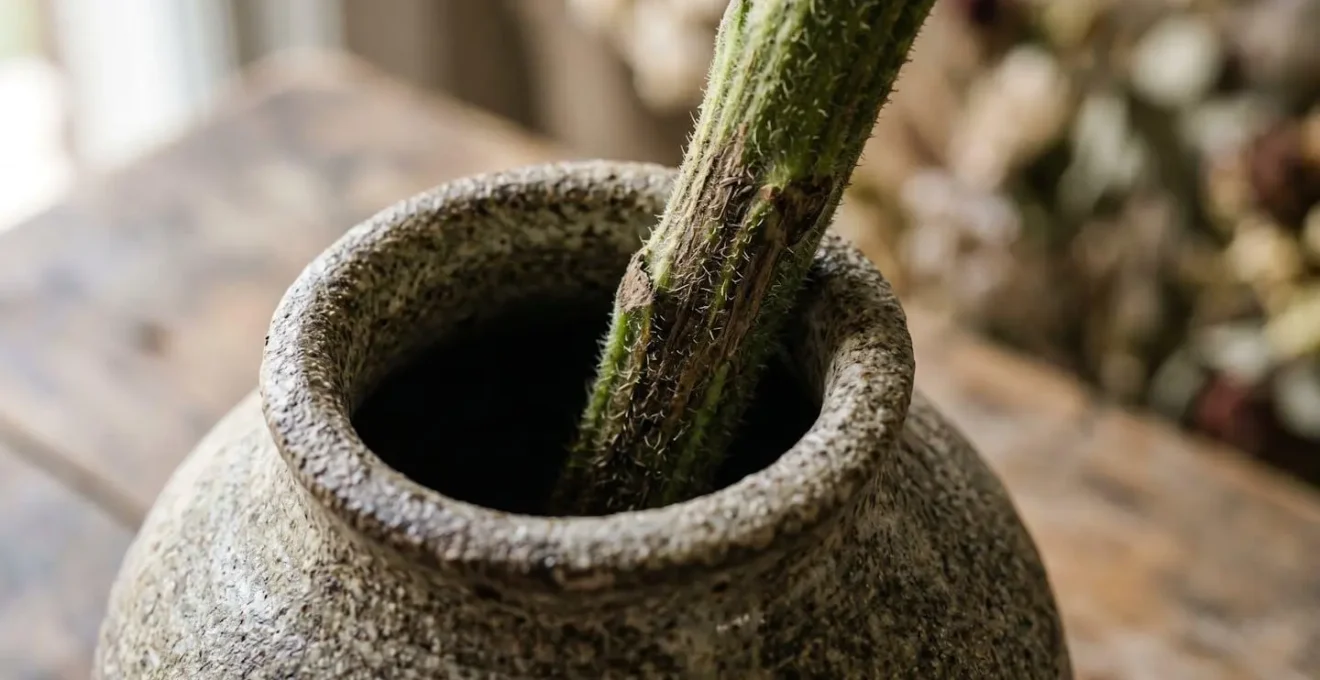
As the image above demonstrates, the visual balance between the volume of the vase and the substance of the stem is critical. A heavy, textural vase requires a stem with enough visual weight to hold its own. The golden rule, universally taught in floral design, is that the height of your botanical element should be at least 1.5 to 2 times the height of your vase. Anything less, and the arrangement will feel stunted and unintentional. This single guideline can instantly transform an amateur arrangement into one that looks professionally styled.
Beyond the vase-to-stem ratio, consider the arrangement’s relationship to its environment. A few key guidelines prevent your minimalist statement from being swallowed by the room:
- Surface Footprint: The entire arrangement (vase included) should not occupy more than 1/4 of the surface area of a small table or shelf.
- Wall Relationship: For a tall arrangement, its total height should not exceed 1/3 of the wall height behind it to avoid looking disproportionately large.
- Breathing Room: Always allow for ample “negative space” around the arrangement. This empty space is what gives the single stem its power and prevents it from looking like clutter.
When to Rotate Flower Types to Keep Minimalist Decor Feeling Fresh?
A key advantage of single-stem styling is the ability to keep your decor feeling fresh and dynamic with minimal effort and expense. Unlike large bouquets that commit you to a certain look for a week, a single stem can be rotated frequently to reflect the season, your mood, or simply to bring a new point of interest into a room. The strategy is to think like a curator, introducing new pieces seasonally to keep the “exhibition” of your home engaging.
The most intuitive and rewarding rotation schedule is one that follows the natural rhythm of the seasons. This practice connects your indoor space with the outside world, creating a subtle but powerful sense of harmony. A simple seasonal rotation ensures you are always using botanicals that are at their peak and often most affordable. This is not only a design choice but a sustainable and budget-aware one.
A simple yet effective seasonal strategy would be:
- Spring: Embrace the return of life with delicate, architectural flowering branches like cherry blossom, magnolia, or forsythia. Their linear forms are perfectly suited to minimalist aesthetics.
- Summer: Opt for a single, dramatic bloom with vibrant color. A tall sunflower, a bold zinnia, or an elegant gladiolus can act as a solitary splash of seasonal energy.
- Autumn: Shift to stems prized for their richly colored foliage rather than their flowers. A single branch of maple or oak with warm, burnished tones brings the essence of the season indoors.
- Winter: Focus on pure form and texture. A bare, sculptural branch, stems with berries (like Ilex), or fuzzy pussy willow provides visual interest without needing blooms.
Beyond the seasons, consider a weekly or bi-weekly refresh simply to match your personal mood. Swapping a bright, energetic stem for a more calming, muted one is one of the quickest and most affordable ways to alter the emotional tone of your space.
How to Choose a Structural Branch That Acts as Sculpture?
Moving beyond flowers, the most sophisticated and budget-friendly way to style with single stems is to use a structural branch. This approach treats the botanical element not as a decoration, but as a piece of sculpture. The focus shifts from color and bloom to line, form, and texture. Finding the right branch is an art of seeing the potential in what nature provides, often for free in your own backyard or a local park.
Case Study: The Branch as a 2D Line Drawing
The modern art of single-stem arrangements is heavily inspired by the Japanese practice of Ikebana, which honors asymmetry, simplicity, and the natural line of each material. When selecting a branch, the key is to look for one that lies mostly flat on a single plane. When this type of branch is placed in a simple vase against a neutral wall, it ceases to be just a branch; it reads as a two-dimensional line drawing. The empty spaces created by its forks and angles become as important as the branch itself, creating a sophisticated aesthetic that feels both organic and highly designed.
To find your perfect sculptural piece, you must train your eye to look for specific qualities. Ignore straight, uniform sticks and instead seek out character and movement. A branch with an interesting angle, a dramatic curve, or a fork that creates compelling negative space is far more valuable than a perfect, symmetrical one. Texture is another key element; lichen, peeling bark, or moss can add a rich, tactile dimension that a simple flower cannot.
Action Plan: How to Source and Prep a Sculptural Branch
- Hunt for Form: Search for branches with interesting angles, ‘movement’, and forks. Prioritize those that have a relatively flat, two-dimensional character over bushy, three-dimensional ones.
- Assess Texture: Look for details that add character, such as peeling bark, patches of lichen, or unique coloration. These elements provide visual interest without needing a bloom.
- Clean and Prepare: Gently scrub the branch with a brush and water to remove any dirt, being careful not to damage the natural bark. Make a fresh, clean, angled cut at the base to help with water absorption.
- Edit the Composition: Strategically prune away small, distracting twigs or dead leaves. The goal is to clarify and emphasize the main architectural line of the branch.
- Perform the Wall Test: Before final placement, hold the branch up against a plain, light-colored wall. Does it read as a dynamic line drawing? If the answer is yes, you have found your sculpture.
Empty Space: How Western Minimalism Differs from Japanese Ma?
In Western design, minimalism is often interpreted as subtraction—the act of removing things until only the essential remains. Empty space is frequently seen as a passive void, simply the background for the objects we choose to display. However, to truly master single-stem styling, we must adopt a more profound understanding of space, one borrowed from the Japanese aesthetic concept of Ma (間).
Ma does not translate to “emptiness.” It translates to “gap,” “interval,” or “pause.” In Japanese philosophy, this space is not a void; it is an active and essential part of the whole. It is the silence between notes that creates music, the unpainted part of a scroll that gives form to the brushstroke. In interior design, Ma is the space that holds and energizes the objects within it. A single branch placed with an understanding of Ma is not just “in” the space; it is in dialogue *with* the space.
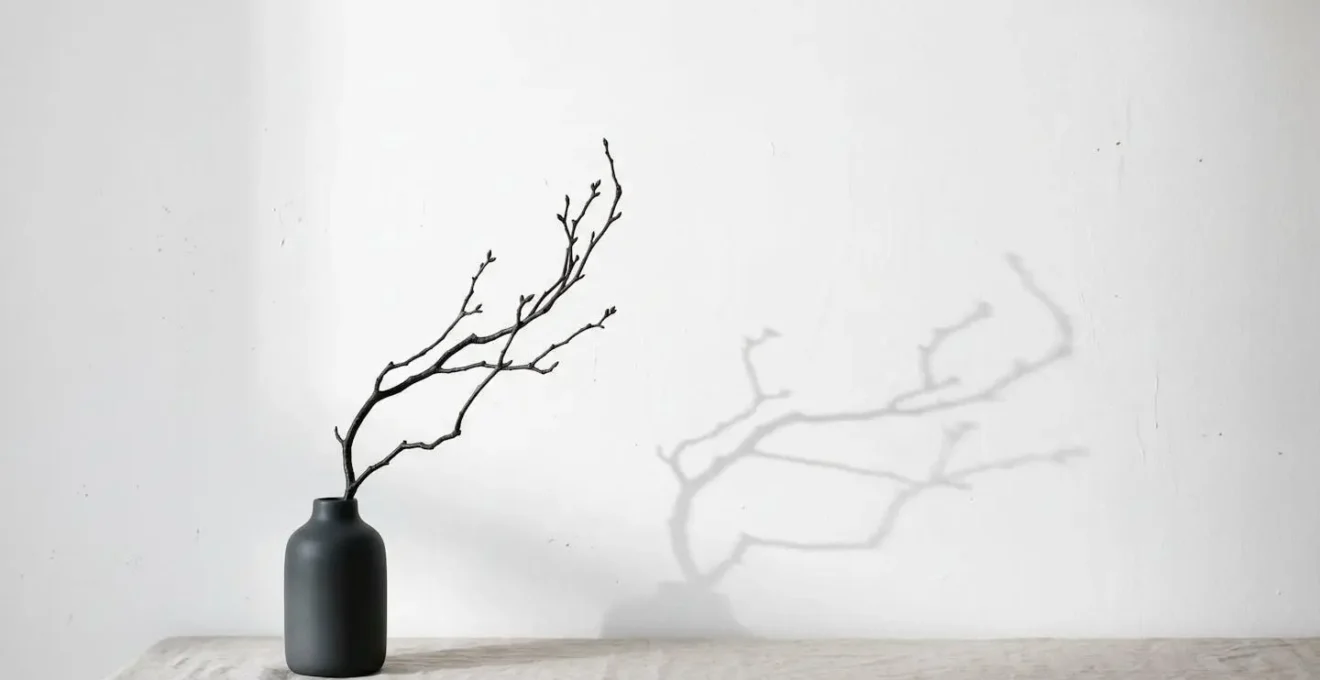
This is the fundamental difference: Western minimalism often creates emptiness, while Japanese aesthetics cultivate intentional space. This principle is perfectly articulated by designer Kristen Bradley, who applies this thinking to floral arrangements:
Negative space emphasizes the stem’s shape and the curvature of the bloom. Placing a flower slightly off-center, tilting it, or allowing it to lean creates visual movement.
– Kristen Bradley, The Art of Single Stem Arrangements in Floral Design
When you place your single stem, don’t just put it in the middle of the table. Place it off-center. See how it changes the balance of the surface. Notice the shape of the air between the stem and the edge of the wall. That is Ma. You are no longer just decorating; you are sculpting with space itself.
Key Takeaways
- The ultimate goal is not emptiness, but creating ‘Ma’—an intentional, active space that gives power to your single stem.
- Scale is the most critical rule: your botanical element should always be at least 1.5 times the height of its vase to look intentional.
- Select stems and branches for their architectural form, line, and texture, treating them as sculptural objects, not just flowers.
How to Accessorize a Minimalist Living Room Using Only Botanicals?
A truly committed minimalist can accessorize an entire living room using only botanical elements, creating a space that feels layered, personal, and deeply connected to nature without a hint of clutter. This strategy moves beyond the single vase, considering how different forms of plant life can add texture, dimension, and architectural interest to various zones of a room. It’s about creating a series of small, curated botanical moments instead of one large one.
The key is to think in terms of form and placement. Each botanical element should serve a specific design purpose, whether it’s adding vertical height, a pop of texture, or a horizontal line. By diversifying the types of displays, you can create a rich, cohesive look that feels dynamic and alive. A taxonomy of these botanical forms might include:
- Linear: A tall, single branch of forsythia or a cluster of dried grasses in a floor vase to add vertical interest in a corner.
- Clustered: A small, shallow bowl filled with seed pods, pinecones, or smooth stones on a bookshelf to create a textural grouping.
- Suspended: A hanging kokedama (moss ball) or a simple air plant in a geometric holder to add spatial dimension and draw the eye upward.
- Planar: A single, large, dramatic leaf—like that of a Monstera or palm—laid flat on a console table or mantelpiece to create a strong horizontal element.
Strategy: Creating Vignettes with Textural Contrast
An advanced technique for a purely botanical look is to create vignettes based on textural contrast rather than color. This fundamental of floral design adds incredible depth while adhering to minimalist principles. Imagine a grouping on a side table: the rough, gnarled bark of a small branch, the smooth, waxy surface of a camellia leaf laid beside it, and the soft, fuzzy texture of a few stems of pussy willow. This monochromatic, multi-sensory approach creates a dynamic display that invites closer inspection and adds a layer of quiet sophistication.
Now that you understand the principles, the next step is to start experimenting. Begin by sourcing your first sculptural branch or selecting a single, perfect stem and find a place in your home to practice the art of Ma. You have all the tools you need to transform your space.