The Victorian “language of flowers” was far more than a simple romantic code for love or jealousy.
- Meanings were not ancient or universal; they were actively constructed through cultural forces like the scientific study of poisons (Foxglove) and the theological rebranding of pagan symbols (the Lily).
- The physical form of bouquets, like the tight tussie-mussie, was dictated as much by social status and technology as by aesthetics.
Recommendation: To truly understand floriography, we must look at a flower’s history—not just a dictionary definition.
The image is a familiar one: a Victorian suitor, heart aflutter, carefully selecting a bouquet to convey a silent, desperate message to his beloved. We are often told this was the “language of flowers,” a rigid system where a red rose meant passion and a yellow one, jealousy. This romantic notion, however, only scratches the surface of a far more complex and fascinating history. It reduces a dynamic cultural practice to a simple dictionary of meanings, ignoring the powerful forces that shaped it.
What if the true story isn’t about the static definitions, but about *how* those definitions came to be? The symbolism of a flower is not a timeless truth waiting to be discovered; it is a cultural artifact, forged in the fires of mythology, tempered by the discoveries of medicine, and cemented into public consciousness by the deliberate hand of religious art. A flower’s meaning could be born from a cautionary tale, a superstitious fear, a scientific breakthrough, or even a strategic act of theological rebranding. To send the wrong flower was not just a social faux pas; it was to risk misquoting a story, a belief, or a deeply held cultural value.
This article moves beyond the simple “what” of floriography to explore the “how” and “why.” We will deconstruct the origins of these floral symbols, revealing the specific historical mechanisms that gave them power. We’ll examine how ancient myths created enduring associations, how deadly poisons became life-saving medicines, and how religious doctrine co-opted pagan symbols to communicate its most sacred ideas. By understanding how this language was built, we can finally appreciate its true depth and complexity.
To navigate this rich history, we will explore the captivating stories behind some of the most potent floral symbols. This journey will reveal how a flower’s identity is not inherent in its petals, but in the stories we tell about it.
Summary: Decoding the Victorian Fear of Sending the Wrong Flower
- How Did the Narcissus Myth Shape the Flower’s Meaning of Vanity?
- Why Is It Bad Luck to Bring White Lilacs Indoors in Some Cultures?
- Foxglove: How Did a Deadly Poison Become a Heart Medicine in Folklore?
- The Lily and the Virgin: How Art History Defined Floral Purity
- When Did Yellow Roses Switch from Jealousy to Friendship?
- Why Were Victorian Arrangements So Round and Tightly Packed?
- How Did Religious Art Cement the White Lily as a Symbol of Virginity?
- How to Use Floriography to Send Secret Messages at Modern Events?
How Did the Narcissus Myth Shape the Flower’s Meaning of Vanity?
The link between the narcissus flower and vanity seems almost self-evident, deeply embedded in Western culture through Ovid’s myth of Narcissus. The story of the handsome youth who falls in love with his own reflection and perishes, leaving only a flower in his place, is a powerful cautionary tale. For the Victorians, with their emphasis on moral instruction, this myth provided the perfect origin story. The flower became a direct symbol of self-obsession, unrequited love, and egotism, a clear warning packaged in a beautiful bloom.
However, to assume this meaning is universal is to miss the far more interesting truth about floral symbolism. These meanings are not inherent; they are culturally specific. While Victorian flower dictionaries locked the narcissus into its role as a symbol of vanity, other cultures saw it very differently. As an analysis of its cross-cultural symbolism shows, the flower’s meaning undergoes a dramatic transformation across the globe. This reveals that the Victorian interpretation was a choice, not an inevitability.
This cultural divergence is a core principle of floriography. A flower is a blank canvas onto which a society projects its values. In this case, the West projected its anxieties about vanity, while other cultures projected their hopes for prosperity and reverence for beauty.
In the East, the daffodil symbolizes wealth and good fortune
– Wikipedia Contributors, Narcissus in culture – Wikipedia
For instance, in Chinese tradition, the narcissus is known as the ‘water immortal’ and is a key feature of Lunar New Year, symbolizing good luck for the coming year. In Persian poetry, it represents beautiful eyes, and in Japan, it signifies mirth. This demonstrates that the meaning of a flower is a cultural artifact, not a universal constant.
Why Is It Bad Luck to Bring White Lilacs Indoors in Some Cultures?
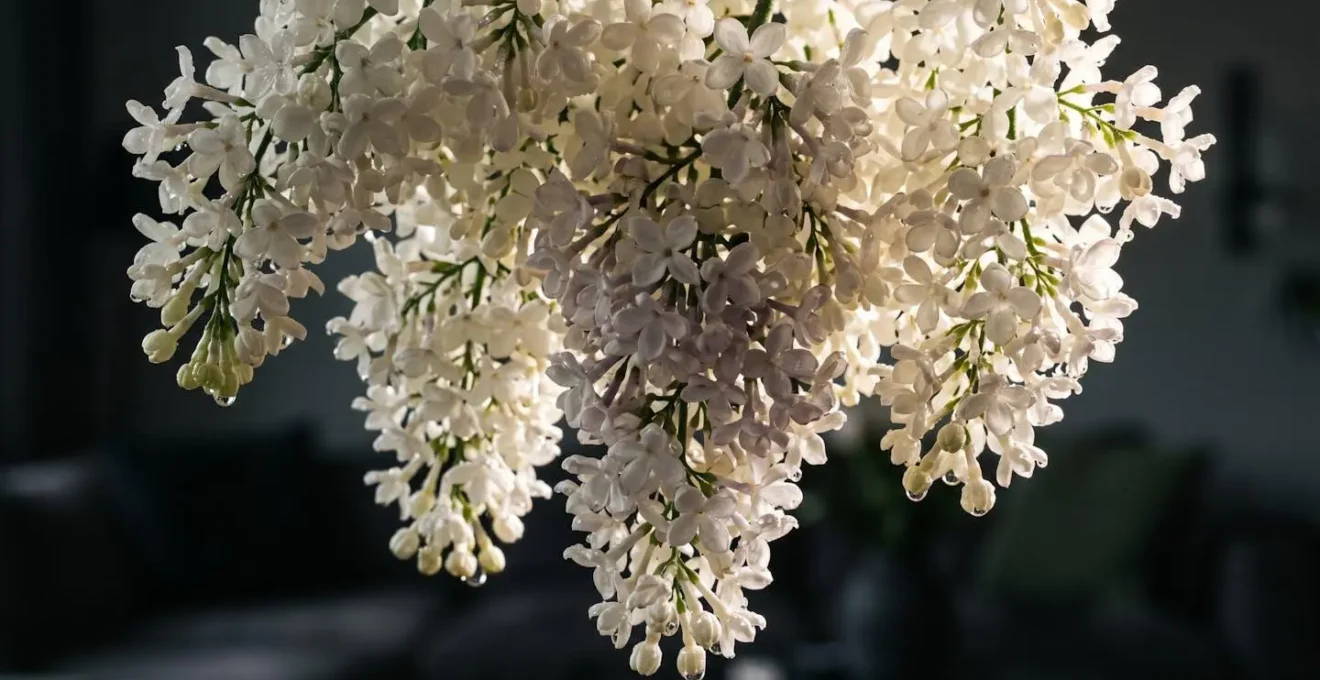
While some floral meanings stem from elegant myths, others have far more visceral, practical origins. The superstition surrounding white lilacs—that bringing them indoors is a harbinger of death or bad luck—is a prime example. This belief isn’t rooted in a fanciful tale but in a grimly pragmatic reality of life before modern funeral practices. The intensely sweet and heady fragrance of the lilac is key to understanding this dark association.
In an era without refrigeration or modern embalming, households had to manage the presence of the deceased for several days before burial. The smell of decomposition was an unavoidable and distressing reality. Flowers with powerful scents were therefore essential. As one historian of domestic traditions notes, this was not about aesthetics but about necessity.
The perfume of lilac was used to disguise the smell of a dead body in the house
– Blog Author (The Squirrelbasket), We’ll gather lilacs – or maybe not…
Because of this function, the scent of lilac became inextricably linked with death and mourning. Its fragrance, encountered outside of a funeral context, could trigger a powerful and unwelcome sensory memory of loss. The flower was no longer just a flower; it was a scent-memory of the death room. Bringing white lilacs into a healthy home was seen as inviting that association—and by extension, death itself—across the threshold. The color white, already linked to purity and spirit, only intensified its role as a funerary flower.
This is a compelling case of how a flower’s sensory properties, combined with human social practices, can create a potent and lasting superstition. The “bad luck” is not magical; it is a cultural memory of the flower’s functional role in managing death. The fear wasn’t of the bloom itself, but of the grim reality it was used to conceal.
Foxglove: How Did a Deadly Poison Become a Heart Medicine in Folklore?
The story of Foxglove (Digitalis purpurea) is a dramatic illustration of how a flower’s meaning can be transformed by science. Long known in European folklore as a plant of ill omen, associated with fairies and witches, its primary identity was that of a deadly poison. Every part of the plant contains potent cardiac glycosides, and consuming it could lead to a swift death. Its beauty was a deception, a classic “femme fatale” of the botanical world. Yet today, digitalis is a cornerstone of modern cardiology. This remarkable journey from poison to prescription medicine represents a powerful symbolic transformation.
The key figure in this story is the 18th-century English physician Dr. William Withering. In 1775, he learned of a secret family recipe from a Shropshire herbalist used to treat “dropsy” (the severe swelling caused by congestive heart failure). The formula contained over twenty herbs, but Withering, with his botanical expertise, correctly identified foxglove as the sole active ingredient. He understood he was dealing with a substance that could either kill or cure, with a perilously thin line between the two.
What followed was not folklore, but one of history’s earliest examples of a clinical trial. For ten years, Withering systematically documented cases, carefully refining dosages and noting effects. His work was meticulous and groundbreaking. His 1785 publication, “An Account of the Foxglove,” detailed his findings, noting that in his trials with dropsy patients, an astonishing 101 out of 158 patients experienced relief. This was not magic; it was medicine.
Withering’s work transformed the foxglove. It was no longer just a witch’s herb or a random poison. It became a quantifiable, controllable, and life-saving medicine. This shift demonstrates how scientific inquiry can demystify a plant, stripping it of its superstitious baggage and giving it a new, evidence-based identity. The foxglove, therefore, carries a dual meaning: a symbol of both danger and healing, a testament to the power of science to harness nature’s most potent secrets.
The Lily and the Virgin: How Art History Defined Floral Purity
Few floral symbols are as deeply ingrained in the Western psyche as the white lily’s association with purity and the Virgin Mary. It seems an ancient and immutable truth. However, this connection is a masterful example of what could be called theological rebranding, where an existing symbol is co-opted and repurposed to serve a new ideological need. Before the lily became the emblem of the Virgin, it was a powerful symbol for pre-Christian fertility goddesses.
In antiquity, the lily was tied to powerful female deities like the Greek Hera and the Roman Juno. It represented fertility, birth, and divine feminine power. When Christianity began to grow, it faced the challenge of communicating its new theology to a population still steeped in these older pagan traditions. Rather than inventing entirely new symbols, a far more effective strategy was to absorb and redefine existing ones. The lily, already associated with divine womanhood, was the perfect candidate for this symbolic appropriation.
The church strategically repurposed the lily’s meaning. The flower’s existing ties to birth and femininity were re-framed to represent Mary’s miraculous virgin birth. This act of co-option allowed the Church to communicate a complex theological concept—Mary’s purity and divine motherhood—using an image that was already culturally resonant. It was a brilliant piece of communication strategy, transforming a symbol of powerful goddesses into the ultimate emblem of virginity.
This transition was cemented by religious art. As one art historian notes, the lily’s presence in sacred art was not an accident but a deliberate iconographic choice. This process took time but eventually became standard practice.
By the time of the Renaissance, the white lily was a non-negotiable element in paintings of the Annunciation, acting as a visual shorthand for Mary’s perpetual virginity. The symbol was so effective that its pagan origins were almost entirely forgotten, a testament to the power of art and religion to shape a cultural artifact and redefine its meaning for centuries.
When Did Yellow Roses Switch from Jealousy to Friendship?
Unlike the lily, whose meaning was strategically repurposed but has remained relatively stable for centuries, the yellow rose represents a complete symbolic transformation. For anyone sending flowers today, a bouquet of yellow roses is a warm, unambiguous gesture of friendship, joy, and platonic affection. In the rigid lexicon of Victorian floriography, however, it meant something entirely different and far more negative: jealousy, infidelity, and a decrease of love.
The Victorian association of yellow with negative emotions was not unique to the rose; yellow carnations, for instance, signified disdain. This negative connotation for the color yellow in the context of relationships was a strong convention of the era. Sending yellow roses was a passive-aggressive act, a way to express suspicion or disappointment without uttering a single word. It was a flower of accusation, not affection. So, how did such a negative symbol perform a complete 180-degree turn to become the cheerful icon of friendship we know today?
This shift did not happen overnight. It was a gradual cultural evolution throughout the 20th century, driven by changing social norms and, crucially, by the floral industry itself. As society moved away from the rigid, coded social interactions of the Victorian era, the need for such negative floral messages waned. Simultaneously, the flower industry saw an opportunity to market the bright, sunny, and optimistic appearance of the yellow rose. Its cheerful color was a natural fit for positive emotions like happiness and warmth.

Through marketing and popular association, the yellow rose was successfully rebranded. Its visual appeal trumped its historical meaning. Today, its Victorian association with jealousy is little more than a historical footnote, a piece of trivia. The modern meaning is entirely defined by its appearance and its new cultural role as a symbol of friendship and celebration, proving that no floral meaning is set in stone.
Why Were Victorian Arrangements So Round and Tightly Packed?
The quintessential image of a Victorian bouquet is not a loose, airy arrangement but a dense, perfectly round, and tightly packed cluster of blooms. This specific aesthetic was not an accident but the result of a confluence of social customs, technology, and function. The form of the bouquet was as much a part of the message as the flowers themselves, turning the arrangement into a complex communicative device.
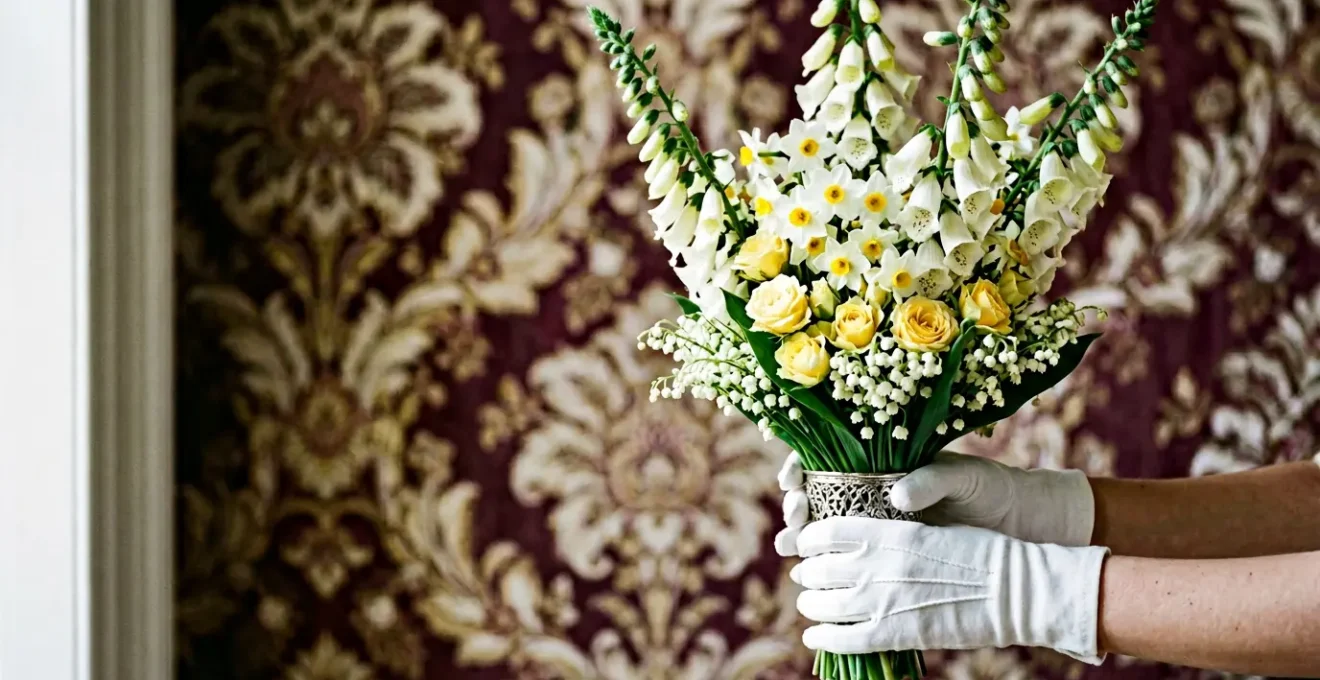
The most popular form for these message-bouquets was the “tussie-mussie” or “nosegay.” These were small, handheld arrangements designed to be carried or worn as a fashion accessory at social gatherings. Their construction was dictated by a very practical need: they had to fit into ornate, often valuable, posy holders made of silver, gold, or ivory. These holders were both a practical tool to keep gloves clean and a status symbol in their own right. The tight, round packing ensured the bouquet remained intact and structurally sound while being carried.
Armed with floral dictionaries, Victorians often exchanged small ‘talking bouquets’ or ‘word poesy,’ called nosegays or tussie-mussies, which could be worn or carried as a fashion accessory
– Wikipedia Contributors, Language of flowers – Wikipedia
Beyond practicality, this dense style also reflected a dominant Victorian design principle: horror vacui, or the fear of empty space. This aesthetic is visible in the cluttered parlors and heavily patterned wallpapers of the era. A tightly packed bouquet, overflowing with blooms, was seen as lush and abundant.
Finally, this style was an overt display of wealth. The ability to create such a dense arrangement, often with exotic or out-of-season flowers, was a direct reflection of one’s access to the new technologies of the Industrial Revolution, specifically heated greenhouses. A tussie-mussie wasn’t just a collection of flowers; it was a statement of social standing, technological access, and sophisticated taste, all condensed into a compact, symbolic object.
How Did Religious Art Cement the White Lily as a Symbol of Virginity?
While we’ve seen how Christianity co-opted the lily from pagan goddesses, the story of its cemented status in religious art reveals another crucial mechanism: the need for a visual shorthand to educate a largely illiterate population. In the medieval and Renaissance periods, religious paintings were not just decorative; they were primary tools for theological instruction. For the church, ensuring doctrinal accuracy in these images was paramount.
As the doctrine of the Immaculate Conception and Mary’s perpetual virginity grew in importance, artists and their patrons faced a significant challenge: how to visually communicate this complex and abstract theological concept to the masses who could not read scripture. Words on a page were useless to them, but a powerful, unambiguous symbol could convey the message instantly. The white lily, already repurposed from its pagan roots, became the perfect solution.
The flower the medievals found to best symbolize the purity of Mary, a virgin ante partum, in partu et post partem, was the lily
– Marian T. Horvat, The Lily: Symbol of the Annunciation & the Resurrection
The inclusion of the lily in a painting of the Annunciation was not merely an artistic flourish; it was often a contractual obligation. Religious patrons—churches, monasteries, and wealthy families—would commission artworks with specific iconographic requirements. The patron would mandate the presence of a white lily to ensure the painting was theologically sound and correctly communicated the doctrine of Mary’s purity. The symbol was a required element of the visual narrative, serving to instruct the faithful, inspire devotion, and encode complex dogma into a single, easily recognizable image.
This practice transformed the lily from a mere symbol into an indispensable piece of iconographic language. It became a stamp of orthodoxy, a visual guarantee that the artwork adhered to church doctrine. This functional role, driven by the practical needs of religious education, is what truly cemented the lily’s meaning in Western art and culture for centuries, making it one of the most successful and enduring examples of a purpose-built symbol.
Key takeaways
- Floral meanings are not universal; they are culturally specific artifacts shaped by myths, folklore, and societal values (e.g., Narcissus).
- Practical uses, such as disguising the smell of death (Lilac) or serving as medicine (Foxglove), have profoundly shaped a flower’s symbolic meaning.
- Powerful institutions like the church deliberately repurposed existing symbols (the Lily) and used them as a “visual shorthand” to communicate complex theology to the masses.
How to Use Floriography to Send Secret Messages at Modern Events?
While the rigid, often punitive, rules of Victorian floriography may seem like a relic of the past, the core concept of using flowers to tell a story is more relevant than ever. In a world saturated with generic gestures, imbuing a bouquet with a hidden layer of meaning transforms it from a simple decoration into a deeply personal and memorable communicative device. The language of flowers isn’t dead; it’s simply waiting for a modern translation.
The key is to move beyond the Victorian obsession with single, fixed meanings and embrace a more narrative approach. Instead of a one-to-one code, think of flowers as words you can use to compose a unique story or sentiment. This can be applied to any event, from weddings and corporate functions to personal gifts, elevating the entire experience for the recipient. By sharing the “secret” behind your choices, you invite people into a more thoughtful and engaging story.
This modern approach to floriography is about creativity and personal significance. It’s about combining traditional symbolism with contemporary contexts to create something new and meaningful. The following plan provides a framework for re-introducing this lost art into modern celebrations.
Your Action Plan: Speaking with Flowers in the 21st Century
- Wedding Bouquet Narrative: Incorporate flowers from the couple’s home regions into the bridal bouquet, or include a bloom representing a shared milestone or inside joke. Provide small cards on reception tables explaining the ‘secret story’ behind each flower choice to engage guests.
- Corporate Event Symbolism: For product launches, use flowers meaning ‘prosperity’ and ‘ambition’ (like Alstroemeria). For employee appreciation events, choose blooms symbolizing ‘gratitude’ (Hydrangea) and ‘admiration’ (dark pink Rose) to elevate thoughtfulness beyond generic arrangements.
- Personal Gift Pairings: Create modern combinations that blend traditional meanings with contemporary situations—give Lavender (‘devotion’) and Mint (‘virtue’) to a mentor, or combine Yellow Rose (‘friendship’) with Geranium (‘resilience’) for a friend facing challenges.
- Seasonal Celebration Codes: For spring events, use Narcissus for ‘new beginnings’ and Crocus for ‘youthful glee.’ For autumn gatherings, incorporate Chrysanthemums (‘optimism’) and Marigolds (‘comfort’).
- Message Cards with Meaning: Attach small cards to bouquets explaining the Victorian significance of each flower, transforming a standard gift into an educational and emotionally resonant gesture that recipients can keep and reference.
Start creating your own meaningful floral messages today by exploring the rich histories behind each bloom and using them to tell a story that is uniquely yours.