
In summary:
- Boxwood provides an essential architectural backbone, giving a garden structure and life even in the dead of winter when other plants are dormant.
- Achieving perfect form is a science, requiring precise shearing techniques, an understanding of the plant’s growth cycle, and careful timing.
- Proper care involves more than just pruning; it demands specific fertilization protocols to avoid root damage and choosing the right alternatives to combat disease.
- Mastering boxwood transforms maintenance from a seasonal chore into a disciplined art form, ensuring a crisp, formal look throughout the year.
As the vibrant hues of autumn fade and perennials retreat into dormancy, many gardens descend into a state of structural ambiguity. The once-lush beds become barren expanses, and the overall design loses its definition, waiting for spring’s return. Gardeners often attempt to combat this winter emptiness with seasonal decorations or hardy but unstructured shrubs. The prevailing wisdom suggests that a garden’s “off-season” is simply a period to be endured, a blank canvas until the next growing season begins.
This perspective, however, overlooks the most potent tool for year-round design integrity: the evergreen boxwood. More than just a simple hedge plant, Buxus is the architectural backbone of the classical garden, a living sculpture that provides form, line, and mass when all else has faded. But if the key to a distinguished four-season garden lies in its evergreen structure, why do so many boxwood hedges appear uneven, suffer from winter burn, or develop unsightly gaps? The answer is that maintaining pristine boxwood is not a matter of occasional shearing; it is a year-round discipline rooted in horticultural science.
This guide moves beyond generic advice to provide a specialist’s perspective on boxwood care. We will dissect the precise techniques for achieving perfect geometric forms, understand the biological reasons behind critical maintenance timings, diagnose common mistakes in fertilization, and explore resilient alternatives. By treating boxwood not as a mere plant but as a permanent structural element, you can ensure your garden possesses a crisp, elegant framework that is as compelling in February as it is in June.
To navigate this disciplined approach, this article details the essential principles, from foundational concepts to advanced design considerations. The following sections break down each critical aspect of boxwood mastery.
Contents: Mastering Boxwood for Year-Round Garden Excellence
- Why Is Boxwood Essential for Gardens That Look Good in February?
- How to Shear Boxwood into Perfect Spheres Without Holes?
- Holly or Yew: Which Substitute Resists Blight Better?
- The Nitrogen Mistake That Burns Boxwood Roots
- When to Stop Pruning to Prevent Winter Frost Damage?
- Why Do Cheap Ceramics Crack in Winter While Quality Ones Survive?
- When to Trim Border Plants to Keep Walkways Clear?
- How to Use Ornamental Grasses to Add Modern Movement to Static Gardens?
Why Is Boxwood Essential for Gardens That Look Good in February?
While many plants offer seasonal appeal, the singular value of boxwood (Buxus) is its unwavering presence. In the starkness of winter, when the garden’s framework is laid bare, boxwood provides the essential architectural backbone. Its dense, fine-textured foliage and tolerance for precise shearing allow it to be sculpted into hedges, spheres, and cones that define space, create sightlines, and offer a vibrant, living green against a monochrome landscape of snow or bare earth. Unlike deciduous shrubs, which contribute only twiggy skeletons, or less-structured evergreens, boxwood holds its form with absolute discipline.
This structural contribution is not merely aesthetic; it is fundamental to the garden’s year-round narrative. A well-placed boxwood hedge can outline a dormant perennial bed, giving it purpose and form even when empty. A pair of topiary spheres can frame an entrance with a sense of formal welcome that persists through every season. This permanence provides a crucial counterpoint to the ephemeral beauty of flowering plants, creating a garden that feels complete and intentional at all times. It is this steadfast structure that transforms a collection of plants into a cohesive, four-season design.
Case Study: Martha Stewart’s 450-Foot Boxwood Allée
At her farm, Martha Stewart demonstrates the power of boxwood structure at a massive scale. A 450-foot Boxwood Allée defines a major axis of the property, running from the stable to a carriage road. Even when surrounding gardens are dormant and the landscape is covered in snow, this powerful green line remains the dominant visual feature. The hundreds of individual specimens are meticulously maintained, covered with protective burlap in winter, and pruned twice yearly. This example proves that when used with intention, boxwood provides a continuous green framework that defines a garden’s architecture and maintains its visual integrity throughout the year, especially in the challenging month of February.
Ultimately, the choice of boxwood is a commitment to the garden’s permanent form. It is a declaration that the design’s integrity should not be a fleeting, fair-weather phenomenon but a constant, defining feature of the landscape.
How to Shear Boxwood into Perfect Spheres Without Holes?
Shearing a boxwood into a perfect sphere is an act of surgical precision, not brute force. The goal is to remove only the outermost layer of growth to encourage dense, compact foliage without creating “holes” or exposing bare wood. The most common mistake is cutting too deeply in one area, which can take years to recover, if at all. The secret lies in a light touch, constant movement, and using the right tools—exceptionally sharp, clean hand shears or hedge trimmers.
Begin by visualizing the final shape. For a sphere, imagine an equator line around the plant’s widest point. Start shearing just above this line, holding the shears parallel to the desired curve. Take small, successive snips, constantly moving your body and the shears around the plant. Never hold the tool still and attack one spot. Step back frequently, every few minutes, to assess the shape from a distance and from multiple angles. Your eyes are the most important tool for ensuring symmetry. The process is akin to sculpting; you are slowly revealing the form hidden within the foliage.
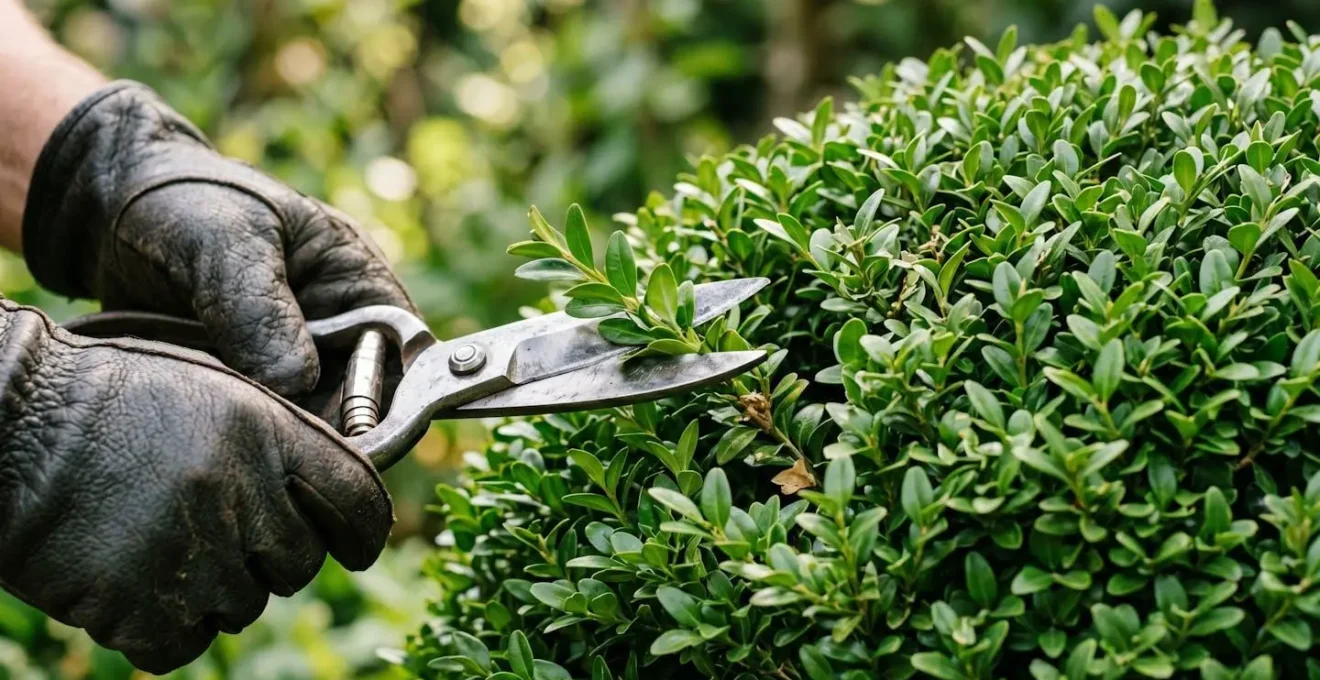
As the image demonstrates, the technique involves making precise cuts on the surface of the plant. A critical detail is to always prune so the top of the plant is slightly narrower than its widest point. This ensures that sunlight can reach the lower branches, preventing the bare, leggy appearance that ruins so many hedges and topiaries. Patience is paramount. A perfectly uniform surface is built over many seasons of light, consistent trimming, not one aggressive session.
Action Plan: Auditing Your Boxwood’s Structural Health
- Assess Form and Density: Examine the overall shape. Is it symmetrical? Are there visible gaps or “holes” in the foliage? Gently part the outer leaves to check for dense growth underneath versus bare interior branches.
- Inspect for Pests and Disease: Look closely at the leaves and stems. Check for the tell-tale signs of boxwood blight (leaf spots, black stem streaks), psyllid damage (cupped leaves), or leafminer infestation (blisters on leaves).
- Evaluate Location and Light: Does the plant receive adequate sunlight for its cultivar (typically 4-6 hours)? Is the base of the hedge receiving enough light, or is it shaded by the top, causing it to become thin?
- Check Soil and Root Zone: Examine the base of the plant. Is the mulch excessive and piled against the stem (a “mulch volcano”)? Is the soil waterlogged or overly dry? The health of the shallow roots is critical.
- Review Pruning History: When was the last time the plant was pruned? Was it a light trim or a hard cutback? Evidence of recent, late-season new growth can signal a high risk for winter frost damage.
Holly or Yew: Which Substitute Resists Blight Better?
The rise of boxwood blight, a devastating fungal disease, has forced many gardeners and designers to seek resilient alternatives. According to recent pest research, boxwood blight has been detected in over 30 states, making cultivar selection and, in some cases, replacement a critical consideration. When the classic look of a clipped hedge is desired, two primary contenders emerge: certain species of Holly (Ilex) and Yew (Taxus). Both are immune to the specific fungus that causes boxwood blight, but they offer different aesthetic qualities and have distinct cultural needs.
Inkberry Holly (Ilex glabra) and Japanese Holly (Ilex crenata) are often the most recommended substitutes. Their small, oval, glossy leaves closely mimic the texture of boxwood. They respond well to shearing and can be maintained as tight, formal hedges. Inkberry Holly, in particular, offers a bright, clean green that is very similar to many Buxus cultivars. Yew, on the other hand, presents a different character. Its soft, dark, needle-like foliage creates a more somber and profound backdrop. Yews are exceptionally long-lived and tolerate heavy shade better than most hollies, but their growth rate is typically slow.
The decision between holly and yew depends on the desired aesthetic and site conditions. For a near-perfect visual substitute for boxwood, the hollies are superior. For a darker, more formal, and permanent backdrop in a shadier location, yew is an unparalleled choice. The following table compares these alternatives directly to provide a clear basis for selection.
| Plant | Blight Resistance | Leaf Texture | Growth Rate | Aesthetic Character | Hardiness Zones |
|---|---|---|---|---|---|
| Inkberry Holly (Ilex glabra) | Immune (not susceptible to boxwood blight fungus) | Small, oval, glossy—closest to boxwood | Slightly faster than boxwood | Bright, clean look; similar density | 5-9 |
| Yew (Taxus spp.) | Immune (not susceptible to boxwood blight fungus) | Soft, matte, needle-like | Slow, very long-lived | Dark, somber green; profound backdrop | 4-7 |
| Japanese Holly (Ilex crenata) | Immune (not susceptible to boxwood blight fungus) | Small, similar to boxwood | Moderate | Slightly less shade-tolerant than boxwood | 6-9 |
| Boxwood (Buxus—for comparison) | Variable by cultivar; many highly susceptible | Fine, dense, glossy green | Slow to moderate | Classic formal; tight clipping | 5-9 (varies) |
The Nitrogen Mistake That Burns Boxwood Roots
Proper fertilization is crucial for vibrant foliage, but with boxwood, it is a delicate operation where incorrect application can be fatal. The most common and damaging error is using fast-release nitrogen fertilizers. As the University of Maryland Extension warns in its resource guide:
Boxwood has a very shallow root system that can be easily damaged by over-fertilization.
– University of Maryland Extension, Boxwood Decline Resource Guide
This root zone vulnerability is the central fact to understand. Unlike plants with deep taproots, boxwood has a fine, fibrous root system that spreads horizontally, often just inches below the soil surface or even within the mulch layer. A sudden dose of high-nitrogen, water-soluble fertilizer acts like a chemical burn on these delicate feeder roots, causing leaf scorch, dieback, and potentially killing the shrub outright.
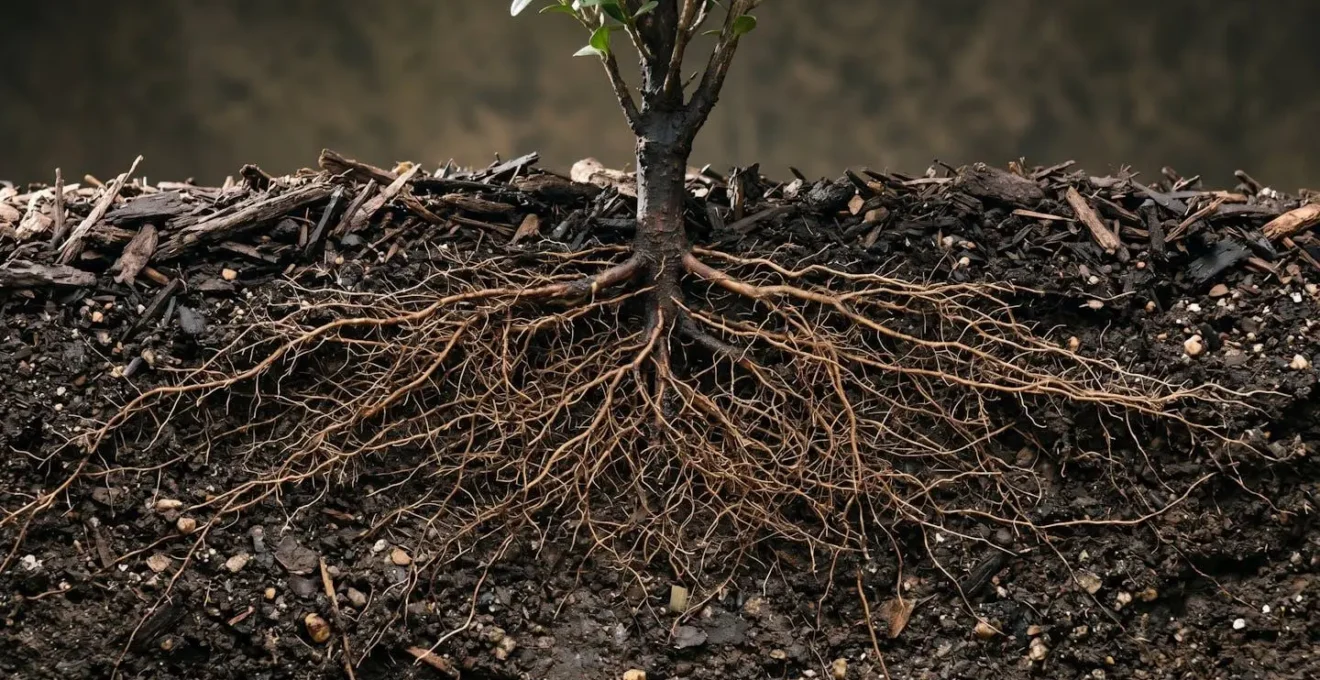
The correct approach is to use a slow-release, balanced granular fertilizer formulated for trees and shrubs, such as a 10-6-4 blend. The “slow-release” component is non-negotiable, as it provides a steady, gentle supply of nutrients over months rather than a single, damaging jolt. Application technique is equally important. Fertilizer should be broadcast evenly over the entire root zone, which extends to the plant’s dripline (the edge of its outermost branches), and always on top of the mulch layer—never directly on the soil or piled against the stem. The mulch acts as a buffer, and rainfall or irrigation will slowly carry the nutrients down to the roots without overwhelming them.
When to Stop Pruning to Prevent Winter Frost Damage?
The timing of pruning is governed by a simple but immutable principle: avoid stimulating new growth late in the season. The single most important rule in the boxwood pruning calendar is to cease all significant shearing by mid-summer, typically no later than the end of July in most temperate climates. Pruning is a signal to the plant to produce a flush of new, tender leaves. When this happens in spring, the growth has the entire season to “harden off”—to mature and develop a waxy cuticle that can withstand winter’s cold, desiccating winds.
However, new growth stimulated in late summer or early fall will not have time to mature before the first frost. These soft, vulnerable leaves are highly susceptible to frost damage, resulting in the familiar and unsightly “winter burn”—a bronze or yellowish scorching of the foliage that can lead to significant dieback. As the horticultural experts at Evergreen Seeds state clearly, this is a matter of respecting the plant’s natural cycle: “Avoid late summer pruning since it may encourage new growth that won’t harden off before cooler temperatures hit.”
The ideal time for major structural pruning is in late winter or early spring, just before the new growth flush begins. This allows you to establish the desired shape and encourages a vigorous response that will have maximum time to mature. A second, lighter trim is traditionally done in early summer (around early June) to neaten the plant after its primary spring growth spurt. Any touch-ups after that should be minimal. From August onward, the shears should be put away, except for the removal of any dead or broken branches. This growth cycle discipline is the key to ensuring your boxwood enters winter healthy and resilient.
Why Do Cheap Ceramics Crack in Winter While Quality Ones Survive?
For gardeners using boxwood topiaries in containers, the choice of pot is as critical as the care of the plant itself. A common and heartbreaking winter failure is finding a prized ceramic pot cracked and a boxwood’s roots lethally exposed to the cold. The reason lies in the material science of the ceramic. Cheap, low-fired terracotta and earthenware are porous. Throughout the season, they absorb water into their microscopic pores. When winter arrives and temperatures drop below freezing, this trapped water expands as it turns to ice, exerting immense pressure that inevitably shatters the pot.
In contrast, high-quality, frost-resistant containers are made from clay that is fired at much higher temperatures. This vitrification process makes the material far less porous and significantly stronger, preventing water from penetrating and causing freeze-thaw damage. These pots act as a durable, protective shell for the plant’s root system. This is especially important for boxwood, as container-grown roots are exposed to cold from all sides, unlike their in-ground counterparts, which are insulated by the earth. A quality container is not just a decorative element; it is a piece of essential survival equipment.
Choosing the right container is an investment in the plant’s longevity. With proper care, studies show that boxwood can be part of your landscape for over 40 years, but this lifespan is severely compromised in a container that fails. The container becomes a permanent part of the design’s structure, and its material quality directly impacts the plant’s survival rate, making the initial investment in a frost-proof pot a wise and necessary decision for any serious container gardener.
When to Trim Border Plants to Keep Walkways Clear?
Maintaining a crisp, clean edge along a walkway is a hallmark of a disciplined garden. For boxwood borders, this requires regular, precise trimming to prevent the foliage from flopping onto the path and creating a messy, untended appearance. The timing follows the general rule for boxwood: a main shaping in early spring, followed by a maintenance trim in early summer after the primary growth flush. However, the technique for borders involves a specific principle for maximum effect: the “air gap” principle.
Instead of shearing the hedge flush with the edge of the walkway, deliberately trim it to maintain a one-inch space between the foliage and the hardscape. This subtle gap creates a sharp, clean shadow line that greatly enhances the sense of order and precision. It also provides a buffer, preventing branches from encroaching on the path even after a heavy rain or as the plant grows between trims. For perfectly straight lines along long walkways, use string guides stretched between stakes to ensure a flawless alignment.
Effective border maintenance is about consistency over intensity. It is far easier to maintain an established shape with light, regular clipping than to let it grow wild and require heavy, corrective pruning, which risks creating holes. Keep the bottom of the hedge slightly wider than the top to ensure the lower branches receive adequate light, keeping the border dense and green all the way to the ground. This attention to detail transforms a simple walkway into a formal, elegant promenade.
Key Takeaways
- Boxwood is the ultimate architectural plant, providing essential evergreen structure that defines a garden’s form throughout the winter.
- Success depends on discipline and science: understanding the plant’s shallow root system to fertilize safely and respecting its growth cycle to prune at the correct times.
- Perfect shaping is an art of surgical precision, requiring sharp tools, constant assessment, and light touches to build density without creating gaps.
How to Use Ornamental Grasses to Add Modern Movement to Static Gardens?
While the disciplined, static geometry of clipped boxwood provides a garden’s essential structure, its perfection can be amplified by a contrasting element: the kinetic, wind-driven movement of ornamental grasses. This pairing is a fundamental principle of modern garden design, creating a dynamic interplay between the still and the moving, the solid and the ethereal. The boxwood acts as the perfect “still point,” a solid green or gold canvas against which the gentle, rustling movement of grasses can be fully appreciated.
This concept of kinetic contrast is particularly powerful in the winter garden. The evergreen boxwood provides a solid, living presence that highlights the bleached, textural beauty of dormant grass seed heads and stems. This creates interest on multiple sensory levels: the visual contrast between the dark, solid hedge and the light, airy grass, and the auditory dimension added by the sound of the wind rustling through the grass stems. As garden designer Kate Gould notes in Gardeningetc:
Soften formal boxwood with drifts of ornamental grasses. Landscaping with grasses is very on trend and boxwood adds punctuation marks to naturalistic planting and introduces crucial structure.
– Gardeningetc Editorial, Kate Gould, Landscaping with Boxwood: 10 Ways to Include This Evergreen
To implement this design, use boxwood to create a strong geometric line—a low hedge, a series of spheres, or a solid cube. Then, plant drifts of grasses like Miscanthus, Panicum, or Pennisetum where their movement can be seen against the static evergreen backdrop. The contrast elevates both elements: the boxwood appears even more solid and structured, while the grasses appear more graceful and dynamic. This sophisticated pairing moves beyond simple planting to create a garden that is a living, breathing composition of form and movement.
By applying these disciplined principles of shearing, feeding, and timing, you transform boxwood maintenance from a simple task into the art of sculpting living architecture. Begin today by auditing your existing plants and planning your seasonal interventions with the precision of a topiary specialist.