In summary:
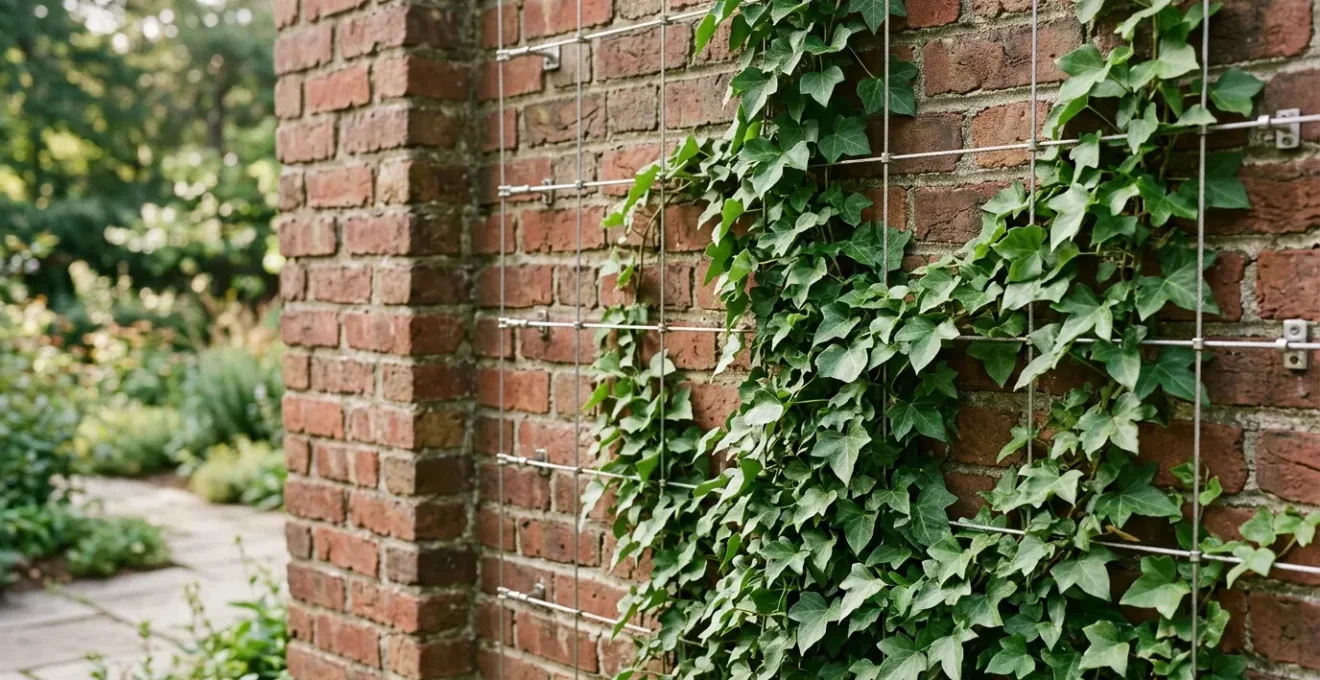
- The key to safe ivy growth is not letting it attach directly to the wall; instead, use a trellis or wire system to create a crucial air gap.
- Choose your species wisely: Deciduous Boston Ivy is far safer for masonry than the invasive aerial roots of evergreen English Ivy.
- A “living facade” requires management. Regular pruning is essential to create buffer zones and prevent ivy from reaching gutters, windows, and the roof.
- For a zero-risk approach, consider using trailing ivy in window boxes to achieve the cascading green look without any wall contact.
The image of an ivy-covered house evokes a timeless, romantic charm. It speaks of history, nature, and a structure peacefully coexisting with its environment. For many homeowners, this aesthetic is the ultimate goal. Yet, this dream is often overshadowed by a significant fear: the destructive potential of ivy on masonry. The common wisdom warns of powerful roots burrowing into mortar, compromising structural integrity, and leading to costly repairs.
Most advice, therefore, focuses on aggressive trimming or complete avoidance. But what if this binary approach is flawed? As a heritage building conservator, I propose a different perspective. The goal should not be to fight the ivy but to thoughtfully manage it. The secret lies in treating it not as a plant growing *on* your wall, but as a separate, controlled “living facade”. This method transforms a potential threat into a managed architectural asset, allowing you to enjoy the beauty of climbing plants without jeopardizing the health of your home’s structure.
This guide will walk you through the essential principles of this conservationist approach. We will explore how to select the right type of creeper for your climate and wall condition, demonstrate the correct installation of a support framework that protects your masonry, and detail the maintenance practices required to keep your living facade beautiful and benign for years to come.
To help you navigate these critical considerations, this article is structured to address each aspect of safe ivy management, from its benefits to long-term control.
Summary: How to Safely Cultivate Ivy on Walls
- Why Does an Ivy-Covered House Stay Cooler in Summer?
- How to Pin Ivy to Masonry for Even Coverage?
- Evergreen or Deciduous: Which Creeper Suits Your Climate Goal?
- The Rodent Risk: Does Thick Ivy Invite Rats to Climb?
- When to Trim Ivy to Prevent It form Invading Gutters?
- Bamboo or Ivy: Which Fast-Growing Plant Block Neighbors Best?
- Why Do Window Boxes Increase the Perceived Value of a Home?
- How to Transform a Small Balcony into a Private Green Sanctuary?
Why Does an Ivy-Covered House Stay Cooler in Summer?
Beyond its aesthetic appeal, a well-managed living facade provides a significant environmental benefit: passive cooling. The dense leaf canopy acts as a natural shield, intercepting a large portion of direct solar radiation before it can heat the building’s walls. This shading effect dramatically reduces the thermal load on the structure, creating a more comfortable indoor environment and lowering the need for energy-intensive air conditioning during warmer months.
The cooling mechanism is twofold. Firstly, the leaves physically block the sun’s rays. Secondly, the plants actively cool the surrounding air through a process called evapotranspiration, where water evaporating from the leaves dissipates heat. The impact is not trivial. Research confirms the effectiveness of this natural insulation, showing that a green facade can result in a reduction of up to 7.2°C in internal wall temperatures and 5.7°C on the external wall surface. This demonstrates that an ivy-covered wall, when managed correctly, is not just beautiful but also an intelligent, sustainable feature for climate regulation.
This cooling benefit is a direct result of treating the ivy as a separate screen rather than a part of the wall itself. The air gap between the foliage and the masonry is crucial, as it allows for airflow that helps dissipate the absorbed heat, preventing it from being transferred directly into the building’s fabric. This makes the case for a structured support system even stronger, as it is the key to unlocking these powerful cooling properties safely.
How to Pin Ivy to Masonry for Even Coverage?
The fundamental rule of safe ivy management is to prevent the plant from ever making direct, uncontrolled contact with your masonry. The idea is not to “pin” the ivy *to* the wall, but to provide a separate structural framework for it to climb. This is the single most important step in preventing damage. A stainless steel wire-trellis system is the professional standard for this task, creating the essential “breathing room” or air gap between the plant and the wall.
This system consists of wires tensioned across a series of wall-mounted stand-off brackets or spacers. These spacers hold the trellis several inches away from the wall surface. This design achieves several critical objectives: it prevents the ivy’s aerial roots or adhesive pads from touching and degrading mortar, it promotes air circulation that keeps the wall dry and healthy, and it makes maintenance and pruning significantly easier. You simply train the young ivy shoots to weave through the wires.
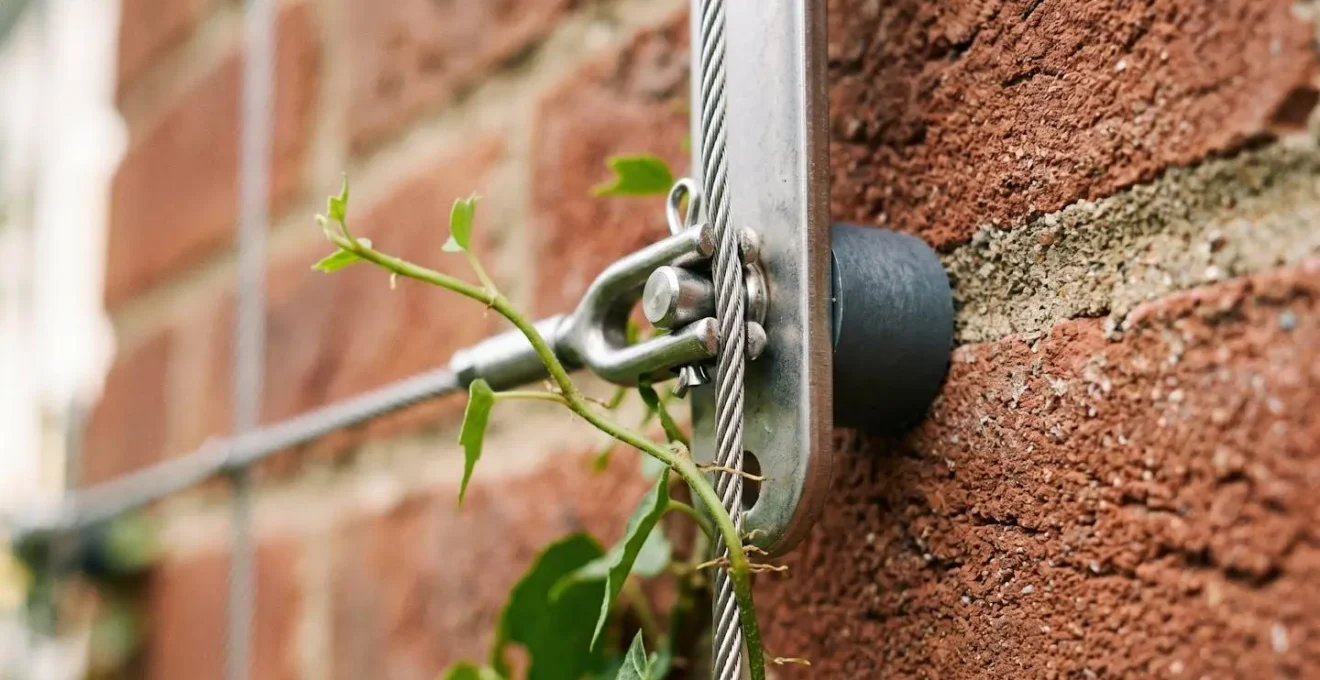
As the illustration above shows, the hardware creates a deliberate and permanent separation. The ivy grows on its own support structure, becoming a true living facade that is visually connected but physically detached from the building. This method gives you complete control over the plant’s growth pattern, allowing you to create even, intentional coverage while ensuring the long-term integrity of your home’s exterior.
Evergreen or Deciduous: Which Creeper Suits Your Climate Goal?
Not all climbing plants are created equal, and choosing the right species is as critical as installing a proper support system. The primary distinction for a conservator lies in the plant’s attachment mechanism. This single factor determines its potential for causing damage and its suitability for your walls. The two most common choices, English Ivy and Boston Ivy, represent two very different approaches to climbing.
English Ivy (Hedera helix) is an evergreen that climbs using invasive aerial roots. These roots actively seek out and penetrate cracks, joints, and imperfections in mortar. Over time, they expand and can cause significant structural damage, especially on older buildings with soft lime mortar or on any wooden surface. Conversely, Boston Ivy (Parthenocissus tricuspidata) is a deciduous climber that attaches itself using small adhesive discs that function like suction cups. These discs stick to the surface without penetrating it, making it a far safer choice for sound masonry.
The following table, drawing from comparative analyses, breaks down the key differences to help you make an informed decision aligned with both your aesthetic and preservation goals, an approach detailed in guides on how to choose the best ivy for your home.
| Characteristic | English Ivy (Hedera helix) – Evergreen | Boston Ivy (Parthenocissus tricuspidata) – Deciduous |
|---|---|---|
| Attachment Method | Invasive aerial roots that bore into masonry, stone, and wood | Adhesive discs (suction cups) that attach to surface without penetration |
| Damage Potential | High – roots exploit cracks and crevices, causing significant structural damage over time | Low – can be peeled back from brick surfaces without damage; gentle power wash removes residue |
| Seasonal Behavior | Semi-evergreen – retains dense wall coverage in winter, sheds some leaves | Fully deciduous – provides summer shade and winter sun exposure; spectacular fall colors (rust, yellow, red) |
| Growth Rate | Slower establishment (few extra seasons), requires less frequent pruning | Rapid grower after 1-2 year establishment, can quickly transform appearance |
| Climate Goal Suitability | Year-round privacy and formal, sculpted coverage | Summer cooling + winter solar gain; seasonal color interest |
| Wall Compatibility | Avoid on pre-1930 mortar, crumbling masonry, wooden surfaces | Safe for sound brick and masonry; generally will not damage underlying structure |
For homeowners prioritizing masonry integrity, Boston Ivy or the similar Virginia Creeper are the clear winners. Their deciduous nature also offers a strategic advantage: dense shade for cooling in the summer, and bare vines in the winter that allow the sun to warm the walls, a phenomenon known as passive solar gain.
The Rodent Risk: Does Thick Ivy Invite Rats to Climb?
A common and valid concern among homeowners is that a dense covering of ivy can provide a habitat and a highway for pests, particularly rodents. Thick, unmanaged ivy growth against a wall creates a sheltered environment, hidden from predators and the elements. More critically, the woody stems act as a perfect climbing frame, giving rats and mice easy access to upper-floor windows, vents, eaves, and roof spaces that would otherwise be out of reach.
This risk is not merely anecdotal. As pest control experts and biologists point out, this is a well-documented pathway for infestations. The Center for Biological Diversity highlights this issue in its guidance on rodent-proofing homes, noting the danger directly:
Ivy on walls can form ‘rat ladders’ to windows, attics, and other interior spaces.
– Center for Biological Diversity, Safe Rodent Control: Real-Life Solutions
However, this does not mean you must abandon your dream of a green wall. The risk is a function of neglect, not of the ivy itself. A managed living facade, particularly one on a trellis system with an air gap, is far less hospitable. By following an Integrated Pest Management (IPM) strategy, you can eliminate the conditions that make ivy attractive to rodents. This involves strategic pruning and denying access, turning your wall from a liability into a controlled feature.
Your Action Plan: Rodent-Proofing an Ivy-Covered Wall
- Establish Ground Clearance: Maintain a minimum 2-foot clear space between the ground and the lowest ivy growth to eliminate the primary ground-to-wall pathway.
- Seal All Entry Points: Meticulously inspect your home’s foundation and walls, sealing any opening larger than a dime to prevent rodents from gaining interior access.
- Eliminate Food & Water Sources: Remove pet food bowls from outdoors, secure compost bins, and ensure bird feeders do not spill seeds on the ground, which attract pests.
- Control Growth Density: Conduct annual pruning to thin out the ivy, especially close to the wall. This reduces shelter, improves air circulation, and makes the habitat less desirable.
- Prune Alternative Routes: Ensure tree branches are trimmed back at least 6-8 feet from your roofline to prevent rodents from using them as an alternative bridge to your house.
By implementing these measures, you disrupt the “rodent highway” and reclaim control, ensuring your ivy provides beauty without offering an invitation to unwelcome guests.
When to Trim Ivy to Prevent It form Invading Gutters?
Once your ivy is established, regular maintenance becomes the key to coexisting peacefully with it. Controlled growth is the goal, and a proactive pruning schedule is your primary tool. The most critical aspect of this maintenance is preventing the ivy from reaching vulnerable parts of your home, such as gutters, roof tiles, window frames, and wooden soffits. When ivy invades these areas, it can block drainage, trap moisture that leads to rot, and even dislodge structural elements with its weight and growth.
The most effective strategy, recommended by horticultural experts, is to establish permanent “no-grow” buffer zones. This involves creating a clear space of at least 18 inches around all vulnerable areas. You maintain this gap with diligent annual or semi-annual trimming. This preventative action is far easier than dealing with an established invasion later. The timing of your pruning is also important. A hard structural prune is best done in late winter when the plant is dormant, allowing you to shape the main woody framework. Lighter trims to control vigorous new shoots can be done throughout the summer.
This gardener is demonstrating the correct technique, using hand shears to carefully maintain the buffer zone below the roofline, ensuring the ivy remains an adornment and not a threat.
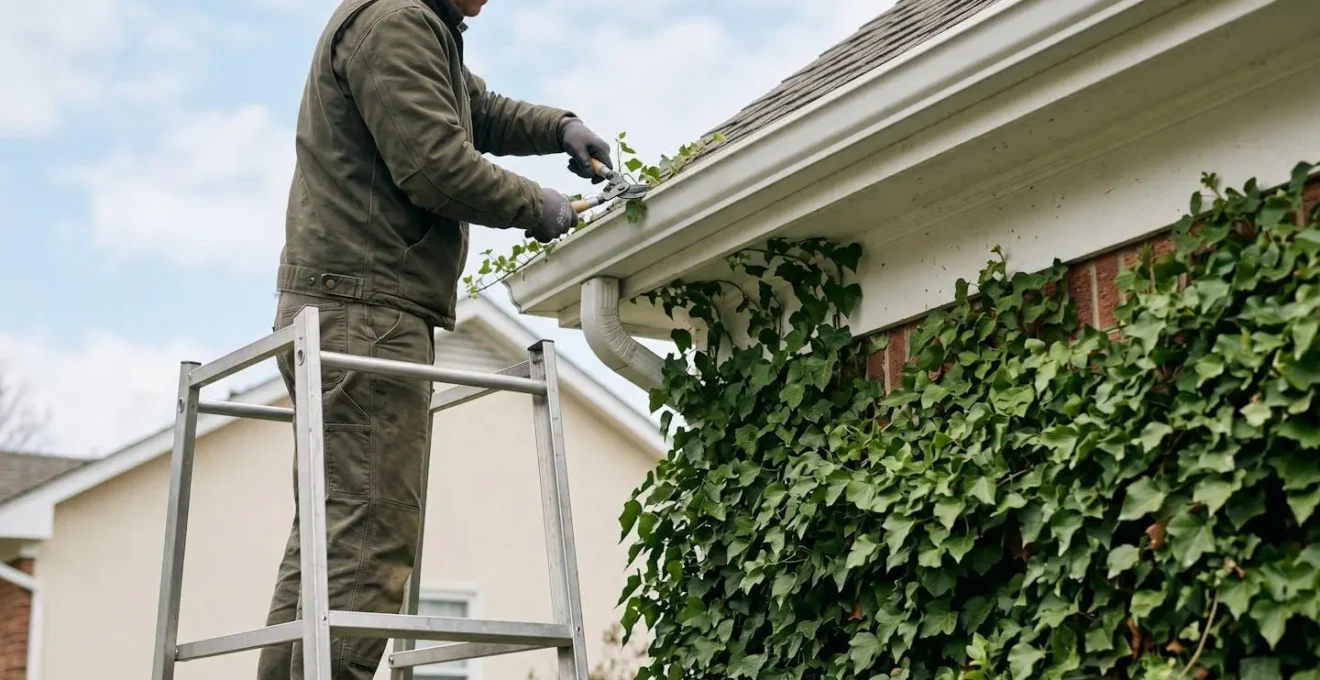
This disciplined trimming ensures the plant’s energy is directed into densifying the desired areas of the wall, rather than exploring where it shouldn’t. It is the practical application of the “managed facade” principle, transforming maintenance from a chore into a form of architectural gardening. For a mature, vigorous ivy, you may need to perform this task two or three times a year, but for many, a single thorough session is sufficient.
Bamboo or Ivy: Which Fast-Growing Plant Block Neighbors Best?
When the goal is fast-growing privacy, homeowners often consider both bamboo and ivy. Both can create a dense green screen relatively quickly, but they operate in fundamentally different ways, with significant implications for your space and your relationship with your neighbors. The choice between them often comes down to one key factor: horizontal space versus vertical space.
Bamboo is notoriously invasive, but its invasiveness is subterranean. The rhizomes of running bamboo spread aggressively underground, sending up new canes far from the original plant. While effective for creating a freestanding screen in a large yard (with a root barrier), it requires a significant ground footprint and poses a constant threat of invading garden beds and neighboring properties. This can lead to difficult removal and disputes.
Ivy, when managed on a trellis, offers a far more contained solution. Its primary advantage is its zero ground footprint. It utilizes vertical space exclusively, making it the ideal choice for narrow side-yards, urban balconies, and property lines where every square foot of ground matters. This comparison table highlights the key trade-offs, based on insights from landscaping guides about growing ivy for vertical coverage.
| Factor | Bamboo | Ivy on Trellis |
|---|---|---|
| Space Requirement | Requires significant ground footprint for root system and cane spread | Zero ground footprint – utilizes vertical space exclusively |
| Ideal Application | Open gardens, large yards with ample horizontal space | Narrow side-yards, patios, urban spaces with limited ground area |
| Invasiveness | Rhizomes spread aggressively underground, invading neighboring properties and garden beds | Growth contained by trellis system; manageable with regular pruning |
| Removal Difficulty | Extremely difficult – requires excavation of extensive rhizome network; regrowth persists for years | Manageable – ivy can be removed from properly installed trellis system without major landscape disruption |
| Privacy Speed | Fast vertical growth (3-5 feet annually) creating dense screen within 1-2 seasons | Rapid coverage on support structure (3-6 feet annually); full coverage in 2-3 seasons |
| Seasonal Interest | Monolithic evergreen appearance year-round; minimal color variation | Deciduous varieties (Virginia Creeper) offer lush green summer screen and dramatic red/orange autumn foliage |
| Freestanding Privacy Fence Alternative | Natural living fence requiring ground planting | Living fence on freestanding trellis – no ground planting needed; ideal for patios and property lines |
For creating privacy in confined areas, a climbing plant on a support structure is unequivocally the more strategic and controllable option. It delivers the desired green wall effect without consuming valuable garden space or creating underground problems for the future.
Why Do Window Boxes Increase the Perceived Value of a Home?
Window boxes add an undeniable layer of charm and “curb appeal” that can significantly enhance a home’s perceived value. They signal care, attention to detail, and pride of ownership. But for the homeowner who desires the aesthetic of a green, cascading wall without any of the associated risks, window boxes offer an ingenious and completely safe alternative. They can be used to cultivate the look of trailing ivy without the plant ever touching the building’s facade.
This strategy cleverly separates the plant from the structure, eliminating all possibility of root damage, moisture retention, or pest pathways on the wall itself. It provides the visual effect of a green cascade while keeping the plant entirely contained. This approach is the ultimate expression of the “managed facade” concept, taken to its most cautious and controlled conclusion.
Case Study: Window Box Ivy as a Damage-Free Wall Enhancement
As detailed by horticultural guides like those found on Nature Hills, planting trailing ivy varieties in window boxes allows the vines to spill gracefully downwards, creating the desired green wall aesthetic without risk. This containment strategy offers the visual appeal of an ivy-covered facade with all the practical benefits of container gardening: no aerial root damage to mortar, easy access for pruning and watering, simple removal or replacement if desired, and the ability to change plants seasonally. Compact and variegated cultivars such as Hedera helix ‘Glacier’ or ‘Goldheart’ are perfectly suited for this application. Their manageable growth habit and attractive foliage provide the cascading effect in a controlled, beautiful, and completely damage-free manner, offering peace of mind to the preservation-conscious homeowner.
By using window boxes, homeowners can achieve the romantic, verdant look they desire, adding character and value to their property. It is a solution that satisfies both the aesthetic impulse and the conservator’s duty of care, proving that you don’t need to risk your masonry to enjoy the beauty of trailing plants.
Key takeaways
- Separation is Safety: The most crucial principle is to never let ivy grow directly on your wall. Always use a trellis or wire system to create a 2-4 inch air gap.
- Choose Wisely: Opt for climbers with adhesive pads (like Boston Ivy) over those with invasive aerial roots (like English Ivy) to protect your masonry.
- Pruning is Not Optional: Establish and maintain 18-inch “no-grow” buffer zones around gutters, windows, and roofs to prevent costly damage and block pest access.
How to Transform a Small Balcony into a Private Green Sanctuary?
The principles we’ve discussed for safely managing ivy on large house walls are perfectly scalable and arguably even more valuable in a smaller space like a balcony. For urban dwellers, a balcony is often the only private outdoor area, and transforming it into a green sanctuary can dramatically improve quality of life. The challenge is creating privacy and lushness without sacrificing precious floor space.
This is where the concept of a vertical, trellis-based living facade truly shines. By installing a freestanding or wall-mounted trellis and planting a manageable climber like Boston Ivy or a compact English Ivy in a container, you can create a dense, vertical green screen. This strategy provides maximum privacy with a minimal footprint, leaving the balcony floor open for seating and other uses. It effectively borrows the “zero ground footprint” advantage we saw in the earlier comparison with bamboo.
You have complete control over this contained ecosystem. The container limits root growth, and the trellis defines the plant’s boundaries. Regular pruning is simple and can be done from the comfort of your balcony. This approach allows you to enjoy all the benefits of a green wall—visual appeal, a sense of seclusion, and even a micro-cooling effect—in a compact, manageable, and entirely reversible way. It is the perfect application of conservationist principles to modern urban living.
By applying these principles of controlled growth, you can confidently begin planning your own living facade, whether on a grand house or a small balcony, transforming your home’s exterior safely and beautifully.