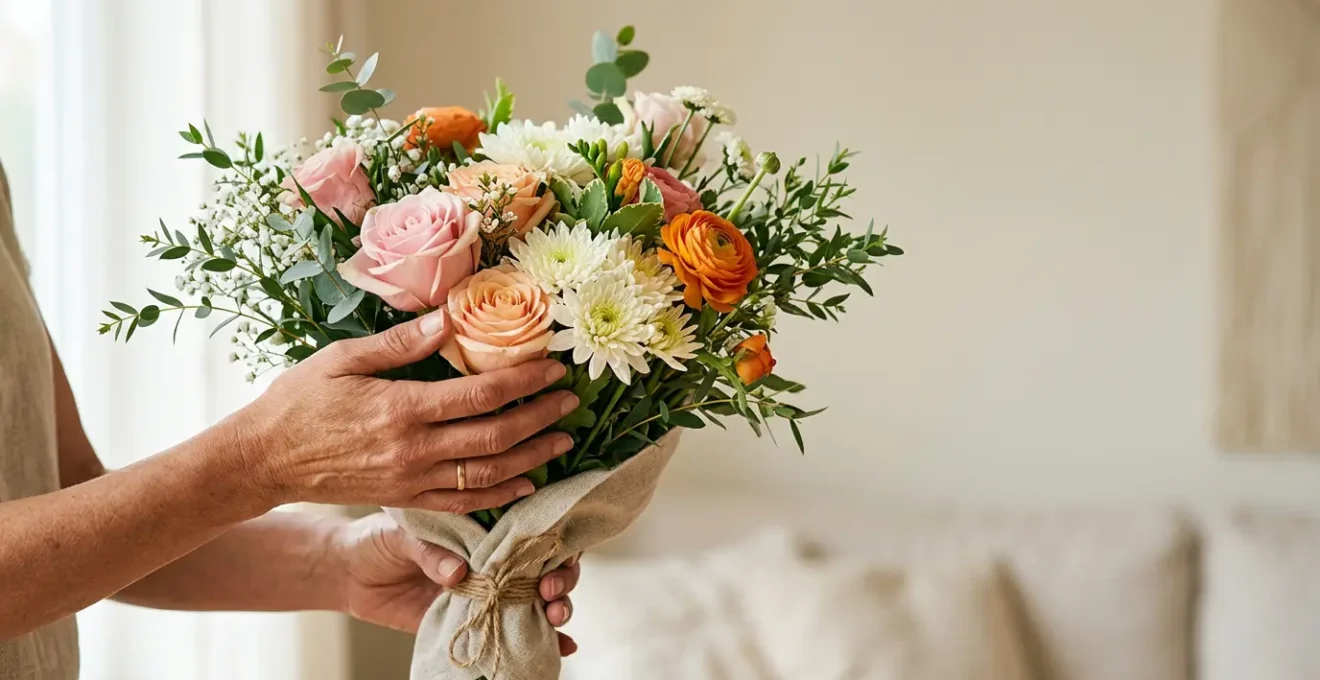
Decoding a bouquet isn’t about dictionary definitions; it’s about reading a complex psychological conversation between the sender and receiver.
- The true meaning lies in the interplay of color psychology, quantity symbolism, and cultural context, not just the type of flower.
- A sender’s choice is often subconscious, revealing their own mood or unexpressed feelings more than a deliberately crafted message.
Recommendation: Approach every bouquet as a psychological puzzle, analyzing its components to understand the complete emotional signature, not just its surface-level message.
Receiving a bouquet of flowers is a complex emotional event. It triggers immediate joy, a sense of being appreciated, but often, a subtle undercurrent of uncertainty. What does this specific arrangement mean? Is this a declaration of love, a gesture of friendship, an apology, or simply a polite formality? The conventional response is to consult a floral dictionary: red roses for love, yellow for friendship. But this simplistic approach misses the rich, nuanced conversation happening just beneath the surface. It’s like trying to understand a novel by only reading the definitions of its words.
The truth is far more intricate and fascinating. The message is not just in the flower type, but in its color, its quantity, its combination with other flowers, and even the cultural background of the sender and receiver. This isn’t botany; it’s floral psychology. The sender’s choice is often guided by subconscious impulses, their own mood, and memories, creating an “emotional signature” that is far more revealing than any pre-defined meaning. To truly understand the message, you must become a floral psychologist, equipped to decode these subtle signals.
This guide will move beyond the dictionary. We will explore the psychological impact of color, what the number of stems reveals about a relationship, the danger of a mixed bouquet sending conflicting signals, and how culture can completely invert a flower’s meaning. By understanding these layers, you will learn to read the hidden emotions behind any bouquet and grasp what is truly being communicated.
To help you navigate this complex floral language, this article breaks down the key psychological components of a bouquet. The following summary outlines the journey we will take to transform you from a simple recipient into an expert floral decoder.
Summary: The Art and Science of Reading Floral Emotions
- Why Does Receiving Orange Flowers Trigger Feelings of Energy?
- 12 Roses vs. 1 Rose: What Does the Quantity Say About the Relationship?
- The Mixed Bouquet Error: Sending Conflicting Signals with Random Flowers
- Why Are Chrysanthemums Offensive Gifts in Some European Countries?
- How Your Subconscious Chooses Flowers Based on Your Mood?
- Why Does the Eye Drawn to Red Flowers First on a Table?
- Why Does Having Nature Indoors Reduce Anxiety Levels Rapidly?
- Why Are Deep Red Roses Considered More Passionate Than Bright Red Ones?
Why Does Receiving Orange Flowers Trigger Feelings of Energy?
The feeling of a sudden mood lift or a jolt of energy upon seeing a bouquet of bright orange marigolds or tulips is not a mere coincidence. It is a direct physiological and psychological response hardwired into our perception of color. Orange, a hue composed of energetic red and cheerful yellow, is one of the most potent colors in the floral spectrum for stimulating a sense of vitality, enthusiasm, and creativity. From a psychological standpoint, the wavelength of orange light is known to increase oxygen supply to the brain, producing an invigorating effect and stimulating mental activity.
This response is not just a modern interpretation but has deep roots in how we associate colors with natural phenomena. Orange evokes the warmth of a sunset, the vibrancy of autumn leaves, and the ripeness of citrus fruits—all symbols of abundance, health, and dynamic energy. When a sender chooses orange flowers, they may be subconsciously trying to convey feelings of excitement, share a sense of joy, or simply wish to lift your spirits. The flower is a medium for a direct transfer of emotional energy, using color as its language.
Beyond aesthetics, the psychological impacts of flower colors are backed by science. Researchers in the field of color psychology have found that certain hues, like blue, have calming effects, while others, like orange, can increase energy levels.
– Color Psychology Researchers, Bloomsy Box Flower Psychology Research
Therefore, when you receive orange flowers, the sender is tapping into this powerful psychological trigger. Whether consciously or not, they are sending a message that is less about romantic passion or somber respect, and more about a shared zest for life. It is an invitation to feel more vibrant, creative, and optimistic. The bouquet becomes a non-verbal encouragement, a burst of cheerfulness intended to brighten your day and energize your mind.
Understanding this allows you to accept the gift not just as a beautiful object, but as a genuine infusion of positive and dynamic emotion.
12 Roses vs. 1 Rose: What Does the Quantity Say About the Relationship?
The number of flowers in a bouquet, especially with a symbolically charged flower like the rose, is a powerful modifier of its message. The difference between receiving a single rose and a dozen is not merely a matter of price or scale; it speaks volumes about the nature, stage, and intention of the relationship. It’s a clear case where quantity fundamentally alters quality of meaning. A single rose is a statement of focused, singular affection. It says, “You are the one.” It’s an intimate gesture, often associated with the beginning of a romance—a symbol of love at first sight or a budding deep affection.
A dozen roses, on the other hand, represents a more established, complete, and overwhelming sentiment. The number twelve itself carries cultural weight, signifying completeness (12 months in a year, 12 zodiac signs). A dozen is a declaration of love that is full, mature, and all-encompassing. It’s a grand gesture, meant to be impressive and leave no doubt about the depth of the sender’s feelings. It moves the message from the specific and intimate (“I am thinking of you”) to the grand and declarative (“My love for you is complete and boundless”).
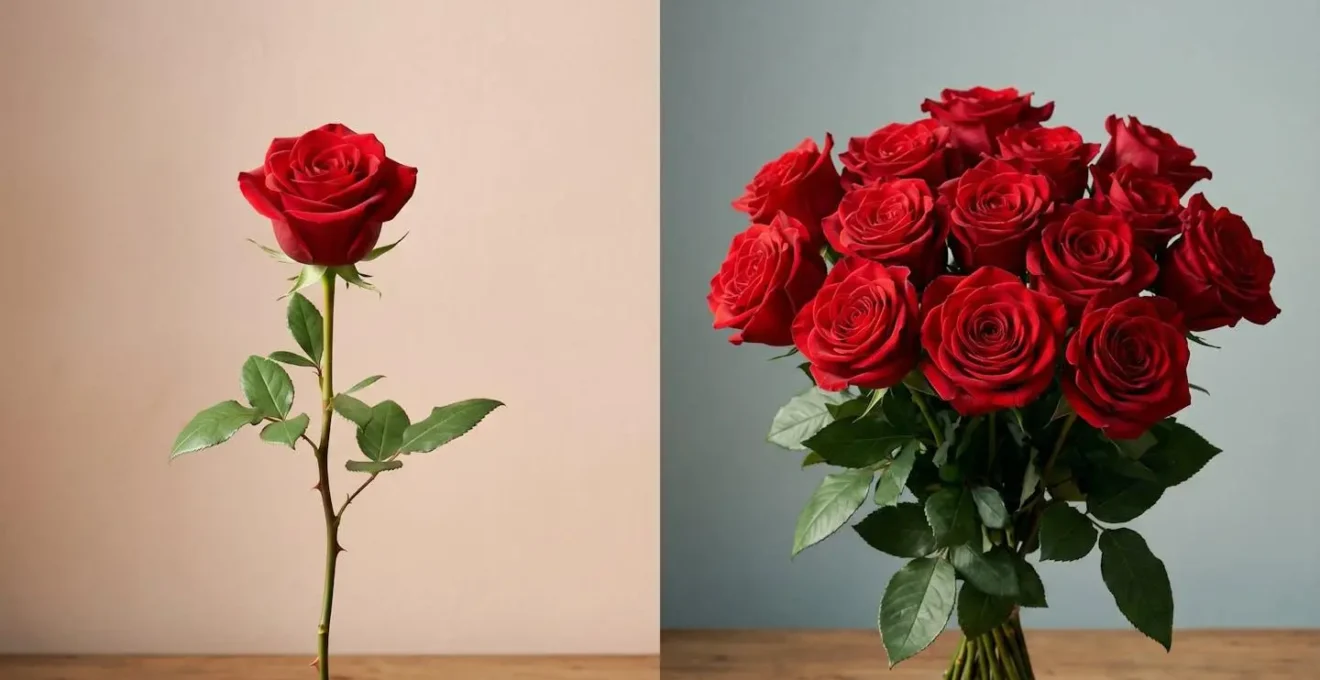
As this visual contrast shows, the psychological impact is starkly different. The single rose invites close inspection and personal reflection, while the dozen creates an impression of abundance and overwhelming emotion. Therefore, when decoding the bouquet, consider the narrative. A single rose might signify the hopeful start of a story, while a dozen suggests a chapter of grand romance is in full swing. One is a whisper of “I like you,” while the other is a chorus of “I love you.” The sender’s choice here is a key indicator of how they perceive the current status and desired trajectory of your relationship.
This numerical language provides a clear framework for interpreting the sender’s intended level of commitment and emotional intensity.
The Mixed Bouquet Error: Sending Conflicting Signals with Random Flowers
The mixed bouquet is the most common source of floral miscommunication. While often intended as a vibrant, “best-of-all-worlds” gesture, it can inadvertently create what floral psychologists call symbolic dissonance. This occurs when the individual meanings and emotional triggers of different flowers and colors clash, sending a muddled or confusing message. For example, combining passionate red roses (love), friendly yellow tulips (cheerfulness), and somber purple irises (royalty or sorrow) in one vase can leave the recipient feeling bewildered. Is this a declaration of love, a friendly hello, or a gesture of respect? The lack of a clear emotional focus can dilute the impact of every flower within the arrangement.
This is not just a matter of subjective interpretation; it has a basis in color psychology. A 2024 study on flower color combinations explored how different harmonies affect emotional responses. Researchers discovered a fascinating conflict: a strong warm color like orange could actually inhibit the relaxing effect of cool colors like blue when they were combined. This demonstrates scientifically how a mixed bouquet can create a psychological tug-of-war. The sender’s attempt to convey multiple positive emotions at once can result in them canceling each other out, leaving a neutral or even confusing impression.
Case Study: The Emotional Conflict of Color Combinations
In a recent study involving 715 participants, researchers examined emotional responses to various flower color combinations. They found that while cool colors did not diminish the positive emotional impact of warm colors, a dominant warm color like orange could suppress the calming, relaxing effects of adjacent cool colors. The study, published in Landscape and Urban Planning, proves that a “random” mix is never truly random in its psychological effect, and can lead to the bouquet sending conflicting signals of high energy and calm relaxation simultaneously.
However, there’s a crucial exception to this rule. As researchers Kuper and Zhang noted, “An individual’s preference for a specific colour can independently elicit positive psychological effects.” If the sender knows your favorite flower is a sunflower and includes it in a mixed bouquet, that specific, personal choice becomes the dominant message. It says, “I know you,” which is often a more powerful statement than any generic color symbolism.
Action Plan: How to Read a Mixed Bouquet
- Identify the dominant color/flower: Which element immediately captures your eye? This is likely the primary, albeit perhaps unintentional, message.
- Note any conflicting pairs: Are there passionate reds next to purely friendly yellows? This may signal the sender’s own emotional uncertainty.
- Assess the overall harmony: Does the bouquet feel visually balanced and pleasant, or chaotic? A harmonious blend suggests thoughtful selection, while chaos may imply a last-minute, thoughtless purchase.
- Scan for personal significance: Is your favorite flower or color included? This personal touch often overrides all other symbolic meanings.
- Consider what’s missing: If you’re in a romantic relationship and there are no red or pink flowers, this absence can be as significant as a flower’s presence.
Ultimately, a mixed bouquet challenges you to look for the most personal element within the composition to find the truest signal.
Why Are Chrysanthemums Offensive Gifts in Some European Countries?
The chrysanthemum offers one of the most striking examples of how culture acts as a powerful, non-negotiable filter in floral psychology. A single flower can carry diametrically opposed meanings depending on the geographical and cultural context of the exchange. In many East Asian cultures, particularly Japan, the chrysanthemum (‘kiku’) is revered. It is a symbol of the Emperor, longevity, and rejuvenation, celebrated annually in the “Festival of Happiness.” Gifting a chrysanthemum in Japan is a gesture of honor and high esteem, wishing the recipient a long and happy life.
However, if that same flower is given as a gift in several European countries, the gesture can be deeply offensive. Research on chrysanthemum symbolism reveals that in places like France, Belgium, Italy, Spain, and Poland, chrysanthemums are known as the “flower of the dead.” Their primary, and often only, use is for adorning graves and for funeral arrangements, particularly around All Saints’ Day. To give a bouquet of chrysanthemums to a host for a dinner party in Paris would be a shocking faux pas, akin to wishing them ill or referencing their mortality. The flower is inextricably linked with mourning and death.
The chrysanthemum carries one of the most sharply divided cultural legacies of any cultivated plant. The geographical path reveals how local climate, religious calendars, and historical timing can entirely rewrite the meaning of a single blossom.
– Your Flowers Guide Cultural Analysis, Chrysanthemum Meaning in Different Cultures
This stark contrast underscores a critical rule of floral decoding: you must consider the shared cultural library of both the sender and the receiver. The meaning is not inherent in the flower itself but is assigned by a collective cultural agreement. An American sender, familiar with chrysanthemums as cheerful autumn flowers, might unknowingly offend a French recipient. This isn’t a failure of intention but a failure to account for the powerful role of cultural context. It proves that no floral interpretation is complete without asking: “Where in the world are we?”
Before you can decode the emotion, you must first establish the cultural dictionary you are both reading from.
How Your Subconscious Chooses Flowers Based on Your Mood?
One of the most revealing aspects of floral psychology is the concept of subconscious selection. Often, the person giving flowers is not consciously consulting a symbolic dictionary. Instead, their choice is guided by a powerful mix of their current emotional state, nostalgic memories, and even subtle environmental cues. The bouquet they give you can be a surprisingly accurate snapshot of their own inner world, making you the recipient of their unexpressed feelings. This is where you move from decoding a message to diagnosing a mood.
Scientific research supports this connection between mood and preference. For example, a recent study published in *Horticulturae* explored the link between emotional state and color choices. Interestingly, it found that flowers with higher red-yellow color indicators were preferred by participants with more diverse income sources, suggesting that feelings of security and complexity can influence attraction to certain hues. While this is just one data point, it points to a broader truth: our life circumstances and emotional state create a bias towards certain aesthetics.
Perhaps even more powerful than color is the role of scent and memory. The olfactory bulb is directly linked to the brain’s limbic system, the seat of emotion and memory. The scent of a particular flower—lilacs from a grandmother’s garden, roses from a first date—can create a potent and lasting emotional association. A sender may find themselves inexplicably drawn to a certain flower, not for its look, but because its scent subconsciously triggers a feeling of comfort, happiness, or nostalgia they wish to share with you.
Case Study: Scent, Memory, and Mindfulness
A study on the behavior of adults caring for houseplants revealed a profound connection between indoor nature and mental well-being. Participants reported that their interactions were often driven by nostalgic connections and the mindfulness the plants induced. The research, available via the National Center for Biotechnology Information, showed that those who cared for houseplants experienced greater mindfulness and well-being. This suggests that the selection of plants and flowers is often guided by a deep, subconscious need for connection to positive memories and emotional states, particularly those tied to scent.
So, when you receive flowers, ask yourself: what might this bouquet say about the sender’s day, their memories, or the emotions they themselves are feeling? The gift might be less about you and more of a window into their soul.
Why Does the Eye Drawn to Red Flowers First on a Table?
The immediate, almost magnetic pull of a red flower in any setting is not just a matter of cultural conditioning or personal preference. It is a deeply ingrained biological response rooted in the very evolution of our visual system. Our eyes are fundamentally biased towards the color red. When you scan a room, a garden, or a floral arrangement, the red elements are what your brain is programmed to process first and with the most urgency. This phenomenon gives red flowers an unmatched power to dominate a visual field and command attention.
The reason for this lies millions of years in our past. Evolutionary biology research demonstrates that the specific way our eyes evolved was optimized for a particular survival task. The development of trichromatic vision in our primate ancestors allowed them to distinguish red from green. This was not for aesthetic reasons, but for a critical purpose: to easily spot ripe, energy-rich fruits and berries against a backdrop of green foliage. Our ability to perceive red with such acuity is a direct inheritance from ancestors for whom this skill meant the difference between a meal and starvation.
Therefore, a red flower effectively hijacks this ancient, hardwired survival circuit. It sends a powerful signal to the brain that says, “Look here! This is important!” This evolutionary explanation also clarifies why red is associated with such strong emotions—passion, danger, and vitality. It’s a color that has always signified something significant in our environment, from food to the flush of blood in another’s face. The psychological weight of red is built upon a physiological foundation. It’s a primary color not just in art, but in our neurology.
When a sender chooses a red flower, they are leveraging millions of years of evolution to ensure their message is the first one you see and the one you feel most intensely.
Why Does Having Nature Indoors Reduce Anxiety Levels Rapidly?
The simple presence of a bouquet of flowers on a table can have a remarkably swift and powerful effect on our mental state, often melting away stress and reducing anxiety. This is not merely a placebo effect or a fleeting moment of aesthetic appreciation. It’s a deep-seated psychological and physiological response explained by what is known as the Biophilia Hypothesis. This theory suggests that humans possess an innate tendency to seek connections with nature and other forms of life. Having flowers indoors directly taps into and satisfies this fundamental, genetic need.
According to this hypothesis, for most of human history, a green and blooming environment signified safety, abundance, and the presence of life-sustaining resources like water and food. A barren landscape, by contrast, signaled danger and scarcity. When we bring flowers and plants into our indoor spaces, we are sending a powerful, primal signal to our brains: “You are in a safe, life-sustaining environment.” This subconscious signal of safety helps to turn off the body’s “fight or flight” response, which is governed by the sympathetic nervous system, and activates the parasympathetic nervous system, responsible for the “rest and digest” state.
The Biophilia Hypothesis posits that humans have an innate, genetic need to connect with nature and other life forms. Having flowers indoors satisfies this deep-seated need, reducing stress by signaling safety and life.
– E.O. Wilson and Stephen Kellert, The Biophilia Hypothesis, 1993
The Physiological Proof: How Nature Calms the Body
This isn’t just a theory; it’s backed by measurable data. A comprehensive systematic review, analyzing decades of research, has confirmed the profound physiological effects of indoor plants. The meta-analyses, which reviewed studies from 1970 to the present, consistently showed that even just viewing nature indoors can lead to a significant reduction in cortisol (the primary stress hormone), lower blood pressure, and a decrease in heart rate. The act of receiving flowers, therefore, is not just an emotional gift but a physiological intervention that actively works to calm the recipient’s nervous system.
So, when someone gives you flowers, they are offering more than a pretty object; they are providing a dose of biophilic therapy that helps your body and mind feel safer, calmer, and more at peace.
Key Takeaways
- Color and quantity are potent psychological signals that convey emotional intensity and intent, moving far beyond simple dictionary definitions.
- The meaning of a flower is not universal; it is filtered through the powerful lenses of cultural context and the recipient’s personal history.
- A sender’s choice is often a subconscious reflection of their own mood or unstated feelings, making the bouquet a window into their inner world.
Why Are Deep Red Roses Considered More Passionate Than Bright Red Ones?
Within the powerful category of red, subtle variations in shade and saturation can communicate vastly different levels of emotional intensity. A bright, cherry-red rose feels energetic, exciting, and full of nascent love—it’s the color of a first blush or a new flame. A deep, velvety crimson or burgundy rose, however, speaks a different language. It conveys depth, gravity, and a passion that is more established and profound. This is not just a poetic interpretation; it’s rooted in how we psychologically process color saturation. Saturation is the language of intensity.
Bright red is high in energy but lower in emotional weight. It’s active, loud, and demands attention. It’s the red of a stop sign or a sports car. Deep red, by contrast, has more black mixed in, giving it visual weight and seriousness. It absorbs more light, creating a sense of depth and mystery. This makes it the color of life’s most profound experiences: the color of blood, fine wine, and deep-seated desire. A bright red rose might say “I’m excited about you,” while a deep red rose unequivocally says, “I desire you deeply.”
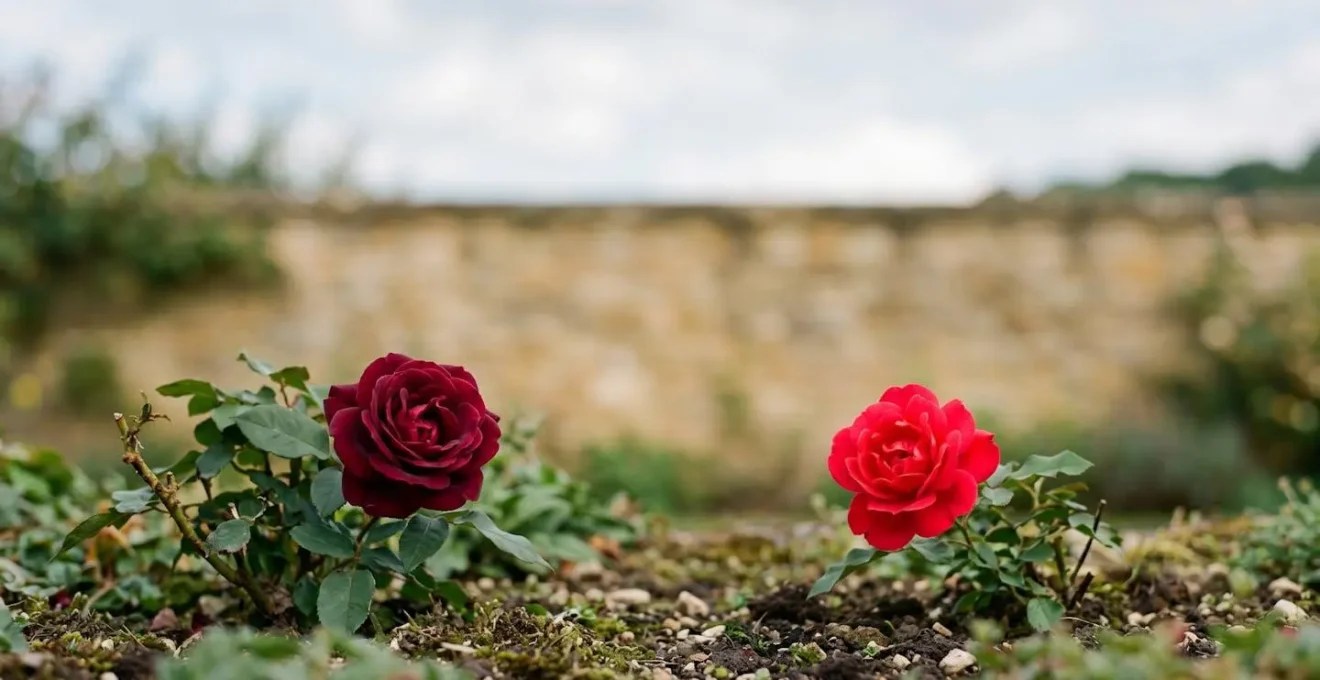
Evolutionary psychology offers a framework for understanding this. Red, in general, is a signal of health, vitality, and emotional arousal (flushing with anger or passion). A deeper, richer red can be subconsciously interpreted as a more potent, healthier, and more intense version of this signal. As the image above illustrates, the two shades create distinct emotional atmospheres. The bright rose feels open and cheerful, while the deep red one feels more introspective and serious. When a sender chooses a deep red, they are moving past the initial excitement of attraction and into the realm of profound, abiding passion. They are selecting a shade that reflects the gravity and depth of their feelings.
Therefore, pay close attention to the shade. The specific point on the spectrum from bright cherry to deep burgundy is one of the most honest indicators of the sender’s true level of emotional intensity.